
The Progressive Pugilist
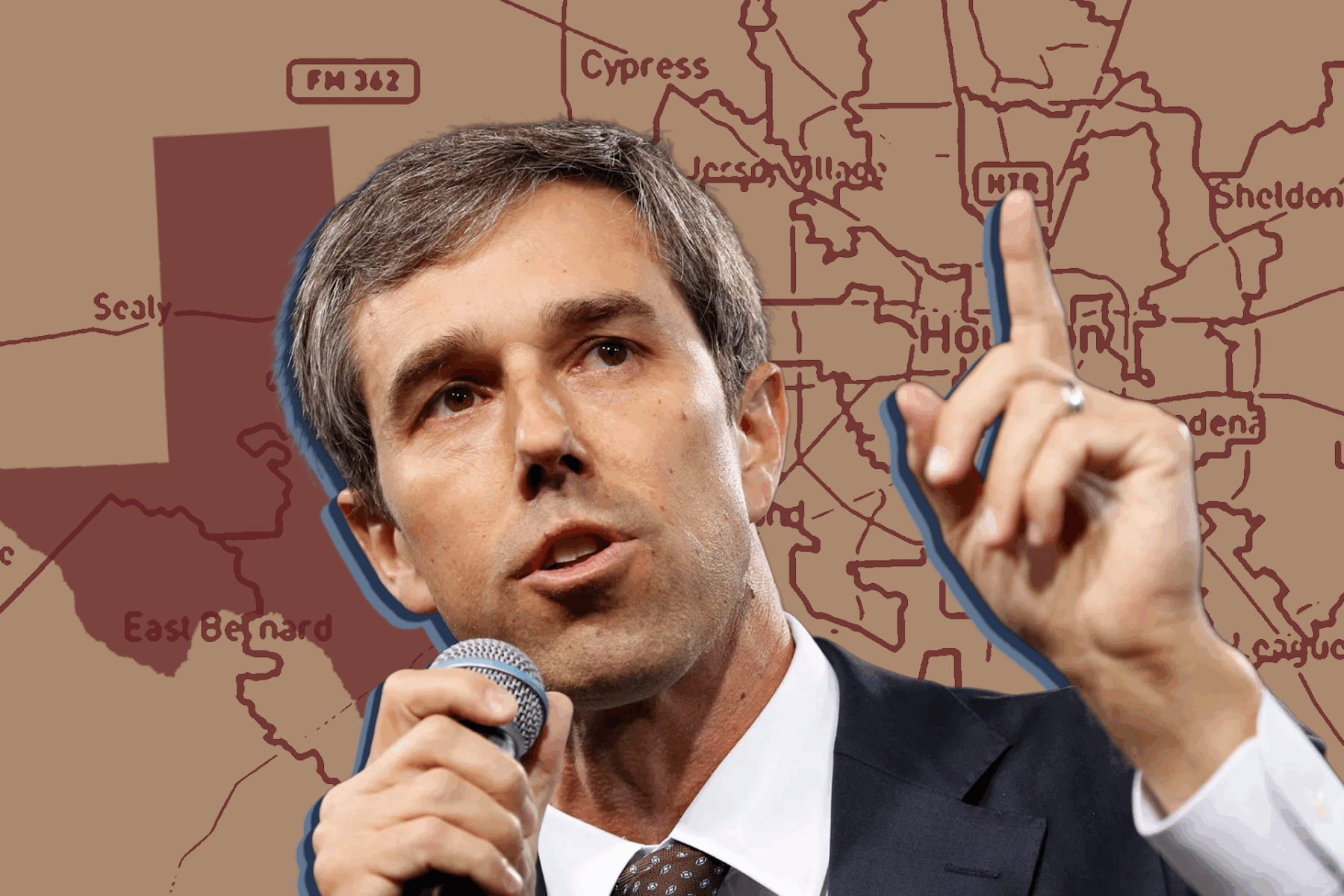
The normally staid First Unitarian Universalist Church of San Antonio, a blonde-wood testament to modest utility, hums with the excitement of a rock concert on a Friday night in late November. A tall, lean figure who looks like he’d be comfortable playing a second-stage acoustic set at South by Southwest approaches the church’s podium, waving to the audience, absorbing the room’s energy.
Beto O’Rourke may no longer be the DIY darling of the Democratic Party, his national star having faded somewhat after quixotic, grassroots campaigns for the Senate and presidency came up short, but as far as he’s concerned, the stakes have never been higher, nor his relevance greater. He’s fighting for democracy, and his battleground is Texas — the state that seems determined to take the lead in advancing the cause of illiberal governance and voter disenfranchisement.
On Wednesday, December 5, the United States Supreme Court ruled that Texas could pursue a highly gerrymandered electoral map drawn this summer. Normally, electoral maps are redrawn every ten years after the census. Texas Republicans, led by Governor Greg Abbott, made the unusual move to redraw the districts mid-decade at President Trump’s request, hoping the new map would secure a Republican upper hand in the 2026 midterms. State courts had declared the bill unconstitutional earlier this month on the grounds of racial discrimination, finding that the new maps rely heavily on race, violating the Fourteenth and Fifteenth Amendments on equal protection and race-based disenfranchisement. The U.S. Supreme Court overturned those decisions, allowing the gerrymandering to proceed.
What does it mean when your party catches up to you possibly a day late and a dollar short for its own, and even the country’s, good?
In response to Texas’s move, California Governor Gavin Newsom sponsored a ballot measure in California — which voters approved in November — to redraw its voting districts to favor Democrats. The two biggest states in the country are now engaged in a form of electoral warfare that could determine the political ethos for decades. In this context, O’Rourke is akin to a special operator, working in deep red territory, trying to win over hearts and minds, especially those of young voters.
He argues the conservative push to secure permanent majorities via gerrymandering comes because President Trump and Republicans know they will lose the midterms unless the election maps are stacked in their favor. The president’s popularity reached historic lows for an administration in its first year — his current approval rating is, at best, 42 percent. People are feeling the effects of inflationary tariffs, slashed government programs, a looming healthcare affordability disaster, and the deployment of the military in their cities and neighborhoods.
“We concede nothing,” O’Rourke stated on social media after the Supreme Court ruling. “We do the work to compete in and win these newly drawn districts.”
O’Rourke hasn’t held public office since his Congressional term ended in 2019, but if this rally is any indication, he still has star power. While in Congress, he lost an underdog bid for the Senate seat held by the incumbent Republican Ted Cruz in 2018 and the Democratic Party presidential nomination in 2020.
Now, though, the commonsense progressivism he ran on — improving the Affordable Care Act, a pathway to citizenship for Dreamers, universal childcare, federal investments in education, sane firearms regulation and increasing taxes on corporations and the wealthy — is all the rage, rebranded as left populism.
So, what does it mean when your party catches up to you possibly a day late and a dollar short for its own, and even the country’s, good? For O’Rourke, it means taking the fight to the enemy, which in Texas is a rigged election map that discourages voter participation and democratic engagement. His ultimate, and possibly quixotic, goal is turning blue a deep red state run by Trumpian zealot Gregg Abbott.
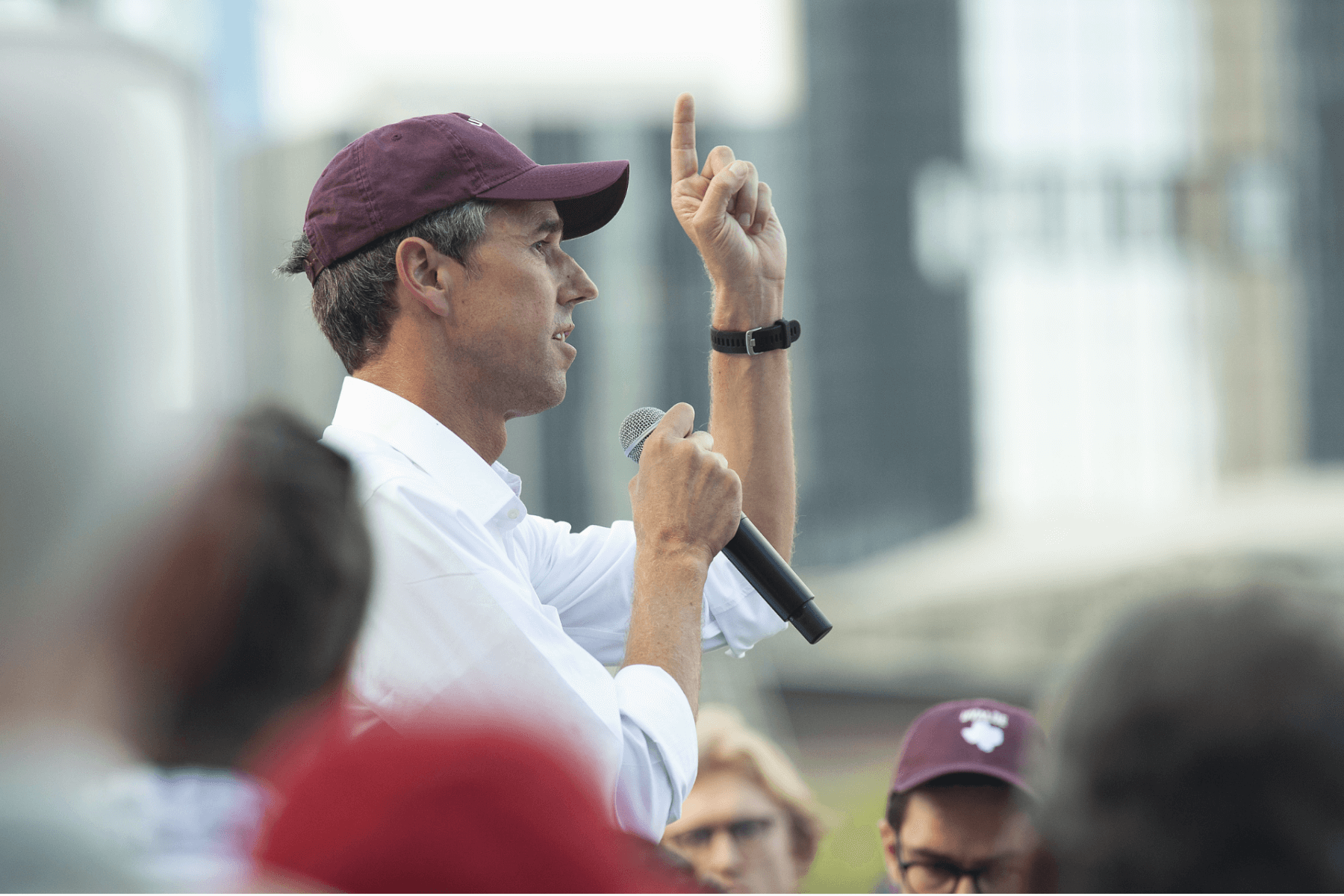
O’Rourke speaking to residents during his 49-day, more than 5,600 mile Drive for Texas that took him to every part of the state during his campaign for governor in 2022. Courtesy of Mario Cantu/CSM/Shutterstock
“Down ballot, at every single position, we need to have a wonderful Texan who is willing to put her name, or his name, on the line,” he says as representatives from ActBlue — a fundraising platform that helped organize the event — pass around a candidate sign-up sheet. A few nervous attendees put their names down, while others volunteer their friends. It was hard for anyone to take their focus off O’Rourke, though.
After the rally, the audience flooded the lobby, where O’Rourke waited patiently to hear fellow Texans’ stories. Retirees up past their bedtime and 20-somethings who could have been hitting the town stood for 30 minutes to shake hands with the former congressman.
O’Rourke gave each person the same attention, never rushing a conversation. He tries to meet people where they are, which on this night includes bending his 6’ 4” frame to snap a picture with a five-foot-nothing woman in her 70s. Practiced or not, O’Rourke gave the impression that he was there to meet the attendees, not the other way around.
When the crowd finally disperses, O’Rourke steps into a quiet corner in the back of the church, where he spoke with Red Canary about the strengths and shortcomings of his party in the Trump era. He didn’t have much time, but he considered every question carefully.
“So often, I find that Democrats start in the middle,” O’Rourke says, arms crossed as he leans his lanky frame against the wall, “and no one’s against that, but you gotta start with what you believe in, and show people that you have the courage of your convictions.”
Earlier that afternoon, the El Paso native was with PxP for a registration drive at the University of Texas, San Antonio. “The folks I was volunteering with today — they’re not waiting to react to anything,” he tells Red Canary. “They’re like, we’ve gotta build the electorate, stay in touch with them, and turn them out if we’re going to win.”
***
O’Rourke founded PxP in 2019 — after his campaigns came up short — to “remove barriers for those who’ve been silenced.” His activism has gone grassroots, searching for solutions among Texas’s tall, scratchy fields. He urged attendees at the church event to look for progressive Texans in every corner of the state (quite the terrain to cover), arguing, “No minority should be assumed Democrat, and no rural district should be seen as a lost cause.”
Outside of voter registration, PxP comes to the aid of Texans in times of peril. During the COVID pandemic, the organization contributed 17,000 shift hours by volunteering at food banks across Texas and donated over $200,000. During the state’s 2021 perilous winter storm, it raised over $1.4 million for “communities who bore the brunt of this disaster.”
More recently, PxP spoke up for the Texas House Democrats who broke quorum this summer in defiance of gerrymandering. Led by O’Rourke, the group fundraised more than $1 million for those legislators who faced the state’s $500-per-day fine imposed when members of the House break quorum. Texas Attorney General Ken Paxton rewarded the effort by filing a lawsuit on the grounds that O’Rourke’s voter registration organization, Powered by People (PxP), was raising political funds for “lavish personal expenditures.”
The suit stretched six weeks and culminated in a verdict from the Fifteenth Court of Appeals in Tarrant County ruling that Paxton violated the defendants’ right to free speech under the state constitution, which came at a perilous time for the First Amendment nationwide. Despite its victory, PxP racked up $400,000 in legal fees.
Despite that, PxP continues to seek out and register voters. O’Rourke claims that 79 percent of the young people registered to vote through PxP turned out for the presidential election [A figure Red Canary could not corroborate independently]. He added, “The national [turnout] average for this demographic is 42 percent.”
“You gotta start with what you believe in, and show people that you have the courage of your convictions.”
O’Rourke sees registering and motivating young people as critical to his party’s fortune. “[Republicans] are obviously targeting these young people because they fear them,” he says. Registering students, who frequently lean to the left, “threatens [conservatives’] purchase on power.”
Registration drives in cities like San Antonio, where 64.4 percent of residents are Hispanic, further connect the organization with minority groups that Democrats lost support among in 2024.
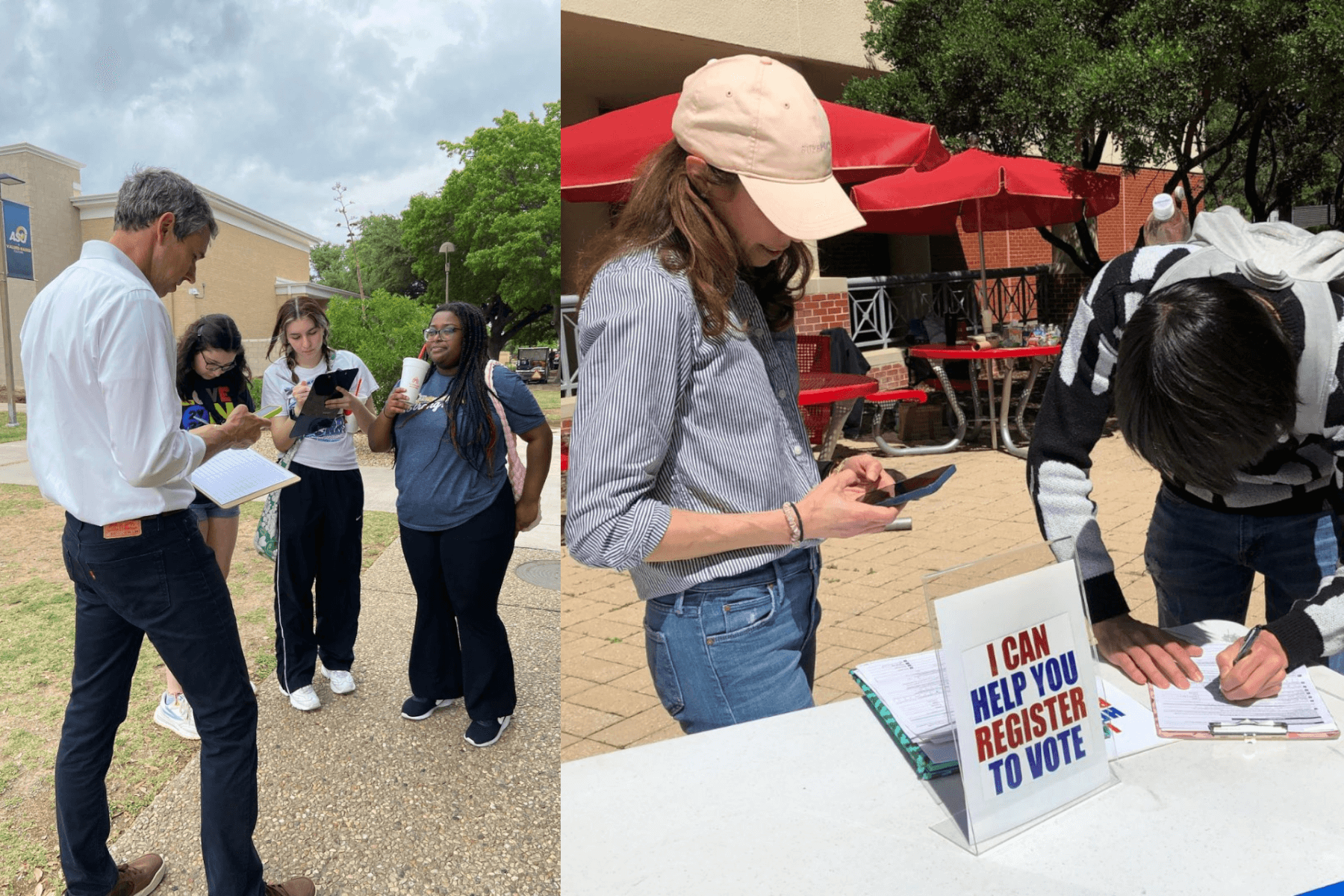
Registering students and younger voters is one of the foundational steps Powered by People focuses on to increasing voter turnout. Courtesy of Powered by People
Texas makes voting more difficult than almost any other state. The Lone Star State ranks 46th on a non-partisan 2022 cost of voting index published by the Election Law Journal. The study notes that there is no online, automatic or same-day voter registration. Although the state allows 13 days of early voting, residents must also register at least 30 days before hand.
Among voters, there are actually more Democrats registered in Texas than Republicans, 8.1 million compared to 6.6, according to the Independent Voter Project. However, Gary Keith, a professor of political science at the University of Texas, explains that the difficulty of registering voters is compounded by “intimidation factors” from the right when it comes to voting, such as “poll watcher dynamics, requiring voter ID and restrictions on voter registration efforts, who can register people to vote and how they can do so.” These tactics suppress minority voters and “magnify the strength of the Republican Party, because business-minded conservatives are the [only] ones voting,” says Keith.
Back in 2018, O’Rourke told Texas Tribune reporters tracking the Senate campaign, “Texas isn’t a red state, or a blue state, it’s a non-voting one.” This phenomenon is a popular theory for why Democrats haven’t won a statewide election in Texas since 1994, and what’s kept some potential candidates off the ballot entirely.
On his not-so-cleverly titled This Is Gavin Newsom podcast, Newsom described Texas as a “petri dish” for democratic decline. Infuriated with the “power grab” in Texas, Newsom put forth the Prop 50 ballot measure to redraw California’s map to “level the playing field.” Newsom told NBC News, “Whatever [Republicans] are doing will be neutered here in the state of California.” Though overwhelmingly approved by voters, the measure is, unsurprisingly, facing legal challenges from the right. Whether the recent Supreme Court decision in favor of Texas’s redrawn voter map will affect these suits remains to be seen.
Meanwhile, Missouri, Ohio and North Carolina already redrew their maps to manufacture more Republican districts for the midterms. Utah has done the same for Democrats. Seven other states are in the process of redrawing voter maps. Political observers are mixed on how the net outcome of all this gerrymandering will affect the midterms, but most agree that this is unhealthy politics.
***
O’Rourke has mixed views on that as well, but sees what Newsom is doing in California as a necessary evil in the face of an existential crisis in the country. O’Rourke wants Democrats to start playing offense.
In Texas, he says Governor Greg Abbott and the Republican-dominated legislature are tearing down “key tenets of our country’s exceptionalism” by limiting free speech and suppressing voter equality. He points to statewide mandates requiring the Ten Commandments to hang in classrooms and ordering universities to eliminate “woke” courses covering gender, sexuality and race. He characterizes President Trump’s agenda as “the biggest authoritarian power grab this country has ever seen.”
At the Texas Tribune festival, an Austin-based political convention, O’Rourke pleaded his case to stop the GOP from jumping institutional guardrails like a 400-meter hurdle race with despotism at the finish line. “We can’t wait for [Republicans] to throw the punch and then respond,” O’Rourke told attendees. “We need to throw the punch first and throw it harder than they do.”
If his party does not win a Congressional majority in 2026, O’Rourke fears “the consolidation of power by the executive branch will be nearly unstoppable.”
In the back of the church, arms still crossed as he leans against a wall, O’Rourke tells Red Canary that Trump “wants America to believe it is at war with itself,” and attacks any political culture of mutual toleration as weak or a betrayal.
In their 2018 book How Democracies Die, Steven Levitsky and Daniel Ziblatt identify mutual toleration, or accepting the legitimacy of political opponents, as one of two critical guardrails for democracy.
The other critical guardrail, institutional forbearance, is defined as “avoiding actions” that “violate the spirit” of the law. Rather than demonstrating respect for the American system, Trump is “a man who promises to be a dictator [and] attempts to govern like one,” O’Rourke says, reminding Americans of “what can happen when a charismatic authoritarian attempts to blow past the constitutional limits of a democracy.”
Democratic preservation, Levitsky and Ziblatt maintain, requires a movement determined to uphold institutional norms, one that provides vertical accountability — the ability for citizens to keep their government in check — to keep what O’Rourke calls “would-be autocrats” such as Trump in line. This would seem to position left populism, which connects with the working class while championing civil rights and fair play, as a formidable strategy for Democrats.
Professor Keith defines left populism as “empowering those who historically and currently do not have much power.”
O’Rourke’s 2018 bid for the U.S. Senate against Ted Cruz and the 2020 presidential campaign, which elevated the congressman to national prominence, were built upon resistance to economic inequality and identity-based discrimination in Texas.
His mantra of change and charismatic stage presence resonated, especially among young voters. “He’s a figurehead for the opposition,” Keith says, “but he’s more than that, because he’s active about it.”
But words and ideas aren’t enough, O’Rourke tells Red Canary. “Bold, aggressive, urgent kinds of action…have to be matched with what Democrats do when they’re actually in power,” he says.
He pointed to Governor Newsom in California and mayor-elect Zohran Mamdani in New York City as excellent examples of taking action and throwing the first punch. Mamdani, in particular, channels the working-class-warrior persona integral to the left populism that O’Rourke attempted to harness in his Senate and presidential bids.
O’Rourke conceded that Democrats “may have to overturn, or go over, or fly under the very controls and regulations that they set up” to win the midterms. This might mean uncomfortably walking the guardrails of democracy like a tightrope.
“No one likes mid-decade redistricting,” he says, shaking his head slightly, “but if [California] hadn’t, it might have very well cost us the 2026 election…it’s really urgent that once Democrats win power, they don’t just restore the guardrails in these singular states, but they find national safeguards against authoritarianism.”
***
“We owe our country the real thing… I’ll show you what it means to fight.”
There are prominent opportunities for Democrats to win in Texas — including the governorship and John Cornyn’s Senate seat — but O’Rourke did not throw his hat into the ring. “I could put my name on the ballot,” he mused at TribFest, before the Dec. 8th filing deadline passed, “but is that what’s best?” Instead, he remains focused on voter registration prizes, hoping to flip a state, not just a seat.
Savannah Anderson-Knight, a UT alumna who attended the TribFest, believes O’Rourke should “act as a support rather than run again. The current path he’s taking seems like a strong choice.”
As for the rest of the party, she believes, “Older leadership needs to make way for new faces [and] embrace more progressive ideals and stop acquiescing.” Newer, younger Democratic candidates espousing some working-class-friendly version of left populism are popping up around the state, such as James Talarico, a state representative from Austin and Jasmine Crockett, a U.S. representative from Dallas — both of whom are running for U.S. Senate.
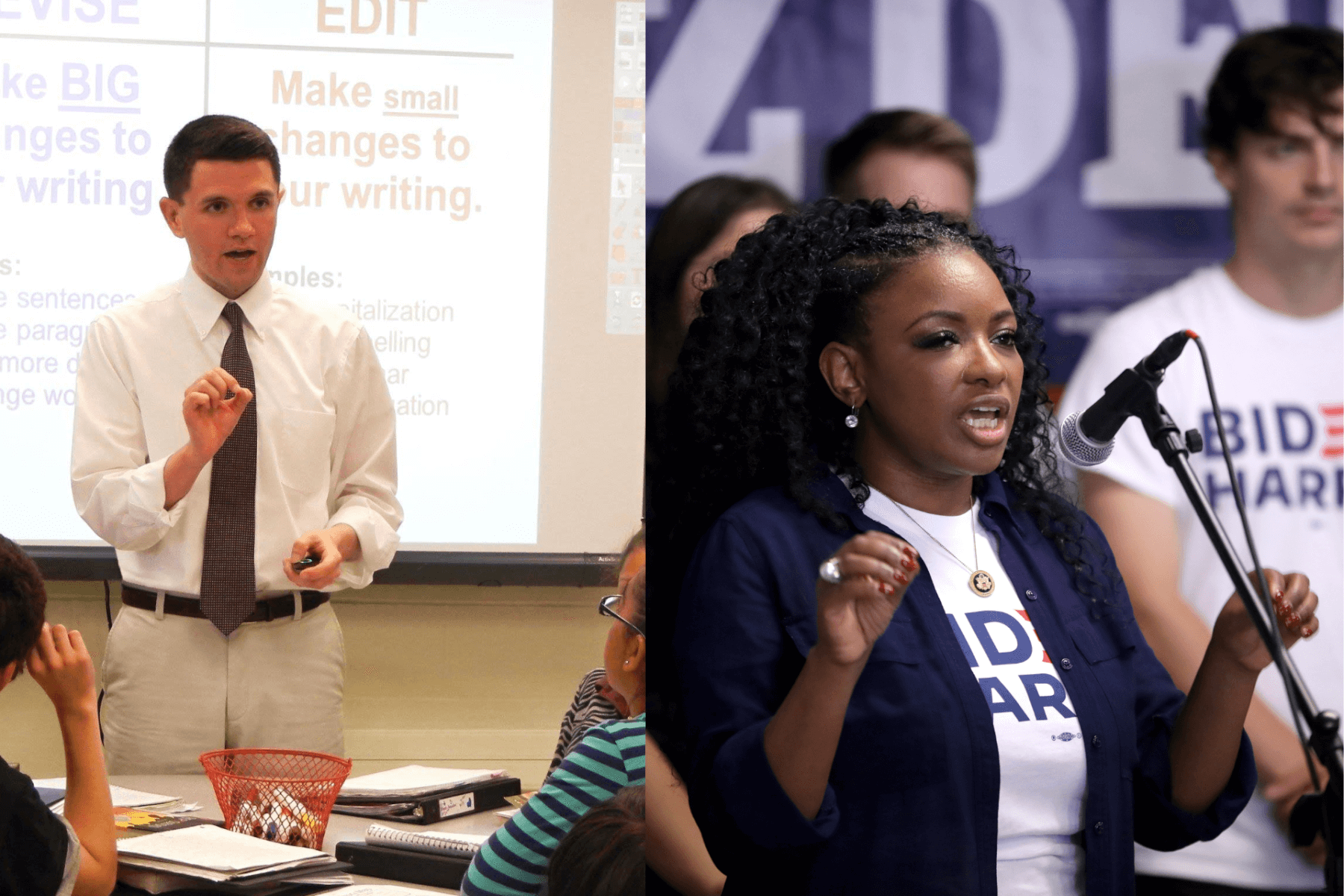
O’Rourke is investing his time where he thinks it will be most valuable, such as lifting up younger Democratic politicians in Texas including Austin-based state representative James Talarico (left) and Dallas-based U.S. representative Jasmine Crockett (right) who is running for U.S. Senate. Courtesy of Wikicommons
“It’s time not just for a generational shift, but also a renewed effort to bring young voters into the system and bring Hispanic and black voters back into the party,” says Professor Keith.
Trump sold a “false version” of hope to the American people, pretending to be on the side of working and middle-class people. Instead, he, as O’Rourke says, “threw Great Gatsby parties as people were starving across this country, and is throwing millions of people off of their healthcare.”
True resistance to authoritarianism and respect for the average American, O’Rourke says, is “not about a party; it’s not even about a person. It’s about human nature and restoring the rule of law and the primacy of the U.S. Constitution.”
As he is being ushered out of the church and onto a late-night strategy session, a relentless day of registering voters behind him and another one coming up, O’Rourke leaves with this, “We owe our country the real thing… And here’s the thing: that’s a message you have to show. I’ll show you what it means to fight.”
Help us sustain independent journalism...
Our team is working hard every day to bring you compelling, carefully-crafted pieces that shed light on the pressing issues of our time. We rely on caring supporters like you to help us sustain our mission. Your support ensures that we can continue to provide deeply-reported, independent, ad-free journalism without fear, favor or pandering. Support us today and make a lasting investment in the future.

RELATED STORIES


Award Winning



Today’s environmental and social justice challenges are unprecedented, and require an unprecedented collective effort.


Stay updated on our latest features, events and more. Subscribe to our Note From the Nest newsletter!
