
Black Middle-Class Dreams Deferred

Editor’s note: This is the fourth in our series examining the future of the West as both aspiration and destination. For more, see Paul Tullis’ “The End of Golden State Exceptionalism?”, Chris Barton’s “Beyond the Heat Dome”, and Jeremy Rosenberg’s “Is The West Still the Best?”
When my family began moving west to Los Angeles from New Orleans in the early ‘40s, the term “middle class” hadn’t yet become shorthand for the postwar American Dream—a dream that centered homeowners in safe, leafy neighborhoods girded by solid economies and good schools, all of it extending into happy perpetuity. Middle class by definition meant not rich, but the new iteration suggested a security and stability that was its own kind of luxury. That such luxury would become available to so many was the most American part of the dream; after all, only so many people could be rich, but everybody had a shot at the middle.
The centerpiece home of the new middle class was in a suburban tract or city neighborhood that was affordable but accorded a family space it had not commonly had before: lawn, patio, backyard, maybe a swimming pool. Southern California was especially suited to the housing bonanza with its open land and metropolises, like LA and San Diego, that were configured more like suburbs than big cities anyway. Expansion was a given.

A row of Spanish Colonial Revival homes in the Leimert Park section of Los Angeles, circa, 1940, welcome new arrivals with a modest slice of the American dream. Photo by Los Angeles Public Library
Of course, this new, egalitarian version of the American Dream was meant for white people. Blacks were largely written out of it through redlining—the institutional practice of denying financial services, especially loans—and through racial housing covenants, all of which were sanctioned for decades by a system that was busily encouraging other Americans to buy homes in new tracts with little money down, to purchase the luxury of security at a bargain price. As with so many other forms of American beneficence, the move to grow the middle class was not only not intended for Black people; it was intended to exclude them.
The exclusion of Black people from safe, leafy neighborhoods is what made them so attractive and so valuable. White exclusivity was baked into the idyll of a middle class that was free of urban tension, specifically racial tension. One of the many revelations in Richard Rothstein’s The Color of Law, a comprehensive history of how race shaped real estate practices, is how the upbeat advertisements for new tract developments often included assurances that the neighborhood would be all white—just like ads for toothpaste promised dazzling white smiles. What other color made sense? Whiteness was the selling point, even when it wasn’t spelled out. Blackness was the opposite.
My family arriving from Louisiana certainly knew all this. We had lived for decades with Jim Crow and the limits of color, had seen up close how even the most well-off Black people were ultimately denied both the tangible privileges of whiteness—like equal protection under the law—to the more significant intangible ones, including the privileges of the newly empowered middle class. They knew LA was not a solution to the South. And yet, they came because they wanted to strive for all that the middle class promised, and LA had an abundance of ingredients of that promise—housing stock, space, growing industries and well-paying labor markets—that just might add up to new Black prosperity to counter the eternally destabilizing forces of racism. In lieu of true social equality, LA offered to the Black aspirational class a kind of spatial equality—not justice, but a starting point. It offered a frontier.
The idea of LA being hospitable to Black prosperity was noted early in the 20th century, years before the start of the Great Migration of Black people out of the South, by the great educator and civil rights pioneer W.E.B. DuBois. During a visit to the West Coast in 1913, two years before the first wave of the Great Migration began in earnest, the Massachusetts-born DuBois was taken aback by what he saw. “Los Angeles is wonderful,” he effused in The Crisis, the national magazine of the NAACP. “The air is scented with orange blossoms, and the beautiful homes lay low crouching on the earth as though they loved its scents and flowers. Nowhere is the Negro more beautifully housed, nor the average efficiency and intelligence in the colored population so high.”
DuBois was as enamored of this paradise as he was of the people he saw living here: a Black middle class. A sociologist, he saw this nascent middle class in LA and elsewhere as the vanguard of Black progress, facilitators of a broader integration with White Americans who would eventually have no choice but to accept that Black folks were as ambitious and deserving as anyone. DuBois’ vision was not widely shared by the white mainstream, certainly not in 1913. His was a shadow American dream. But it was as optimistic as the mainstream version that came later. And LA was an exemplar, the American place where the many dimensions of the Black middle-class dream seemed most likely to be realized.
***
The dream wasn’t a total bust. My grandparents and parents’ generation found that the housing stock in Los Angeles was indeed better, jobs were more plentiful and, thanks to the sheer breadth of the city, the racism was less overt. But the frontier soon stalled. In 2021, the spatial equality that held such promise for Black people has all but vanished. This is mostly because of cost: over time, especially in the last decade, wildly escalating housing prices have erected a wall around home accessibility that very often not even the well-off can scale.
The Black middle class that DuBois saw flourishing into the future has become tenuous. While LA eventually did become home to the largest Black middle-class population west of the Mississippi (concentrated largely in enclaves like Baldwin Hills and Leimert Park), the massive white flight that created those enclaves undercut any possibilities of equality. When whites left, they took their property values and middle-class imprimatur with them, so that what remained were Black neighborhoods that, despite having pools and patios and backyards, were simply Black neighborhoods (there was a considerable Japanese population in Crenshaw, but in the ‘70s it, too, began to migrate out). That was the curious thing: though Blacks in LA were much better situated than they had been in the South—many of them “beautifully housed,” as DuBois said—the segregationist paradigm didn’t change. Less affluent neighborhoods that had nonetheless been rooted in the tract-home idyll, such as South Central, Compton and Inglewood, were even more diminished by white flight: overnight, they went from being the hardy soul of the American Dream to being peripheral.

Going, going, gone? A postcard-ready picture from a Black middle-class neighborhood on the edge of Leimert Park and the West Adams District in 1988. Courtesy of Los Angeles Public Library
Now we are coming full circle—not to closure, but to a kind of reckoning. Gentrification is looking to restore the peripheral to the middle—at a price. Running underneath the shiny new apartment towers, retail and businesses popping up all over Crenshaw and elsewhere is a ruthless but ancient dynamic of racial exclusion. The improvements are for the white people returning to the places they abandoned, not for the Black residents who have made places like Crenshaw and Inglewood home for a long time.
In this new scenario/reckoning, Black people can stay put (‘Don’t sell your house!’ is a battle cry I hear a lot), but if they don’t own a home already, they can’t move in. And where gentrification isn’t shrinking a Black presence, Latino immigration already has: the Black-to-brown demographic shift in South Central, Compton, Watts and Inglewood predicted thirty years ago is almost complete. Unlike gentrification, the shift isn’t a deliberate upscaling meant to make certain places white again—quite the opposite. But it’s resulted in Black erasure nonetheless. The point is that the vision of LA as a frontier for Black folk, as a conducive place to grow its own American dream to merge with the American dream, is gone.
We are just trying to hold on.
And yet, the effort to survive has yielded a new Black fight that isn’t just about survival, but idealism, maybe because with so much at stake, idealism feels like the only real option left. Downtown Crenshaw Rising, a nonprofit dedicated to Black-led development in the Crenshaw area, grew out of a grassroots anti-gentrification effort in 2020 to thwart the sale of the forty-acre Crenshaw Baldwin Hills Plaza, the heart of economic activity in the Crenshaw District, to a traditional white developer with no community ties. Initially, the campaigns worked: two developers that had won the bid for the mall, including one with ties to Jared Kushner, Donald Trump’s son-in-law, pulled out.
As it waged the campaigns, the grassroots group began devising a plan to purchase the mall itself, recruiting architects, financial and other professionals who reimagined the plaza as a place to fill local needs, a mixed-use mall that could encompass not just retail but things such as affordable housing, green space, and arts space. Very quickly, Downtown Crenshaw Rising became a serious operation that attracted not just community support but also the support of private-sector Black activists who had long nurtured a dream of real community ownership and self-determination. Two of the architectural firms whose support DCR had enlisted are SmithGroup, which designed the Smithsonian National Museum of Art History and Culture in Washington, D.C., and MASS, which designed the National Museum of Peace and Justice in Alabama. Realizing that the only way to keep property available and affordable for Black people (at least in the near future) is to take it off the market, one of the first things on DCR’s agenda was to establish a community land trust.
Downtown Crenshaw Rising raised millions for the purchase of the mall, mostly pledges from philanthropic outfits. The fight during the past year has been over the refusal of the Crenshaw mall’s broker to entertain DCR’s bid, which at $122 million was higher than it had to be. It didn’t matter; in August the plaza was sold to Harridge Development Group, a traditional white developer known for its “urban-infill” projects. Harridge’s CEO, David Schwartzman, has a history of bankruptcy and failed ventures, and was sued in 2019 over a Hollywood development for violating tenants’ rights and displacing communities of color.
Damien Goodmon, a veteran organizer and a founding member of DCR, calls the sale racist. As a potential buyer, his group, he says, has been contending with high-level, deep-seated racism in the commercial real estate business that’s seldom challenged, the kind of institutional racism you often hear about, but rarely see so up close. For years, Black people have been trying to persuade big developers to come in and invest, to supply their communities with such coveted middle-class amenities as Starbucks, Trader Joe’s and Nordstrom’s Rack. In the last decade, and especially since 2020, it’s clear that what Black LA needs is much more than that—not just materially, but philosophically. In its push to buy the mall and implement its own development plan, DCR is arguing that for Black neighborhoods, prosperity and self-determination go hand in hand, and always have. Putting the two together in a collaboration with real purchasing capacity creates nothing less than a new frontier.
Though the mall has been sold, DCR is not giving up its fight. Currently, it is exploring legal action against Harridge and the mall’s broker for potentially violating a fiduciary responsibility to award the mall to the highest bidder. The fight is personal for many members of DCR and for Goodmon, especially. His family in LA goes back over a hundred years, to before the time of DuBois’ visit. His great-great-grandfather was the founder of Liberty Savings, the first Black-owned savings and loan west of the Mississippi (the name of DCR’s land trust, not coincidentally, is Liberty). Institutions like Liberty were realizations of the earliest dreams of Black self-determination, but for a variety of reasons they didn’t last. Goodmon is looking to reclaim lost ground, to expand it and this time, to keep it.
***
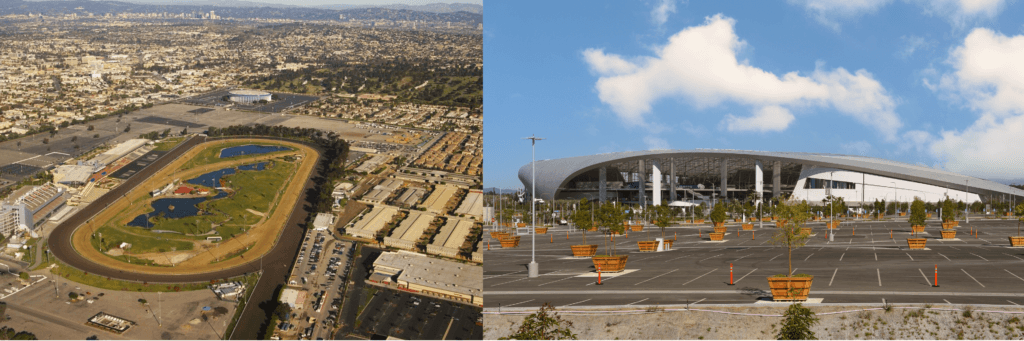
Unlike the Crenshaw District, Inglewood is its own, separate city, but it is also losing ground. And, unlike virtually all other areas of Los Angeles County, roughly half the residents here are Black. The city has distinct features, including a sizeable downtown and, in Inglewood’s case, a legacy of sports venues, notably the Hollywood Park racetrack (now demolished) and the Forum. The Forum housed the Lakers for forty years, but that didn’t automatically enrich the city. For 40 years, a premiere NBA franchise existed in a kind of glamourous bubble—one more way Black people stood on the outside of American largesse looking in. Even so, the Lakers and the sports profile kept Inglewood on the map and on the edge of possibility, the kind my family had relocated here from Louisiana to seek.
Now, Inglewood is on the map in a big way, for the same reason. The billion-dollar-plus SoFi Stadium and entertainment center opened last year, despite the pandemic, to rave reviews. The Forum, which became a music-only venue seven years ago, has reopened after being shuttered for a year and a half. Ditto—the Hollywood Park Casino, a sleek reincarnation of the more downscale, card-club casino sat adjacent to the racetrack for decades. Across the street on Prairie Avenue, construction is underway for yet another billion-dollar-plus sports arena, this one financed by billionaire Los Angeles Clippers owner Steve Ballmer and bearing the very LA name of the Intuit Dome. All of these things are touted as positive developments for Inglewood. They are what pundits and real-estate types cite when they talk about things looking up for a city whose good points have been overwhelmed for the past 30 years by a ghetto reputation. Sports venues may be accelerating gentrification in Inglewood, but they are also reaffirming it as a destination, the new narrative goes, bringing back the value lost long ago to white flight and neglect: White return is building back a middle-class stability that Inglewood deserves.
The problem with that narrative is that the middle class, the great American Dream of the past 70 years or so, has become a shadow of its former self. There is no more critical mass of white people, as there once was, buying modestly priced homes in leafy, largely white neighborhoods guaranteed by their demographics to increase in value and assure residents of a comfortable future. White people, too, have been priced out of stability, especially in LA, where a nondescript 1,400-square foot house can go for million dollars or more. The collapse of the middle means that houses in Inglewood, like houses everywhere, are being sold to the rich, the rapidly ascendant or the very fortunate. Having a shot at the dream has gone from being normal to being exceptional. The democracy implicit in the Dream, like democracy period, has been gutted, though we like to pretend otherwise. Maybe, in some ways, we have to.
We’re running out of real estate. I used to have this thought often in 2016, as I walked my aging dog, Toby, a sunny golden retriever mix who for years lived for chasing balls. Now, he was steadily losing his ability to walk. Over a matter of months, our daily outings shrank from an hour to thirty minutes, then to a jaunt around the block, then up and down one block, and finally, half of that. The land Toby could reasonably traverse was getting smaller, and all I could do was stay close and chart the decline. This is what gentrification is feeling like. I live here but the neighborhood is less and less mine. This is despite owning my house, as do most of my neighbors. But our homeownership, the foundation of middle-class status and stability, does not protect or insulate us, as it did for white people. We are still buffeted by forces, not of our desire or creation.
The SoFi stadium that was fast-tracked by Inglewood’s mayor and city council and that is touted as such an asset for residents is, practically speaking, a headache. For one thing, the astronomical parking fees at SoFi have meant that Rams and Charger fans have tried to park in surrounding neighborhoods. The city responded by announcing to residents that the entire city of Inglewood will have permitted parking, meaning that residents will have to bear the burden of solving a problem we didn’t ask for, weren’t consulted about, and that doesn’t improve our quality of life. Permit parking is common in more affluent areas like West Hollywood and Beverly Hills, where residents request and pay for restricted parking on public streets in order to protect the sanctity of their space. They protect their bubble of good life from the noisome outside. In Inglewood it’s the reverse – we are the inconvenience for the new insiders, the NFL, the developers and our own politicians who see longtime residents as obstacles to progress. We are not the protected.
In all the churn and uncertainty, there are some hopeful signs. Downtown Crenshaw Rising’s mission of Black ownership only keeps growing, despite setbacks. To create new living space, Black homeowners are building more backyard units and add-ons, expanding the space they already have and returning to the tradition of multiple generations under one roof. The unsustainable pursuit of individual space is yielding back to a way of life that was common in my father’s generation and generations before that—one that was about economic survival, but also about shoring up community and helping whoever needed help in a fight against common enemies of discrimination and isolation. Those things are still around, exacerbated by the new enemy of housing unaffordability. The challenge now is to find places to live while still aspiring to the legitimate values of middle class-ness—stability, security, optimism that things will grow incrementally better over time. Though created as a white phenomenon, the deepest meaning of the middle class—putting the fundamental struggle of survival (economically and physically) to rest in order to live life on a higher plane—resonates even more for Black people, not least because it’s taking so long to get there. It is a frontier we still have to pursue.
Goodmon, who is 39, counts among his many inspirations my father, a fellow activist. Larry Aubry died in May 2020 at the age of 86, at what turned out to be a critical moment. That month Covid-19 was rising meteorically, George Floyd was murdered, and the anti-gentrification battle for Black people in LA—the battle to be in LA at all—was shifting into a higher gear as Goodmon and others who would eventually become Downtown Crenshaw Rising joined forces to take a stand. During what is increasingly being described as one of the darkest times in American history, this has been genuinely encouraging. The post-Floyd protests have been encouraging too, and almost certainly have helped DCR’s cause, or at least clarify it. But I have to confess that without my father’s voice and the voices of his generation, the battles are more daunting. History is becoming memory. It is no longer at my side, as it was for much of my life.
Not that history made everything all right: after nearly 80 years in LA, my father had many concerns about Black people thriving—the same concerns his family carried here from New Orleans. Yet, he made thriving seem more possible because his vision never flagged; he always believed. He made fighting essential, not something to opt-out of or move away from. He made me and younger generations realize that for Black people, it’s all about pushing against erasure, and always has been. And that Los Angeles is still as good a place for fighting that erasure as anywhere else.
Maybe, still, the best place.
Help us sustain independent journalism...
Our team is working hard every day to bring you compelling, carefully-crafted pieces that shed light on the pressing issues of our time. We rely on caring supporters like you to help us sustain our mission. Your support ensures that we can continue to provide deeply-reported, independent, ad-free journalism without fear, favor or pandering. Support us today and make a lasting investment in the future.
RELATED STORIES


Award Winning


Today’s environmental and social justice challenges are unprecedented, and require an unprecedented collective effort.


Stay updated on our latest features, events and more. Subscribe to our Note From the Nest newsletter!
