
Black Eve
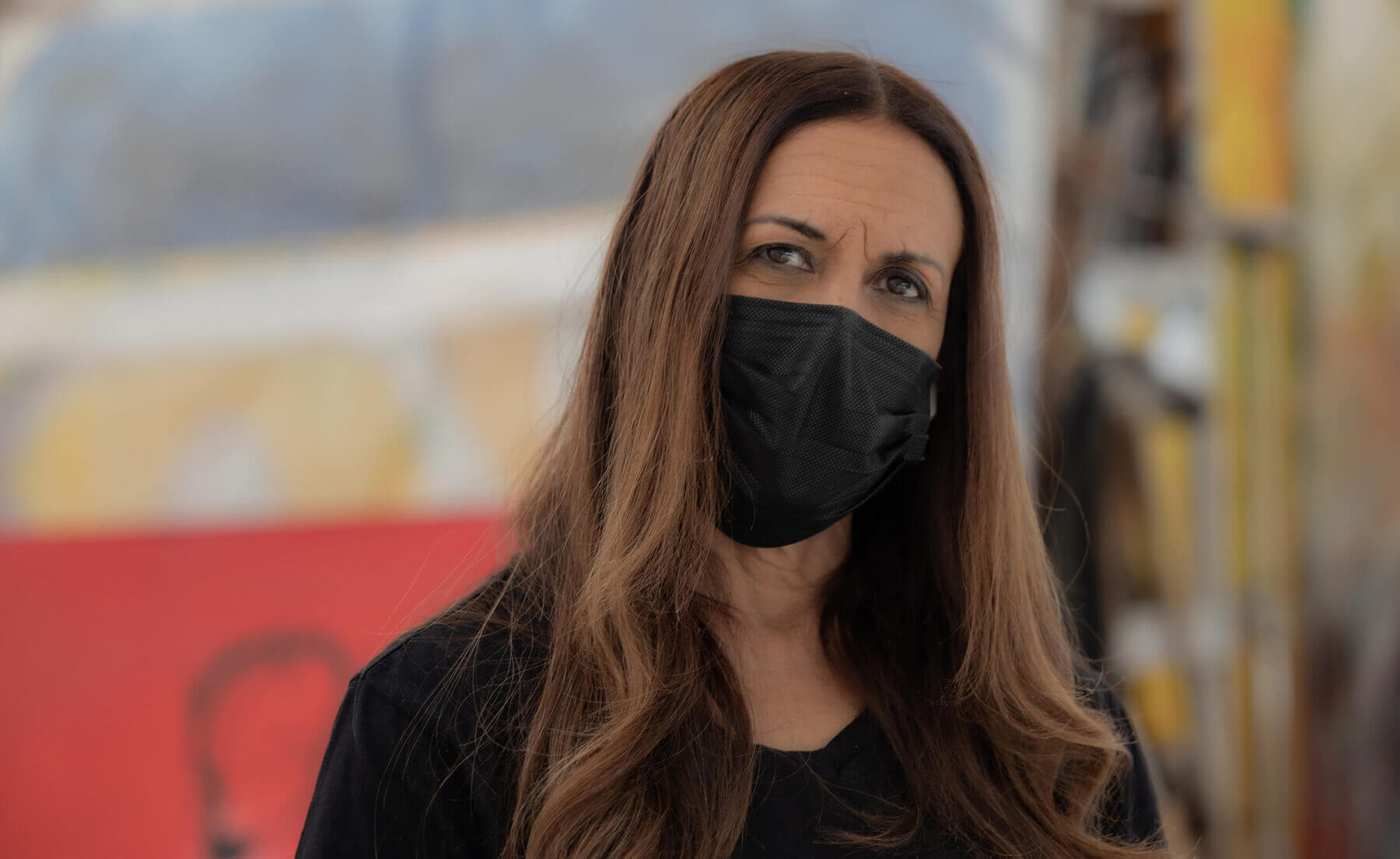
The directions to Toni Scott’s studio in Goleta, California are the kind of directions you get trying to navigate Maui or other places that run on island time. Follow the white fence until you reach an old sign, turn right at the end of a dirt road, park where you see cars and then boom! you’re in an artists’ utopia: an erstwhile orchid farm, now converted to an agritourist, work-live art space.
We’d driven past an arboretum filled with Venus fly traps and succulents, the moss on the floor entangled with strawberries, and an indoor skatepark. Then came a gaggle of greenhouses, one of which — the middle one — had been converted into Scott’s studio. Across from her greenhouse, young women were wallriding and busting kickflips on a halfpipe. A tough, weathered, carrot-colored pitbull lazed nearby.
The first thing I see beside the entrance of Scott’s studio is a tall, black palm frond.
I recognize it immediately from her installation piece “The Empire Strikes Black” (now titled “Black Ascension”). The original piece was comprised of up to 150 queen palm fronds. Of the piece, Scott says, “The idea is thinking about this planet — our behavior towards the planet and the absolute critical need to change our ways to preserve it. So nature here is reaching out saying, ‘I’m here. I’m dropping seeds. I’m shedding. I’m growing. But are you hearing my voice? I’m Black.’ It’s a statement that we need to pay attention. Another thing it represents is Black Lives Matter. The Empire represents America striking back against people of color, poor people, individuals who are under extreme oppression or the structural racism or the death of people at the hands of the police. Oppressed by the Empire but still holding strong — its arms wide open to take flight — to find its future in a positive way.”
That last bit — “to find its future in a positive way” — is what’s crucial here as a way of seeing and looking at Scott’s work. I think of all the ways the Empire has oppressed marginalized artists and writers, the demand for us to translate/explain/apologize, the practice that forces us to accept the normative status of a white/dominant audience that is not one’s own, to cultivate a yearning for recognition from the dominant Other.
I use color to invite people in — a pretty blue or green to invite them into the space.
The Dominant Other, the Tastemakers, often encourage the “sublime” — something transcendent. Yet, that transcendent space leaves little room for reckoning, for brutality, for confusion or complication, for bringing to light racist, sexist, classist, aspects of this impossible country of love and lovelessness.
I notice a copy of John Berger’s Ways of Seeing in the library at the back of Scott’s studio, which seems fitting to Berger’s passage: “‘You can’t talk about aesthetics without talking about the principle of hope and the existence of evil.”’ This is just another way that I see Scott’s work pushing back against the status quo. Like “Black Eve,” who stands front and center commanding all your attention as you walk into the studio.
Black Eve, the sculpture’s current incarnation, is made of fiberglass and 7 feet tall. “Black Eve” has had many renditions. It’s a narrative that starts with the beginning of humankind and brings us forward to today. She was first “Mitochondrial Eve” — the first woman who marched out of Africa throughout the plains and throughout the country, throughout the world, and settled in different places along the way.
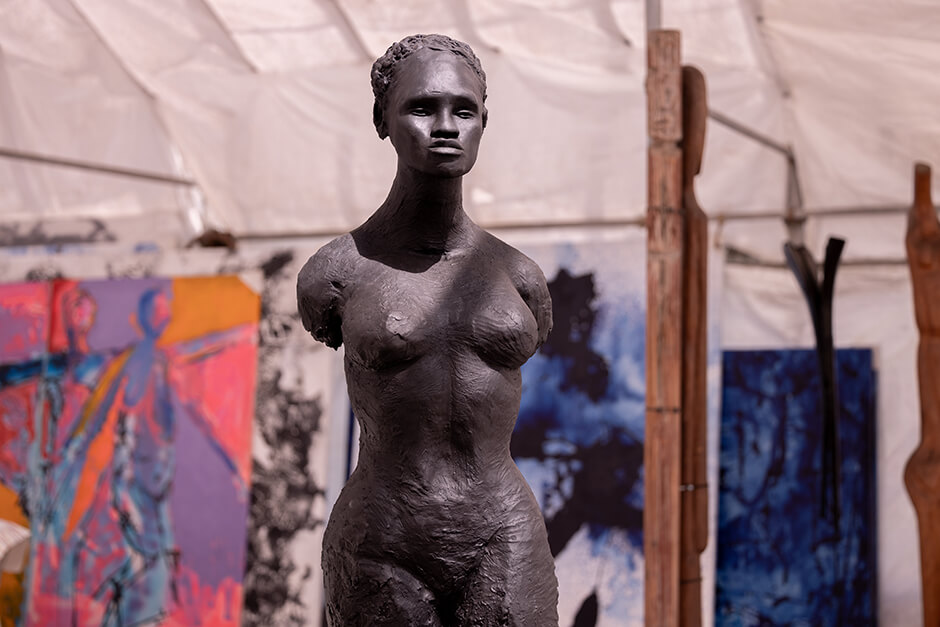
Becoming Eve: Toni Scott’s “Black Eve” sculpture series explores the evolution of identity. Photo by Sam Slovick
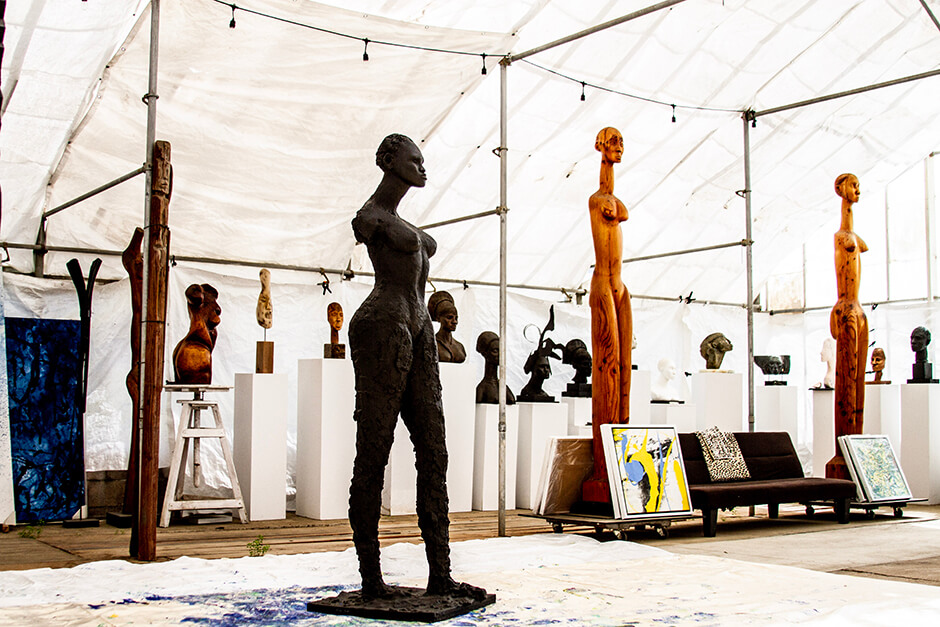
The many manifestations of “Black Eve.” Photo by Jaimie Sarra
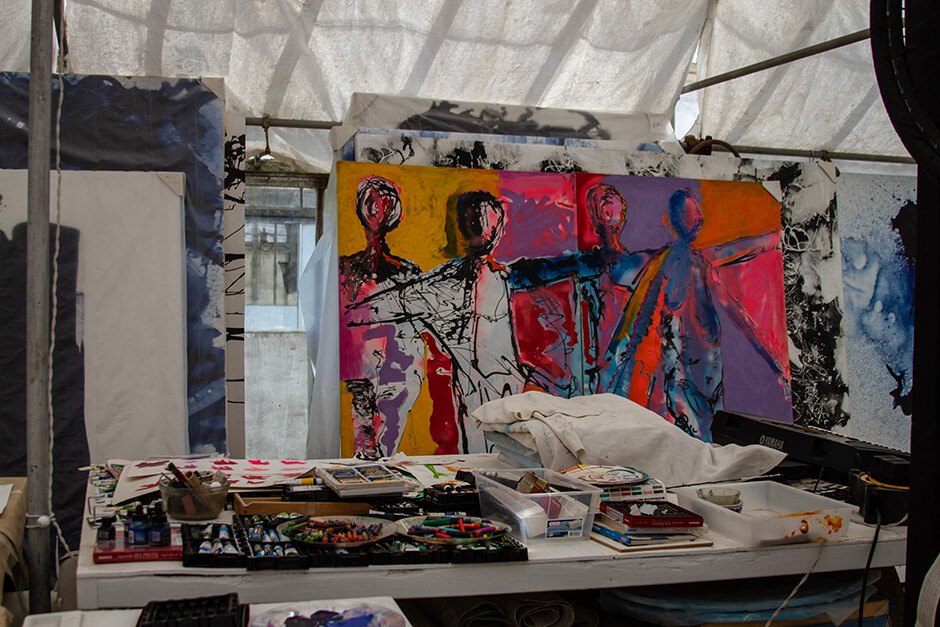
Works in progress: Inside Toni Scott’s studio, one encounters many mediums. Photo by Jaimie Sarra
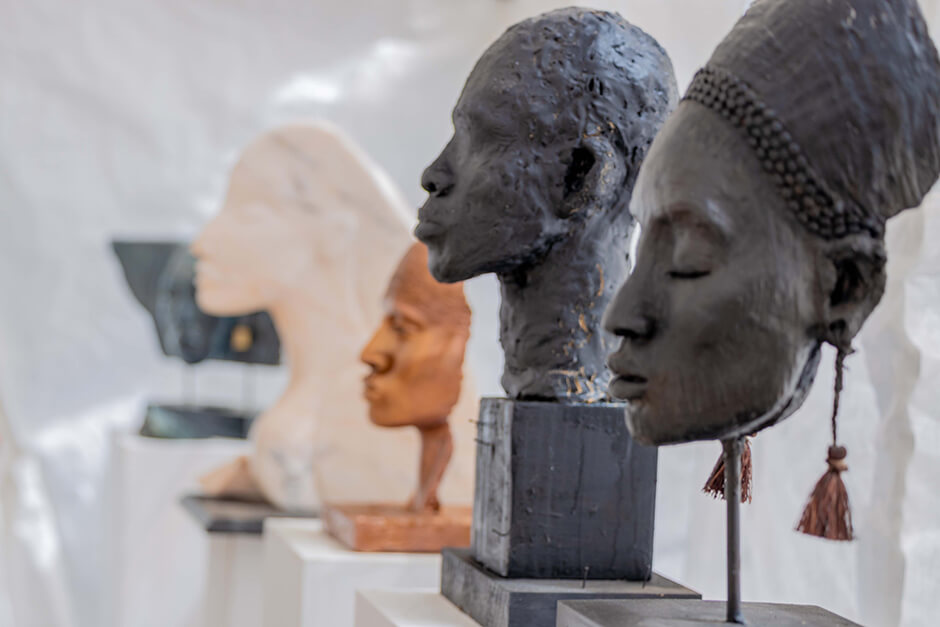
Sculptures from Toni Scott’s “Heritage Series” (background to foreground): “Hatshepsut” in Chlorite stone; “Saharan” in Rosa Portuguese marble; “Mangbetu” in bronze; “Nubian Man” in clay; “Mangbetu II” in Hydrostone. Photo by Sam Slovick
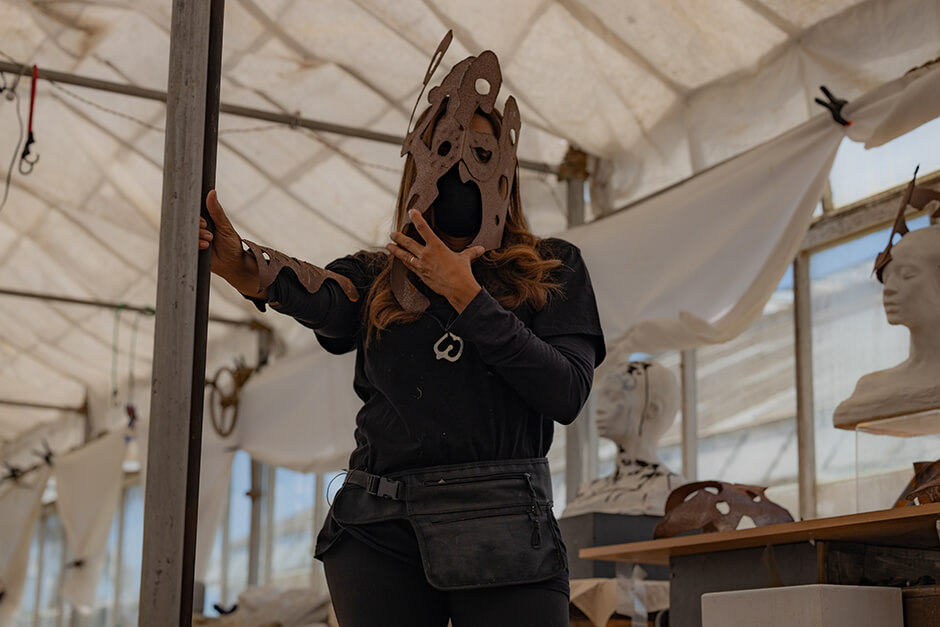
Toni Scott created a series on heroic women warriors, featuring metal masks and spears. Photo by Sam Slovick
***
Toni Scott, a native of California, grew up in Los Angeles, where she recalls her dad in the garage problem solving and inventing. Her sister painted murals, and her mother and grandmother sang in the choir. Her grandmother had a lot of mediums, gold leafing among them. Another, Scott reveals, laughing, is, “one I never had — she was a whistler.” She also recalls injustice being part of her experience growing up in Los Angeles: how badly she wanted to swim in the pool in Centinela Park in Inglewood and how the Black children were either charged more than the white children or turned away.
Scott received her bachelor’s degree in international relations from University of Southern California. In fall 2018, Scott was selected as artist in residence at the Squire Foundation in Santa Barbara, and the prestigious CCS Artist in Residence, at University of California, Santa Barbara. She holds an MFA from the latter. She is a citizen of the Muscogee Creek Nation and part of a global traveling exhibition of Muscogee Creek Artists.
She is of mixed Black American and American Indian ancestry, and she uses her talent and work to highlight and honor her dual heritages. Her exhibitions and installations weave together artistically powerful stories presented through installations, multimedia, photography, painting, sculpture and digital ingenuity, often referencing fraught histories.
In 2004, before the age of Google, her world and idea of home expanded when her maternal uncle, Richard Procello, authored Discovering Our Past: The May Family History 1705-2004. The investigation enabled Scott to reconnect with a span of 302 years of stories, images and compassion demonstrated by her ancestors. She then learned from her grandmother Calle that her great-grandmother on her father’s side, Fine, was an indentured slave who had been kidnapped. She said she often thinks of how difficult Fine’s life was, and how kind she was. The state came and wanted to put her nieces’ children in an orphanage, but Fine stood on her porch and said, “You ain’t taking my grandkids.” “Learning of my multicultural family heritage has inspired me to give life to the lost images and stories of history,” explains Scott.
She has a series called “Bloodlines” that talks about the African American journey from Africa to America and the experiences that African Americans had here. Which brings us back to Black Eve, who was the first woman on the auction block. In this incarnation, she stands 10 feet tall and has a shackle around her neck.
In an ensuing iteration, her shackle has been removed and she has moved along again on her journey. “White Eve or White-Washed Eve,” symbolizes the history that so many people have covered up. The history that is now being exposed more and more: early American history, slavery, indigenous genocide. The whitewashing of history.
This interdependence, this concept of the breath has never been more clear, in the time of a virus that is transmitted through breath, as well as in the time of the Black Lives Matter movement, and the murdering of unarmed Black men, women and children by police.
She has since evolved to the current version of Black Eve. And Black Eve is where she will stay. She represents her culture as a Black woman and the beauty and nobility of a culture that is often overlooked and undermined in representation. She stands with her arms missing — symbolizing that she is still coming into her own. Scott explains, “Those arms are missing to say ‘I’m still moving forward, I’m still strong, but there’s still a ways to go to be fully whole.’ She’s left rough on the surface and smooth because that’s the journey — sometimes it’s rough and sometimes it’s smooth, but with each stride she stays on the road moving forward and never surrendering.”
At the heart of her “Bloodlines” series exhibition was an approximately 24-ft-long, illuminated slave ship suspended from the ceiling. It was constructed from 500 translucent, blue-tinted images of family members and images taken from archival collections of people who were enslaved. The blue stain represents the stain of the ocean. The portraits themselves were an attempt to restore the individuality and grievability of the countless people who were forcibly uprooted and transformed into chattel. Scott says she had to find and utilize hundreds of distinct images so the same person would not be repeated twice.
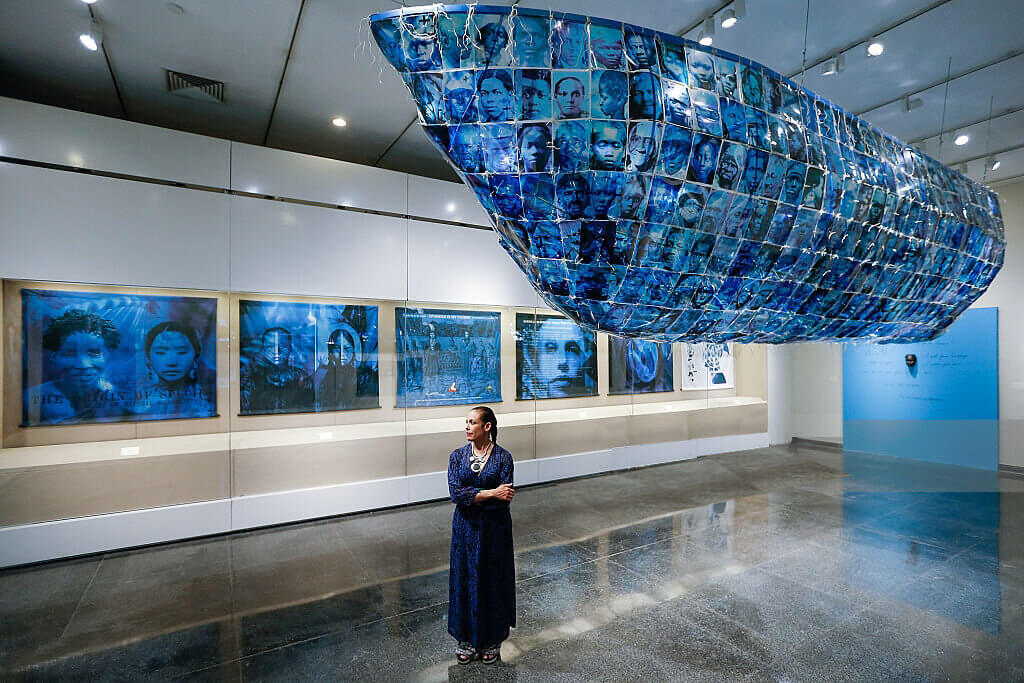
The “Bloodlines” exhibit — featuring “Forgotten Ship,” a 24-foot sculpture made from woven photo transparencies — at the Arthur M. Sackler Museum of Art and Archaeology at Peking University in July 2015. Photo courtesy of Toni Scott
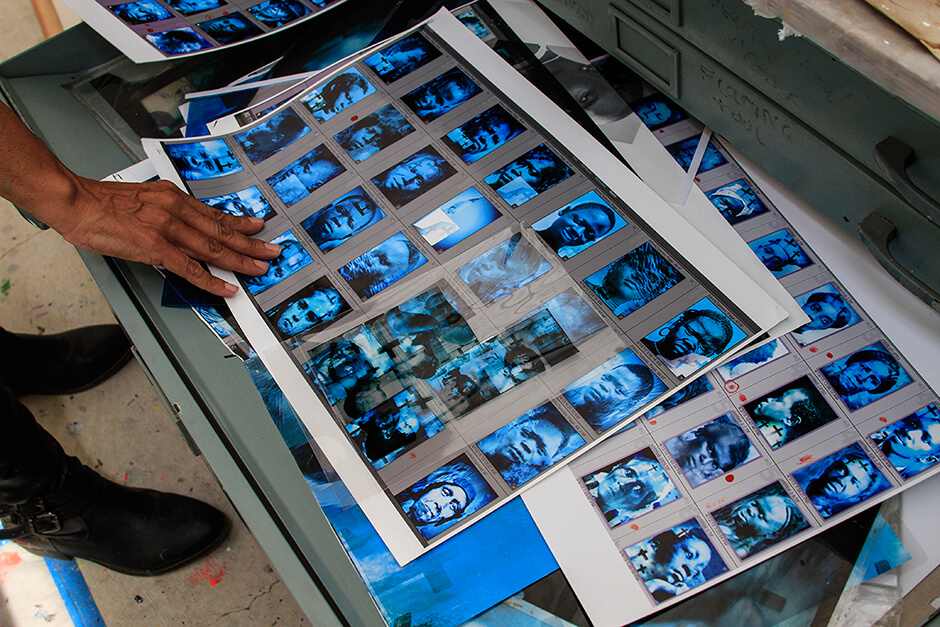
Ghost ship: Portraits used for “Bloodlines” that were later transferred to the large transparencies used to make “Forgotten Ship.” Photo by Jaimie Sarra
One image in particular stuck out to me: William Casby, a former slave from Algiers, Louisiana. I knew this photo (below, left) because it appears in the French literary theorist Roland Barthes’ Camera Lucida. Barthes uses Casby’s image to elucidate how the image of his face is a mask that lays bare the essence of slavery. Up until now, I thought, Barthes knew something I didn’t. Maybe I’m not smart enough for Barthes, I thought. He reads pain and time in this image.
The photo itself was taken by Richard Avedon in March 1963, three months prior to the Civil Rights Address by President John F. Kennedy that put into motion the civil rights legislation of 1964. Avedon’s earlier portraits were most known for their movement, whereas in this image, Casby seems frozen in time. His static pose represents the social inequality of African Americans still over a century following the Emancipation Proclamation when the photo was taken. This is the image that appeared in Barthes’ Camera Lucida:

(left) “William Casby, Born in slavery, Algiers, Louisiana (1963).” Photo by Richard Avedon / © The Richard Avedon Foundation.
(right) “William Casby [front, holding baby], one of the last living Americans born into slavery, surrounded by several generations of his family in Algiers, Louisiana on March 24, 1963.” Photo by Richard Avedon / © The Richard Avedon Foundation.
On the right is yet another image of William Casby by Avedon from his collaboration with author James Baldwin, Nothing Personal.
Nothing good grows in the dark. This is a story I’ve been telling myself and others in reference to a time in my life when I was sinking into bad habits, yearning for a darkness where one ends and there is no room to begin again. Scott’s work, like good art does, has me thinking about my stories.
Back then, I was living in a rent-controlled apartment across from Plummer Park in West Hollywood, surrounded by the sounds of people hawking loogies and smells of boiled cabbage. I wasn’t seeking anything in that apartment. I didn’t wake with the sunrise to go hiking up Runyon Canyon. I missed most mornings all together, having been up late watching garbage television and drinking Two-Buck Chuck from the Trader Joe’s across the street.
I slumped post-drunk, on my Ikea futon, and tried to settle my mind until I could rustle up more change to go across the street for more cheap wine or menthol cigarettes. I think of this apartment. Its darkness, shrouded in shadow. I called it my Vampire Cave for all the lovers I’ve kept trapped with me there. We stayed inside and never left — sucking the life out of each other.
One girlfriend took my dog and locked herself in the bathroom where I knew there was at least one razor. I pushed on one side of the door while I thought she pushed on the other, so when she finally released the pressure, I’d accidentally shoved the door in her face. Hot with fury, I grabbed her by the shoulders, shaking and unsure of what I would do, what kind of violence would erupt from me, and there in her eyes I saw it: that younger me, crouched in a ball, filled with terror. Which meant the face I had, the face I showed her was the face of a person who destroyed me. The face that once belonged to my mother. I lived there with that younger shadow self for seven years in my twenties. Stagnant and ashamed. So, when people ask why I quit drinking, to keep it simple, I say, “Nothing good grows in the dark.”
Yet, there in a greenhouse of all places — after viewing the spectacular conceptual artwork and installations of Toni Scott, I realize I’ve been telling it wrong. Plenty good grows in, and out of, the dark. You just have to know how to see it.
James Baldwin writes of that first photo of Casby, “It is necessary, while in darkness, to know that there is a light somewhere. To know that in oneself, waiting to be found, there is a light. What the light reveals is danger, and what it demands is faith.”
This is the same brand of faith that Scott’s work rewards. What I’d come to think of as a reckoning was what she called an awakening. I asked her about what it’s like to have an artmaking practice in this time of grief, of racists airing their illegitimate opinions, devaluing Black life. Fox News and conservatives across the world have weaved a narrative that renders “the economy or the health of the economy” more grievable than people. Urging us to go out and shop and support restaurants, for fear that The Economy, personified, will become ill — yet humans, people in service-sector jobs, people who offer childcare, people in Amazon warehouses, are actually becoming ill and dying.
Particularly, people of color and poor people. Yet, still much of Scott’s work is around healing and how she practices healing during this time. Is there space for healing in a reckoning practice or reckoning in a healing practice?
“Yes of course, you want to pull the covers over your head,” says Scott. “As creative people we need to recharge, then record; document. Speak out against injustice. Many of us are called to provide a certain service, to report injustice, enslavement, genocide. Yet, I’m an optimist. Through all of this, I believe in humanity. I think it’s critical to build empathy and to demonstrate, in a way, the domino effect. It takes effort to see and utilize tools of strength and healing as opposed to anger. It is important to be mad sometimes, but that anger needs a compliment.”
Then, she says the sweetest thing: “I use color to invite people in — a pretty blue or green to invite them into the space.”
***
We eventually get around, as we all must, to talking about life during quarantine. I ask Scott what I’ve been asking everyone I speak to these days, “What’s the most interesting thing you’ve seen recently?” She tells me of this partnership facilitated by California State University, Dominguez Hills President Thomas A. Parham that enabled her to delve into “live painting” with the Inner City Youth Orchestra as her muse. It was an opportunity to examine the symbiotic relationship between the visual arts and music.
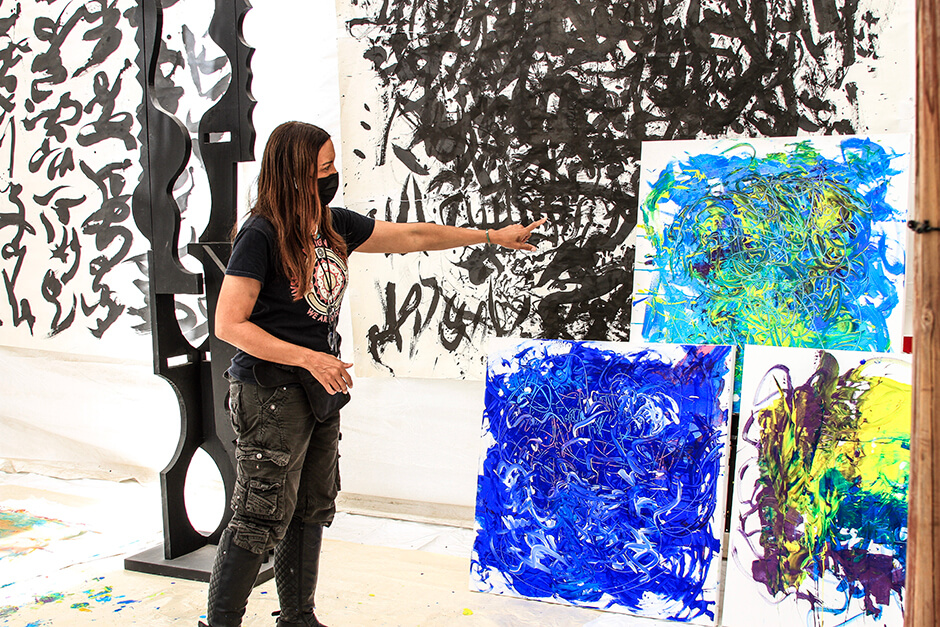
“Live Paintings” from the artists session with the Inner City Youth Orchestra in Santa Barbara, California. Photo by Jaime Sarra
Now I get to share the most interesting thing I’ve seen recently — an idea that broke my world wide open. Towards the end of the tour of Scott’s studio, where she pointed out sculptures, prints, paintings and photos, and the gold leafing that her grandmother worked with, of which I have my own cherished sample beside me on my desk at home as I type, she walked me over to a contraption that looked like a tall shelving unit, with a bicycle wheel attached to a box up top.
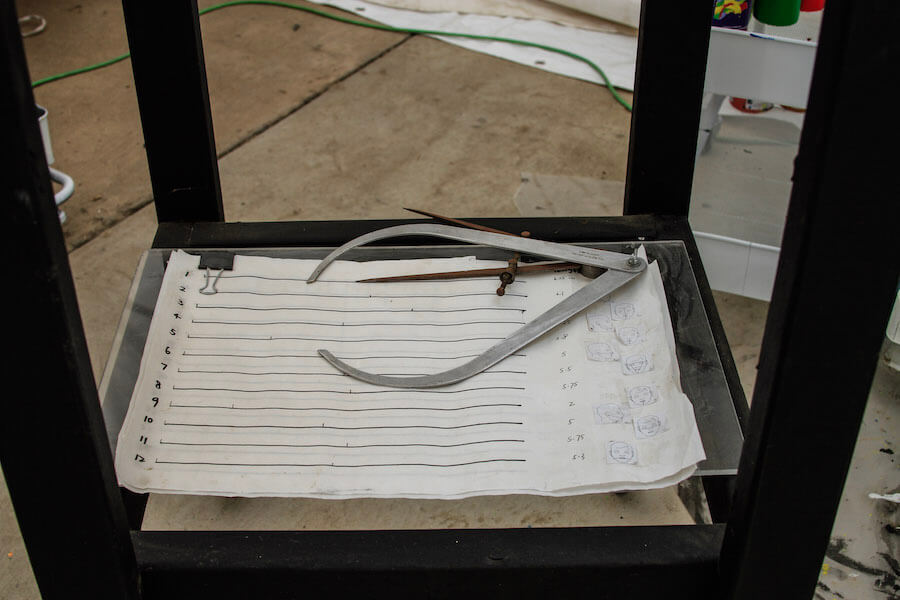
Photo by Jaimie Sarra
On the lowest shelf (pictured above), there is a set of calipers and sketches of faces and measurements mapped out on a sheet of paper. The distance from eye to eye cheek to cheek.
The next shelf had a small white notecard that instructed, “Listen to my head size by rotating the wheel in the direction of the arrows. Rotate gently.”
The highest shelf below the box with the wheel attached to it had photos, images of people, calipers and a small music box with a scroll rolling through it, with the data and readings of the head measurements stamped out of the scroll. It looked like the sheet music you feed through a player piano.
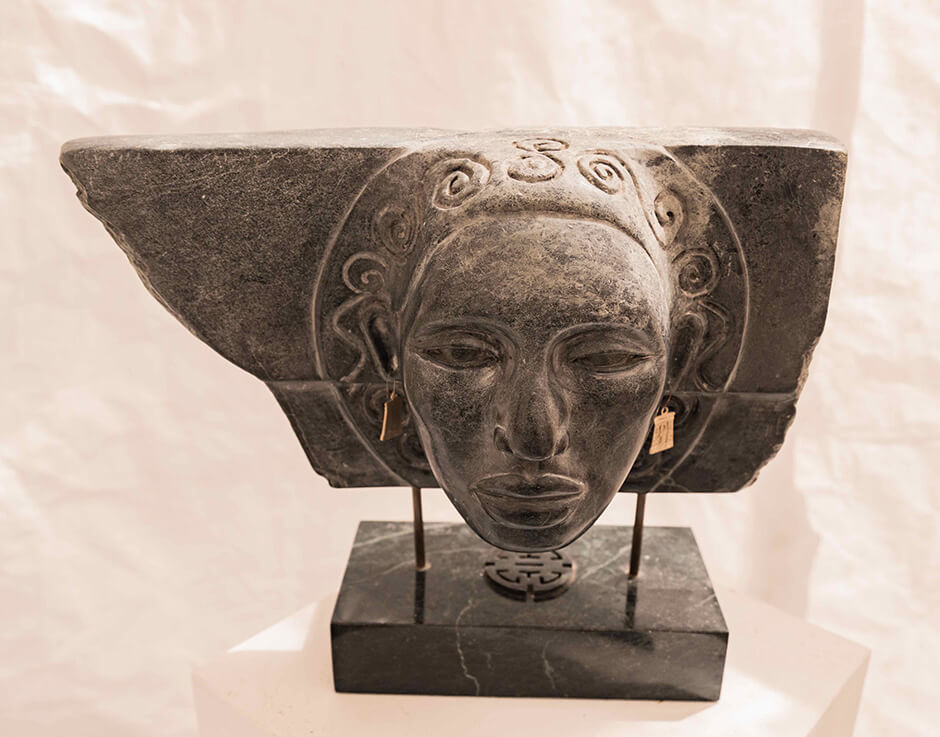
“Homage to Hatshepsut,” the first female pharaoh. The chlorite stone carving features cast metal earrings. Photo by Sam Slovick
As Scott gently fed the scroll through, sure enough, it twinkled out the sound of heads. Listening to this music, I was astounded. Scott explained how the sounds had nothing at all to do with the color of our skin, but the measurements we took. I couldn’t help but think of the French philosopher Maurice Merleau Ponty and his concept of phenomenology. It’s been on my mind since the pandemic. The basic underpinning of phenomenology has much to do with proprioception and how our bodies move and engage with the world. That what one breathes out, another breathes in. This interdependence, this concept of the breath has never been more clear, in the time of a virus that is transmitted through breath, as well as in the time of the Black Lives Matter movement and the murdering of unarmed Black men, women and children by police.
Scott has a piece titled “I Can’t Breathe,” which she first created in plaster in 2009 as an emotional response to Oscar Grant. This year, deeply grieved by the death of George Floyd, she recast the bust in concrete. Concrete is a combination of cement and sand aggregate. Scott explains, “Concrete is the material of the streets — a hard material that is the foundation on which many things are built. It is also the place where so many people have violently perished. Both figures sit high on their bases resurrected as if battered but not broken.”
It is easy to recount all the ways that this interdependence, our interdependence is the death of us, but there in that greenhouse in Goleta, I saw (and heard) another way — our interdependence is the music — the life of us.
Help us sustain independent journalism...
Our team is working hard every day to bring you compelling, carefully-crafted pieces that shed light on the pressing issues of our time. We rely on caring supporters like you to help us sustain our mission. Your support ensures that we can continue to provide deeply-reported, independent, ad-free journalism without fear, favor or pandering. Support us today and make a lasting investment in the future.
RELATED STORIES


Award Winning


Today’s environmental and social justice challenges are unprecedented, and require an unprecedented collective effort.


Stay updated on our latest features, events and more. Subscribe to our Note From the Nest newsletter!
