
On the Hot Seat
You’ve likely noticed headlines of late about how our planet just experienced its hottest day ever recorded. And then, you likely saw the same headlines the next day. And the next.
Those records are just the tip of the (melting) iceberg: “Before July 2023, the previous daily global average temperature record was 16.8°C,” or, 62.24°F, the EU’s climate change service wrote. “From 3 July 2023 to 23 July 2024, there have been 59 days that have exceeded that previous record.”
As the world broils this summer, the United States, especially the South and Southwest, have been roasting in temperatures so high that a CNN meteorologist called July’s heatwave “a killing spree.” So, yeah, climate change is out and climate-changed is in. Given the new normal, it seemed like a good time to check in with those charged with making our hottest cities more hospitable in an increasingly inhospitable climate.
For the first in an ongoing series, we spoke with Jane Gilbert about her work as the Chief Heat Officer of Miami-Dade County in Florida — the first person in the world to hold that title. Gilbert took the post in 2021, having previously served as the City of Miami’s Chief Resilience Officer.
She has her work cut out for her. Miami-Dade is the low-lying home to 2.6 million people. It is, of course, known globally for a host of positive reasons (the “capital of Latin America,” vibrant culture, cuisine, Wynwood Walls, Sergio Busquets, beaches, architecture, burgeoning tech hub and snowbirds) but also for myriad challenges coming soon to a city near you if things don’t improve: heat, hurricanes, flooding, and sea level rise, all exacerbated by income inequality.
Climate change is out and climate-changed is in. Given the new normal, it seemed like a good time to check in with those charged with making our hottest cities more hospitable in an increasingly inhospitable climate.
Miami is different in some ways, though, as its very existence is threatened by climate change. The University of Miami explains that 56 percent of the county sits at a sea level elevation of 72-inches or less, and projects that, by the end of the century, local sea level rise to be between 28 and 57 inches. Miami is the “most vulnerable major coastal city” in the world, writes the think tank Resources for the Future, adding, “Miami may be gone by 2100, undone by hurricanes and the rising ocean.”
The RFF also soberly forecasts a rise in mortality rates, with a median estimate of between 1,000 and 1,500 more people dying annually, by 2035.

Jane Gilbert (pictured above) was the first appointed Chief Heat Officer. According to Arsht-Rock, these officials are responsible for “unifying their city governments’ responses to extreme heat” — including furthering protection against extreme heat and finding new initiatives to reduce risk. Courtesy of Miami-Dade County
In 2023, Gilbert noted in an end-of-the-year LinkedIn post, Miami-Dade faced more than 60 days where the heat index reached 105 degrees Fahrenheit or more. Still, those of us on the planet Earth can’t just throw our hands up and surrender. There is enormous work to be done, and city planners such as Gilbert are on the case, doing what they can to make a difference in myriad positive ways.
In the following interview with Gilbert, which has been edited for length and clarity, we discuss her about her work, her pioneering title, her connections to others doing good, and more.
***
Jeremy Rosenberg: Can you talk about what you’re most proud of so far during your time as Chief Heat Officer? And then also what are you most optimistic about your work moving forward?
Jane Gilbert: I think we’ve done a really great job at raising people’s awareness, both of the risks related to heat here in Miami-Dade County, but also what they can do to prevent them.
We’ve done that through a multimedia campaign — multilingual in targeting the zip codes that we know have the highest rates of heat-related illnesses — through outdoor media, radio, television, billboards, bus shelter and bus wrap ads, posters in healthcare facilities, our parks, our libraries, and highly targeted social media messaging to our most vulnerable populations.
We’ve also done a huge series of heat safety trainings for community healthcare practitioners, summer camp providers, homeless outreach staff and volunteers, community disaster volunteers from our most vulnerable neighborhoods and all our cooling site staff at our parks and libraries. We did a lot of direct outreach to our unsheltered population, particularly these last two summers where we had so many heat advisories, heat warnings, and such extreme heat. Our first goal is to inform and prepare people and we’ve had a very successful effort. We knew that was the thing we needed to do first, coming out of the gate.
When I was first hired, people questioned why we needed my role. That’s no longer a question. People are questioning why I don’t get more resources at this point. So that’s great. We also have begun training for employers of outdoor workers, and they’re going to be doing a lot more of that next year, really ramping up the outreach and education to employers and employees of high risk industries.
That’s our first goal area. The second goal area is to help people stay cool at home, affordably. We’ve had some great wins there in terms of increased funding. We installed 1,700 efficient AC units in all our county-managed public housing where we had inadequate cooling. Those were installed before this last heat season, thankfully. And then we doubled our county funding of the weatherization program, which is a retrofit program for single family homes, and then created one for multifamily rental housing.
Is that cool roofs?
It’s everything. It’s definitely cool roofs, but it’s also insulation, efficient AC systems and efficient appliances. It’s basically to bring down utility costs, but also to make sure people have adequate cooling systems. We have a lot of old buildings here with a lot of old AC systems not only using more energy, but leaking really high greenhouse gas potent refrigerants.
As we replace them, we have to make sure those are recovered and that we’re putting in higher efficient systems. There’s so much more work to be done in that area, we’re just beginning to scratch the surface. Existing buildings are a big issue, both in terms of meeting our carbon mitigation goals, but also to keep people safe from the heat.
The last area that we’ve made some great progress in is our urban heat island mitigation. We had set a goal since 2007 to get to 30 percent tree canopy. We currently have an average of 20 percent countywide and the updated tree canopy assessment in 2021 revealed that we had remained flat for the last five years at 20 precent. Even though we have great tree giveaway and planting programs, we found we need to accelerate everything even more due to losses from hurricanes, development pressures and weakening state laws, making it harder for us to enforce tree removal permits. All of that’s been a challenge. But the mayor and commission have approved $2.5 million each year over the last two years to increase tree planting and maintenance, prioritizing our urban heat islands with less than 20 percent tree canopy.
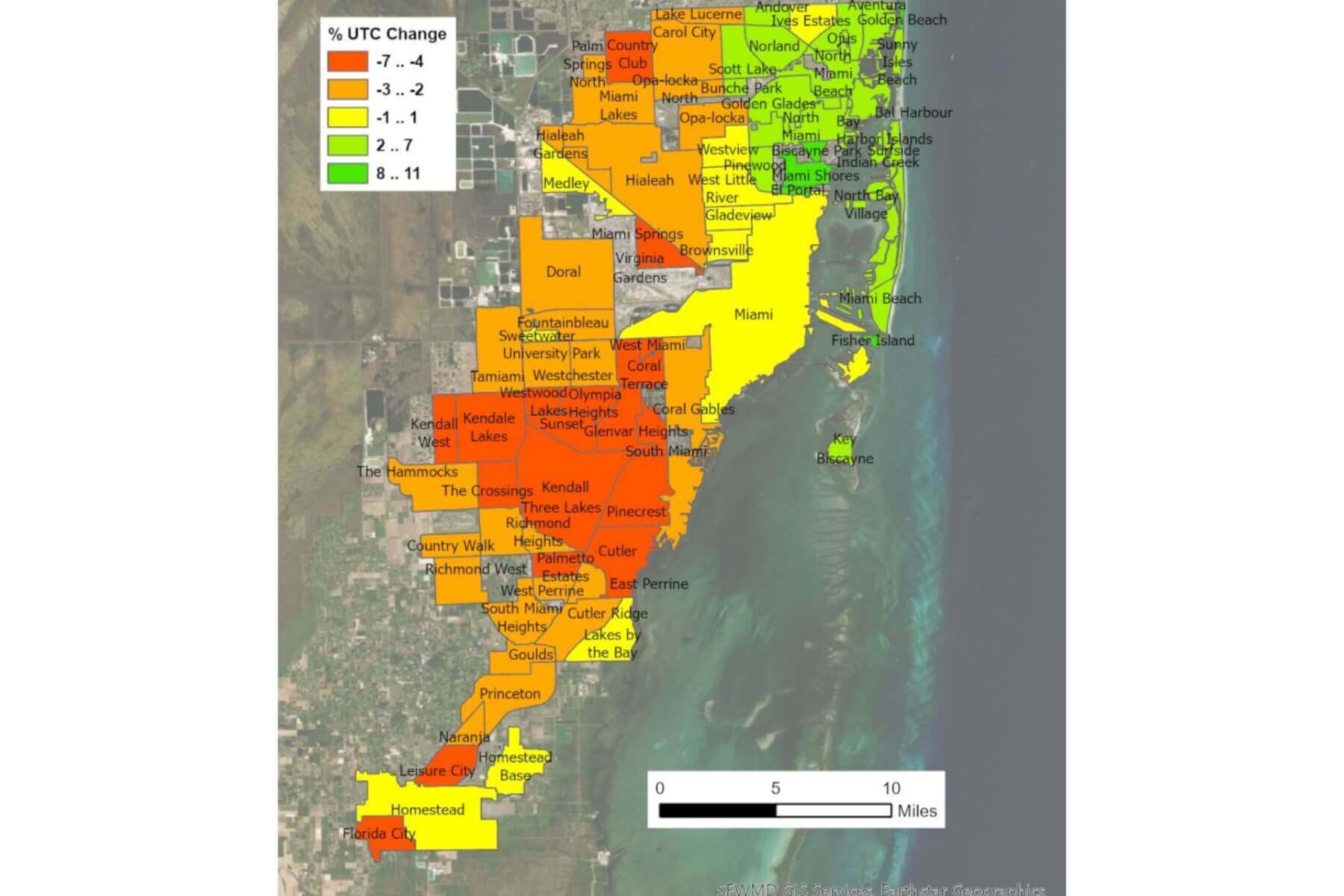
As Miami heats up, mitigations like shade-providing trees will become more important. This map shows the change in urban tree canopy (UTC) land cover from 2016 to 2020. The region has its work cut out for it, as despite programs to increase canopy gain in the north along the beach, some areas also saw a reduction of UTC due to development construction and hurricane impact. Courtesy of the Miami-Dade County, 2021.
In addition, we just got one of the USDA US Forest Service grants for $10 million over the next five years. We’re very excited about what we’re going to be able to get done with that funding. It’s all focused on the hardest trees to plant and the most expensive — those are street trees in our urban heat islands, our biggest concrete jungles in our lowest income areas. So we’re excited at the runway we’ve started, but even more excited about what the next five years will bring in terms of both the housing retrofit and the tree planting work.
Is tree equity the same as shade equity?
We use tree equity, but yes, it’s a similar thing. In our heat vulnerability analysis, we looked at the heat-related emergency department visits and hospitalizations by zip code in the ounty. And then, what were the highest correlating factors related to those? The two things were high poverty rates and high land surface temperatures, so our urban heat islands are definitely contributing to exacerbating existing vulnerabilities to heat. While man-made shade can also cool an area and may be the only option in certain areas, maximizing tree canopy offers so many other co-benefits in terms of stormwater management, habitat, carbon sequestration and aesthetics.
The 1,700 air conditioning units you mentioned — did those go in public housing as opposed to private because that’s easiest from a bureaucratic point of view? Or because these are lower income residents who can’t afford their own AC? Or both?
The county feels responsible for anyone that’s under their care to make sure they are well taken care of, so that was the first priority. The second is that these are some of our lowest-income populations, and they wouldn’t have been able to afford a unit themselves. The other piece is, even though they increased funding for housing retrofits for single family and multifamily, we’re continuing looking for more funds because the need is great.
You are a Chief Heat Officer, and you were the first person in the world to have that title. Others have followed since, in part thanks to funding from the Adrienne Arsht-Rockefeller Foundation Resilience Center — which your position received as well. How much camaraderie and communication do you have with the other CHOs? Are you learning from each other?
I came into this role after having served for the City of Miami as their first Chief Resilience Officer, so I was looking at the whole of climate risk and resilience initiatives. Everyone in this community here got into this work largely because of our high risk to sea-level rise and hurricanes. Heat wasn’t really on peoples’ radar, to be honest.
It was not only because of Arsht-Rock’s leadership on this, but a coalition of community-based organizations in 2020 did a series of focus groups and surveys in our most vulnerable communities throughout Miami-Dade County, and found that their top concern was not sea level rise, and not even hurricanes even though we’ve seen the disparity between low income people and their impacts. It was extreme heat, because that’s what they feel day in and day out, six months of the year or more.
I was excited to take on the role to focus on this particular risk because it was hitting our most vulnerable communities. And similar to my Chief Resilience Officer work, not only across departments in the county, but across jurisdictions and sectors, to come up with solutions. That’s what excited me. I didn’t really think much about the title and being the first. That was more the media. Other people got excited about that, but I was more excited about the work.
And yes, absolutely, our cohort of Chief Heat Officers has been great. I interact with them, we have a WhatsApp chat and a monthly call. And, sometimes, we do one-on-one exchanges. David Hondula’s team in Phoenix and my team just had a meeting between us and our research partners; that exchange was great. One of the things I find in local government is there’s an incredible willingness for peer-to-peer sharing.
I knew there’d be a group chat! Are there things that you’ve taken from any of your colleagues in other cities and brought to Miami-Dade? Or things, even if they’re not from the chat, that you see globally and you’re like, we should bring that here?
I think we all share a deep focus on green infrastructure solutions, so there’s just a lot of exchange. I don’t know if there’s a particular solution that I could point to saying, ‘I’m importing that,’ but it’s just we can sometimes share similar challenges and not feel alone in those challenges.
In part there’s been a lot of exchange around early warning systems and how to inform people — heat advisories, heat ranking and heat wave naming. We’re working very closely with the Weather Service on this, so we want to be aligned. If they go to a ranking, we would be very supportive. We did work with them on lowering our heat advisory and warning thresholds.
Their top concern was not sea level rise, and not even hurricane. It was extreme heat, because that’s what they feel day in and day out, six months of the year or more.
And then with David [Hondula] in Phoenix, they’ve done some really great outreach with their unsheltered population. Maricopa County, which is where Phoenix sits within, has done some great work in documenting heat-related deaths better than most medical examiner’s offices. We’ve had exchanges on all of that, it’s been very helpful.
How do the mechanics of your position work? Are you a department head with a whole team? Are you someone who is kind of a fixer who makes sure that everyone’s talking to each other? Can you describe what your actual day-to-day role is?
I sit within the Office of Resilience and there is a Chief Resilience Officer. We have teams focused on flood adaptation, on carbon mitigation. I focus on heat. The Chief Resilience Officer, the Chief Heat Officer, are like partners in a law firm. We kind of both report to the Mayor. So it’s a unique organizational structure, particularly for local governments, which tend to be more hierarchical. This is much more lateral. But the overall office is charged with working across departments and coordinating. We are strategic planning; we identify resources, policy, and policymaking. We are not implementers. We have to depend on our partners within the county and outside of the county to implement. But the Office of Resilience is 23 people now, so it’s significant.
Help us sustain independent journalism...
Our team is working hard every day to bring you compelling, carefully-crafted pieces that shed light on the pressing issues of our time. We rely on caring supporters like you to help us sustain our mission. Your support ensures that we can continue to provide deeply-reported, independent, ad-free journalism without fear, favor or pandering. Support us today and make a lasting investment in the future.

RELATED STORIES


Award Winning



Today’s environmental and social justice challenges are unprecedented, and require an unprecedented collective effort.


Stay updated on our latest features, events and more. Subscribe to our Note From the Nest newsletter!
