
On the Case

Earlier this month, 44-year-old Yangchen Lachungpa was arrested in a small Himalayan village in northeastern India. Long one of Interpol’s most wanted, Tibet-born Lachungpa is accused of trafficking endangered creatures—dead, alive, whole, dismembered—for decades.
Wildlife officials called Lachungpa’s arrest a blow to the global animal trafficking that is driven, in large part, by China’s insatiable appetite for rhinoceros horns, tiger bones, pangolin scales, and other “medicinal” bits. It’s an open question, of course, whether her arrest will help stem the illegal trade and the slaughter that often accompanies it. Still, learning of her capture while reading Julia Shaw’s new book, Green Crime: Inside the Minds of the People Destroying the Planet, and How to Stop Them felt like a gratifying instance of kismet.
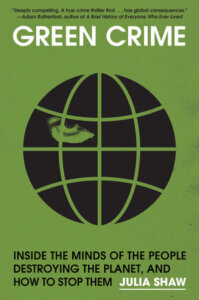
Born in Germany, raised in Canada, now living in the UK, Julia Shaw is a criminal psychologist, a bestselling author (The Memory Illusion, Evil, and other titles), and something of a TED Talk star speaker. Green Crime weaves together themes that have shaped Shaw’s career and research—the malleability of memory, the ways that people justify depraved behavior, the wellsprings of criminality—in service to a lofty goal. As the book’s subtitle has it, she aims to psychologically profile the people destroying the planet and identify means of stopping them.
Far from a jeremiad or a grim recitation of eco-horrors, Green Crime is a bracingly unclassifiable work, comprising psychology, history (ancient and modern), true crime and memoir. Indeed, the opening line of the Introduction—“Never have I felt more hopeful about Earth’s future than after diving into some of the world’s worst environmental crimes”—telegraphs that Shaw will not only serve as writer, or guide, but as an actor in the narrative. Throughout, she relays experiences from her own life that bear on the phenomenon of “green crime”—a phrase, she notes, “that is synonymous with environmental crime, and . . . is used by researchers in the social sciences.”
In the intro, Shaw writes, “we can, and should, debate whether individual acts should be punished by law. But this book focuses on laws that are already in place, and cases brought before the courts where people have been convicted.” That said, Shaw is convinced that we can and must do better. “There has been good environmental protection legislation in places like the European Union, the UK and the US for decades,” she acknowledges. “But under-enforcement of these laws has led to a sense of impunity among the perpetrators of green crime.”
Each of the six cases that Shaw highlights is given its own punchy, and apt, chapter title: “The Murderers” (on the targeted killings of activists in the Amazon), “The Con Men” (examining Volkswagen’s gobsmackingly venal “Dieselgate” emissions fraud that came to light in 2015), “The Traffickers” (unveiling a poaching syndicate with tentacles reaching from China to South Africa), and so on. Along with deep dives into each case, Shaw adroitly weaves larger philosophical and ethical questions into her analysis of particular crimes.
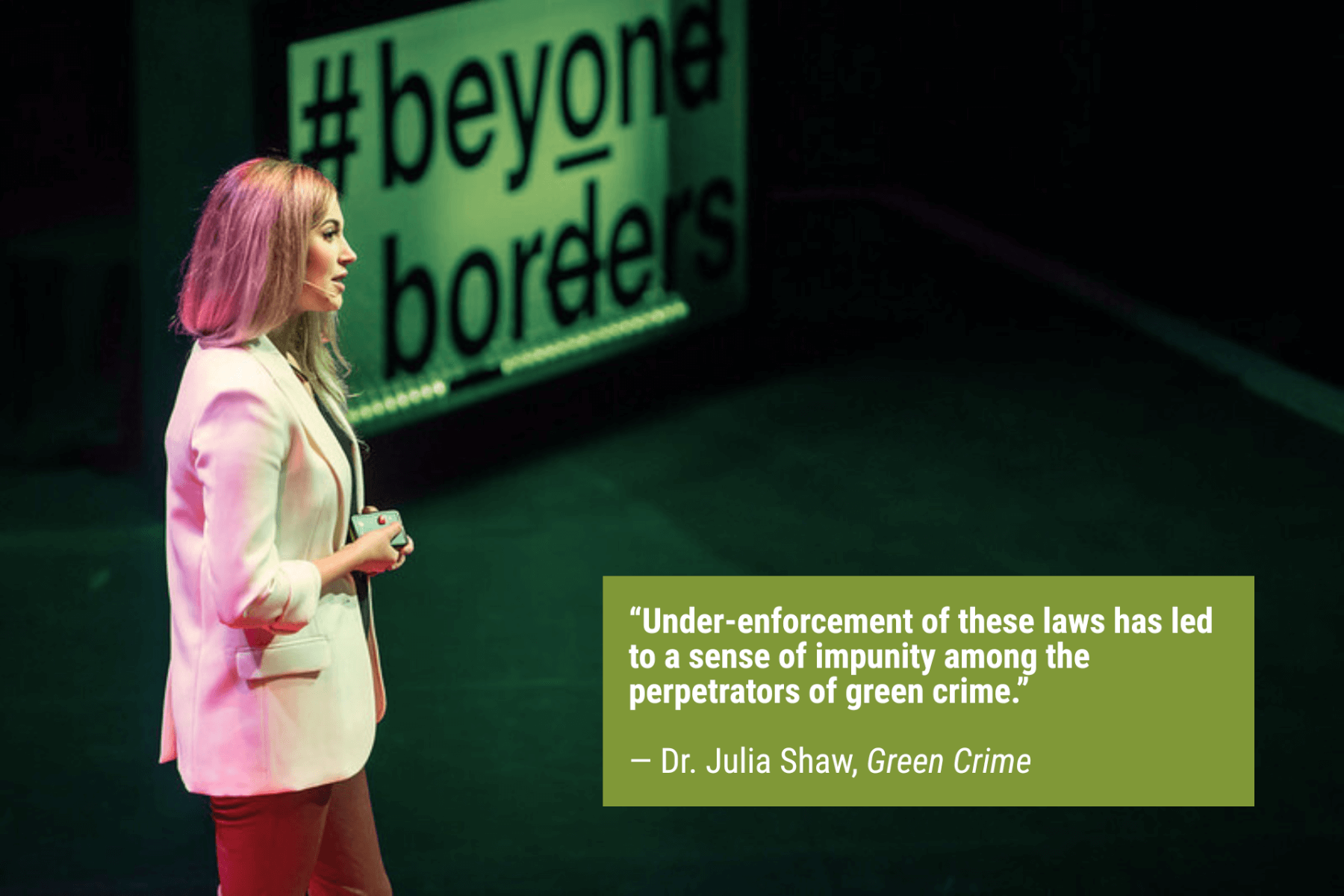
Shaw at TEDxLondon during her “A memory scientist’s solution to workplace harassment” discussion. Courtesy of JASON WEN
For instance, in the chapter on Dieselgate—a corporate fraud case, one of the largest in history, that resulted in billions of dollars in fines and jail time for at least some of the principals—Shaw looks at how phenomena like “epistemic malevolence” (when organizations harm people and communities by lying) play out in real-world scandals. Her career in criminal psychology helps put the crimes in context. But where possible, Shaw speaks directly with people involved: for example, much of the Dieselgate chapter is, in effect, narrated by Alberto Ayala, an American air-quality regulator who played a central role—arguably the central role—in drawing back the curtain on Volkswagen’s years of criminality.
Anchoring each chapter in the book is, in Shaw’s words, “a pattern of psychological factors driving green crime” that she calls the “six pillars”: ease (when destruction is seen as more convenient than sustainability), impunity (the belief that one will get away with crime), greed (of course), rationalization (stories we tell ourselves and others that make our actions seem less harmful than they really are), conformity (peer pressure, in all its nefarious forms) and desperation (people in almost any economic circumstance, from extreme poverty to relative comfort, can feel trapped in a situation where criminality seems the only way out).
The ways that these pillars apply to specific crimes vary, and Shaw’s ability to tailor her rather broad construct, the “pattern of factors,” to instances ranging from ivory poaching to illegal mining to outlaw Antarctic fishing is more than a little impressive. But perhaps most striking about the pillars is how commonsensical they are. Of course impunity, greed and desperation play a role in crimes big and small (we tell ourselves, with 20/20 hindsight).
Something else is going on in this book, though, that is worth mentioning — something that Shaw does not dwell on but, once experienced, once felt by the reader, is impossible to shake. Namely, the unsettling, necessary reminder that green crime is not just a legal concept, or a pithy name for a global scourge, but a tangible threat to individual lives, to communities, to Life with a capital L.
Green crime is assaultive. Invasive. Violent. (Criminologists refer to a lot of green crime as “slow violence” because, Shaw notes, “the harm unfolds over years, sometimes even decades.”)
One line in the book that captures this condition comes, again, in the chapter on Dieselgate. In the dramatic fall of an automotive darling—VW, after all, greenwashed itself for decades as an eco-friendly purveyor of quirky rides for quirky people—Shaw sees an “infuriating scandal that reached right into people’s own driveways, and even their own lungs.” [Emphasis mine.]
Images like that underscore the point that green crimes—trafficking endangered species, or engaging in the sort of lethal, unforgivable negligence that defined the Deepwater Horizon catastrophe—are not abstract regulatory violations. They harm. They disfigure, and even kill. They don’t just impact pocketbooks; they impact our bodies and the bodies of our fellow creatures, often for reasons that are, to rational minds, wholly obscene.
Consider that in parts of Asia rhino horn is believed to possess “detoxifying” properties and is used as a treatment for rheumatism, convulsions and other ailments. Pangolin scales, meanwhile, purportedly improve circulation, alleviate menstrual pain and heal abscesses. All this, and more, even as Shaw reminds us that “scientifically speaking, consuming rhino horn or pangolin scales is about the same as eating your own fingernails.”
To her credit, Shaw spends a good amount of time examining the well-established nexus between green crime and poverty, especially in the global South, and draws a distinction between well-off criminals exploiting nature to grow their already significant fortunes and desperate families who don’t enjoy the luxury of passing up what amounts to a month’s pay, or more, for a few hours of grisly work in the bush.
Shaw’s unflinching description of what goes into the poaching of elephant ivory—the disabling of the great creature with a burst from an assault rifle; the removal of its face with a chainsaw; the brutal extraction of its tusks; the tossing away, like garbage, of “carelessly cut” flesh—is gruesome. That she herself exhibits, and elicits from the reader, empathy for the desperate, undereducated young men who so often engage in the cold savagery of poaching is at-once unexpected and oddly moving.
A sobering book, Green Crime is also, at heart, an optimistic one. In it we meet remarkable humans, including journalists, scientists, undercover agents, regulators (the first chapter is a veritable paean to the gutsy nerds who hold entire industries to account) and others who rage, often without recognition or recompense, against the dying of nature’s light.
One unforgettable figure among so many: Claudelice Santos, the sister of Amazon activist José Cláudio Ribeiro da Silva who, along with his wife, Maria do Espírito Santo, was murdered in May 2011. Two local men were tried and convicted for the killing. The wealthy landowner who hired them, Jose Rodrigues Moreira, was convicted in absentia in 2016, and sentenced to 60 years. He has been a fugitive ever since, and it’s tempting to imagine Claudelice’s justification for defending the rain forest pursuing Moreira, like an ancient curse, to his grave: “If I don’t do it, who will? If I do not resist, who will resist? Who would I wait for?”
In the end, we find that the words we encountered early on—Never have I felt more hopeful about Earth’s future—are, improbably, more credible than when we first came across them. In that sense, Green Crime is something few would expect from a book filled with tales of barbarity, unsung heroes and all-too-infrequent justice: a gift we didn’t know we needed.
Help us sustain independent journalism...
Our team is working hard every day to bring you compelling, carefully-crafted pieces that shed light on the pressing issues of our time. We rely on caring supporters like you to help us sustain our mission. Your support ensures that we can continue to provide deeply-reported, independent, ad-free journalism without fear, favor or pandering. Support us today and make a lasting investment in the future.

RELATED STORIES

Award Winning



Today’s environmental and social justice challenges are unprecedented, and require an unprecedented collective effort.


Stay updated on our latest features, events and more. Subscribe to our Note From the Nest newsletter!
