
Capturing the Third-Culture Zeitgeist

“Every person’s story matters.”
Ruth Chan sits across from me in a royal blue linen blouse with large, white, half-cylinder-shaped polka dots. A few letter bracelets line her right wrist and a single-line tattoo that connects with a small dot right at the center of her forearm briefly flashes on the camera screen as she holds her hands up to emphasize her point. “Everyone wants to be understood and listened to.”
Chan, a budding star in the comic and graphic novel world, mostly rose to fame online with the comics she publishes on Instagram under the account @ohtruth that depict the experiences of the Asian American and Pacific Islander (AAPI) community. “My parents are of Chinese descent, mostly from Hong Kong,” she says, sipping from a coffee mug with little houses of orange, blue and red painted on it. “They immigrated to Canada for university and then stayed there.” The family resided in Canada until her parents decided to move back to Hong Kong when Chan was 13 years old. After graduating high school in Beijing, Chan headed back west to attend Wellesley College, in Wellesley, Mass.
Every person’s story matters. Everyone wants to be understood and listened to.
Walking into her first college art course, Chan was immediately pulled toward drawing. After idling between different fields of study — which she referred to as doing the “college thing” — she had the epiphany that she could focus her studies on what she was most passionate about: art. Her parents, though, did not greet the idea with the same enthusiasm, expressing their concern about chasing the non-viable professional field. They ended up in a compromise; Chan decided to double-major. “I ended up in developmental psychology, which I really loved, and studio art with photography,” she says.
This cross between cognitive study and art has remained consistent through the rest of Chan’s education and into her professional career. She attended the Arts in Education program at Harvard Education School, where she learned how to make the arts accessible and inclusive, even to students and individuals who do not feel artistically inclined.
From there, Chan taught art for pre-kindergarten and elementary school kids in Boston’s Chinatown and then in Washington, D.C. until she realized that teaching art was not exactly what she wanted to do in the long term. Chan knew that there was still something else in life waiting for her, so she began working in nonprofit management for community-based nonprofits in underserved communities. She organized youth and family programs in the Washington, D.C., and New York City areas for five years.
“I was in New York and I found myself without a job and without a home,” she says, recounting her thought process during this existential moment sparked by her career shift. “What do I actually want to do with my life? I loved nonprofit management and I loved working with families in underserved communities, but I’m really burnt out. There’s something else that’s still calling me.”
This calling pushed Chan to reflect on her love for studio art and drawing. She decided to research how to create children’s picture books. “To me, a picture book is this perfect object,” she says. “It’s something you can hold in your hand. It has beautiful storytelling, amazing writing, incredible art. It’s got wit and humor, but also a lot of heart and a lot of truth.”
Her search for something else paid off. Chan has now illustrated nine children’s picture books, including Thank You Neighbor, The Alpactory: Ready, Pack, Go, Where’s the Party? and Georgie’s Best Bad Day. Chan’s success in children’s picture books has now pushed her to create more than just illustrations, but also comics. She says, “I got really into graphic memoirs. It is such a cool format for me for storytelling.” That fresh form of storytelling that has pushed her to create her own graphic novel.
Chan’s father was born during the Sino-Japanese war while his family was fleeing from Japanese soldiers. With Chan’s grandmother pregnant, they fled into the mountains, where he was then born in a barn.

Chan illustrates her father’s story in her upcoming novel, “Uprooted.” Illustration by Ruth Chan

Chan illustrates her father’s story in her upcoming novel, “Uprooted.” Illustration by Ruth Chan

Chan illustrates her father’s story in her upcoming novel, “Uprooted.” Illustration by Ruth Chan
This story of her father’s survival resonated with Chan. The more she worked to tell his story, the more she found her own thoughts and emotions merging into the storytelling. “The story was told so many times growing up that it’s become this family myth. There’s this legacy and spirituality around it. I wanted to make that a real thing, rather than have it be told orally through the generations.” She pauses. “I thought, I want to make a graphic novel, it makes sense to include myself in it, not just about my father.”
She realized that her father’s story was relatable, because her personal story held its same themes. “It became really clear when I moved from Toronto to Hong Kong. The idea of being completely uprooted in your life and being thrown into another life was similar to my dad’s story,” she says. “I thought it would be so cool to make a graphic novel that is about being uprooted and culture and family history and see how those two stories come together — how they diverge and how they converge.”
I hope to smash those stereotypes and biases to give one more reference point to an Asian story that is not the same thing that we’re always reading about.
Chan draws from her experience as a third-culture kid by sharing her difficulty of being too Canadian in China, but also too Chinese in Canada. “It’s like a reverse immigration story,” Chan says. The term “reverse immigration” is often used to describe the migration from urban areas back to rural areas. In Chan’s case, however, it was moving back to her parents’ home country from the country her parents immigrated to before she was born. Chan’s goal within this upcoming graphic novel, titled Uprooted, is to tackle those dichotic feelings that are at the heart of the third-culture kid experience, finding courage and strength in their own stories from the struggles they go through. Uprooted will be published by a Roaring Brook Press and released in Winter 2024.

Experiences from Boston. Illustrated by Ruth Chan

Experiences from Boston. Illustrated by Ruth Chan

Experiences from Boston. Illustrated by Ruth Chan
As Chan embarks on her journey of writing and illustrating Uprooted, she hopes the novel will demonstrate three things for third-culture kids to attach to: “One, I hope they don’t feel so alone. The second thing, I hope this book inspires others to share their own stories. There is some value in them to connect to it. Third, I want to show an Asian story as a complex character. There are so many ethnic groups within AAPI, [so I hope to] smash those stereotypes and biases to give one more reference point to an Asian story that is not the same thing that we’re always reading about.”
When the Stop Asian Hate movement gained momentum earlier this year as a reaction to the attacks on Asian American lives surfaced, Chan felt that the only way for her to cope with the horrifying events was to create comics on how she felt. At that moment, Chan had no idea what a huge impact her drawings would make online. She says, “It’s really nuts. Before all of it, I had like 2,000 followers. When all the AAPI stuff came up, the only way I could process things was through comics and they really took off. People really related to it.”
Asian cultures often emphasize the importance of family. “In East Asian cultures, we’re taught to not rock the boat. You’re not the most important thing; the group is the most important thing,” she says. While Chan holds these beliefs of her East Asian background, she also has also begun to recognize how the stories of the individuals are just as valuable. “I never thought that much about being proud to be an Asian American-Canadian. Yeah, I know I’m Chinese, have Chinese roots and lived in China, but I never felt like a huge sense of pride in ‘This is who I am.’”
Through creating her comics and illustrating her own experiences onto a physical page, Chan realized that sense of pride she had been missing. As her audience began to grow, she saw that power began to aid others in reaching that realization about themselves, too. “I feel like it wasn’t me preaching something I knew,” she says, “but as I was growing and processing things, so were other people alongside me.”
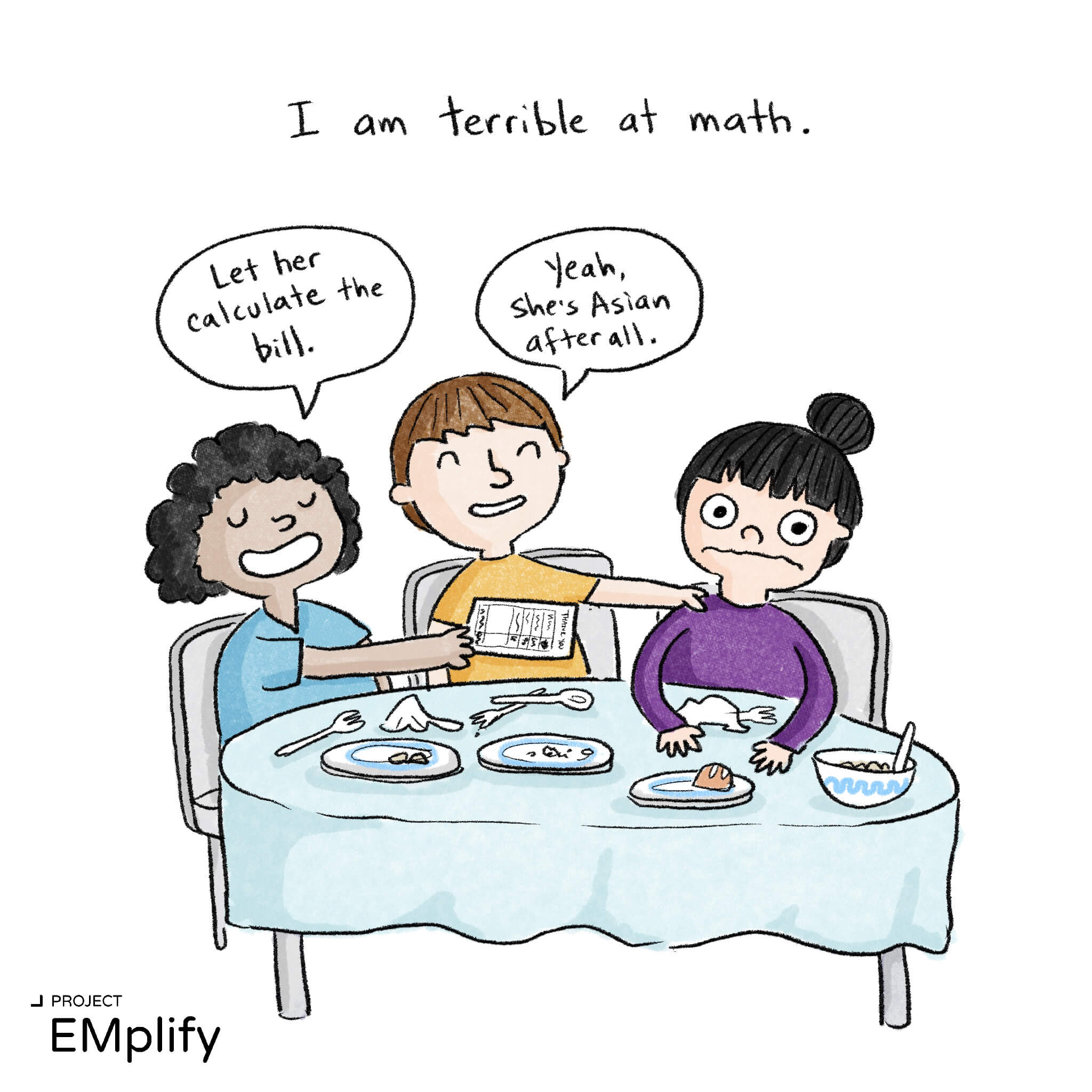
Chan demonstrates the effects of stereotypes in collaboration with Project EMplify. Illustrations by Ruth Chan
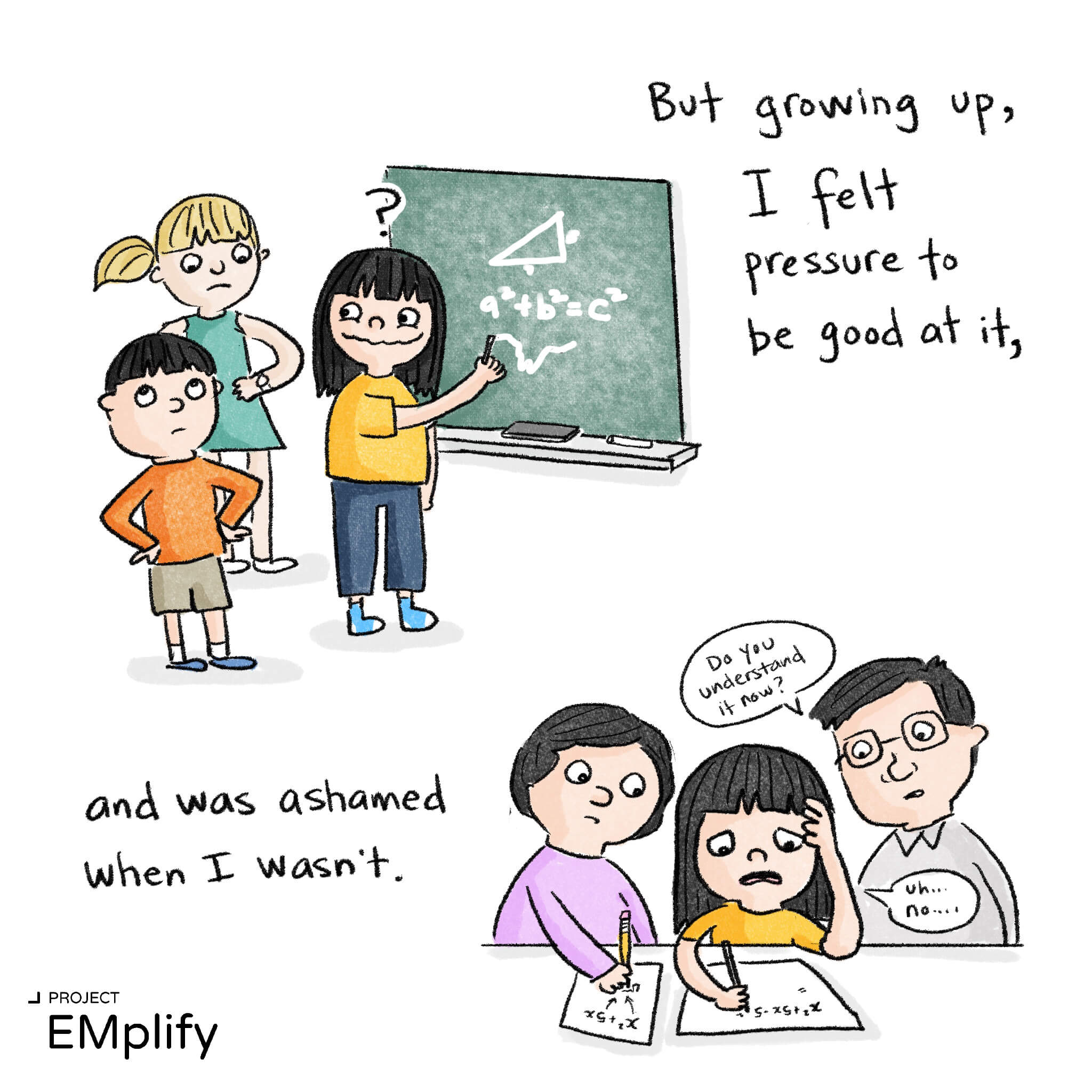
Chan demonstrates the effects of stereotypes in collaboration with Project EMplify. Illustrations by Ruth Chan

Chan demonstrates the effects of stereotypes in collaboration with Project EMplify. Illustrations by Ruth Chan
When I asked her about how she plans to incorporate AAPI heritage and themes within her illustrations and comics, she surprised me with a response I had never considered. “You know, the scary thing was I didn’t even realize that I needed [AAPI representation]. All the characters [you see out there] were white, and you want to be like a white character. I didn’t know that I need that [validation].” Chan continues, “I do feel like that now I have become more proud of who I am and where I come from, that [AAPI heritage and themes] naturally is going to be filtered into what I do.”
Chan recently finished Thank You, Neighbor, a story that aims to capture the camaraderie and community created in her Brooklyn neighborhood during the pandemic. “The character is a young Asian girl and that is something I very intentionally wanted to do,” she says of her body of work. “I feel like, especially in picture books, if it’s an Asian character, we have to talk about their Asian holidays or the food that they eat. It drives me insane! Why can’t there be an Asian American character just having a normal American day?”
Her point resonates. How is the AAPI community supposed to share their stories when they are constantly pushed into specific stereotypes? Giving the AAPI community a chance to share their stories and the validation that their stories matter is what Chan has given through her illustrations and comics.
“You don’t think your life is that interesting, but everybody has a very valuable story to tell, especially when it feeds into that larger narrative of what is the AAPI community. There are so many things within that.”
Help us sustain independent journalism...
Our team is working hard every day to bring you compelling, carefully-crafted pieces that shed light on the pressing issues of our time. We rely on caring supporters like you to help us sustain our mission. Your support ensures that we can continue to provide deeply-reported, independent, ad-free journalism without fear, favor or pandering. Support us today and make a lasting investment in the future.

RELATED STORIES



Award Winning



Today’s environmental and social justice challenges are unprecedented, and require an unprecedented collective effort.


Stay updated on our latest features, events and more. Subscribe to our Note From the Nest newsletter!
