The Wild Delight of Wild Things
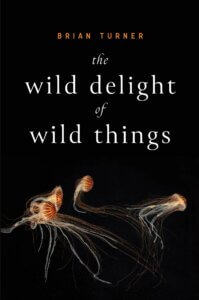
I recently sat down with Brian Turner to talk about his poetry collection, The Wild Delight of Wild Things, a moving meditation on grief and ecology. The book begins with a poem by his late wife, Ilyse Kusnetz, whose image of birds embodying “the wild delight of wild things” gives the collection its heart.
Turner is a U.S. Army veteran who served in Bosnia and Iraq. His first book of poems, Here, Bullet, drew on that experience and established him as one of the most powerful voices of his generation. He has since published Phantom Noise, the memoir My Life as a Foreign Country, among other books, and now The Wild Delight of Wild Things, a very different book—one that moves between lineated poetry and prose poems, weaving neuroscience, marine biology, astronomy, and grief into a love letter to being.
The book is, as Turner acknowledges, “a bit of a beast”—not because of its length, but because of its ambition. It hopscotches categories, between nonfiction and poetry, between scientific and lyrical. At its core is the loss of Kusnetz, who died of cancer, and Turner’s struggle to find meaning in a world that seemed indifferent to the passing of “a great soul.”
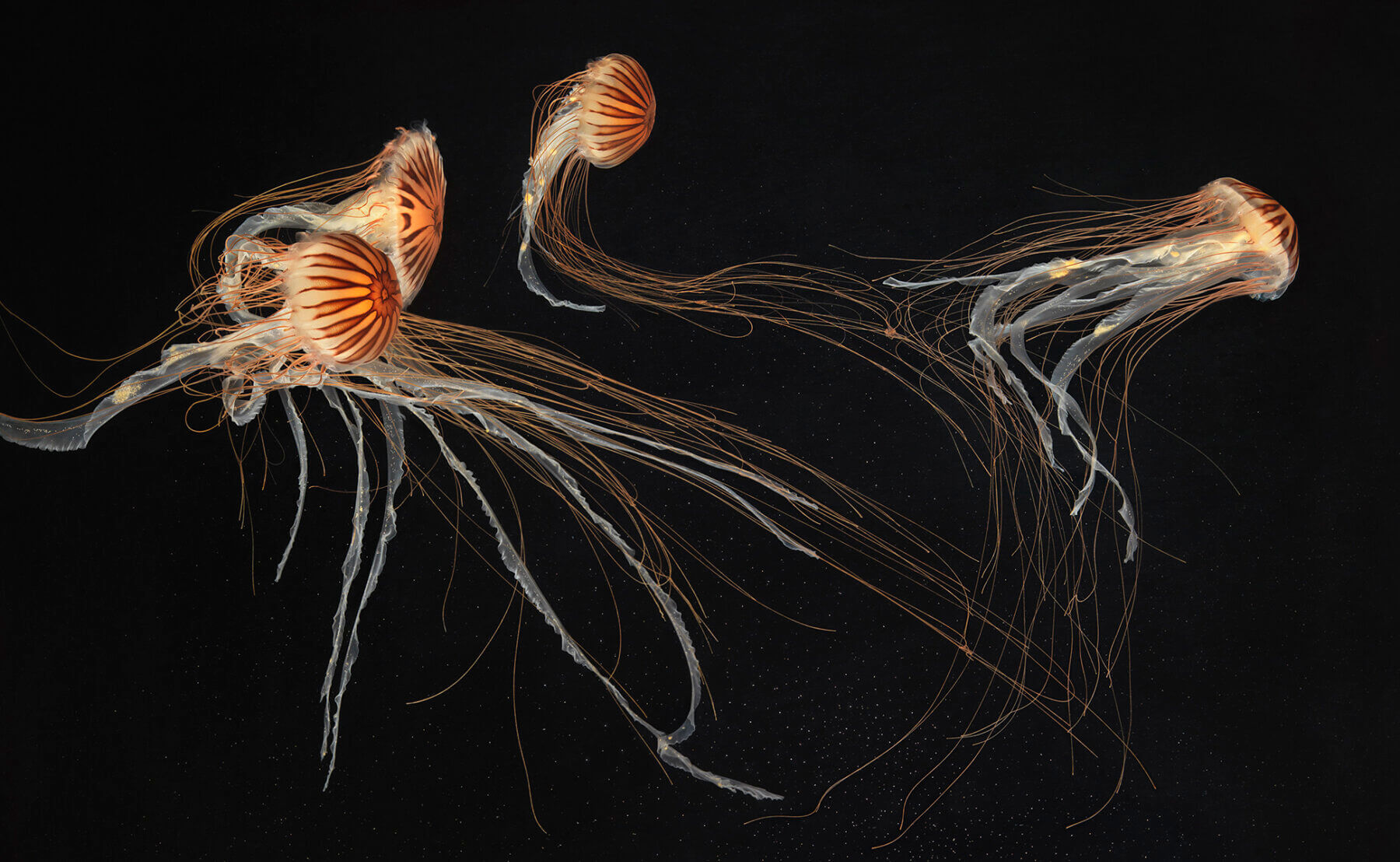
The book uses the mechanisms of nature—whale falls, immortal jellyfish, quantum entanglement, brainwaves like ocean waves—to understand the inner works of love and loss. By the end, Turner comes to a numinous revelation that falling in love with the world is how to continue loving one who has passed.
Framed by bookshelves in his Orlando home, Turner spoke with me about posthumanism and panpsychism, the militarization of American police forces, the relationship between scientific and poetic language, and how curiosity saved his life. The following conversation has been edited for concision and clarity.
***
You start the book with “Geologic,” a poem by your wife, Ilyse Kusnetz, which ends with an image that gives you the title for the book—birds feeding, “glittering with seeds, / the tickle and nudge / of their beaks, a perfect engulfment— / the wild delight of wild things, my love, / I hope we’ll have that again.”
The poem imagines humanity in geologic time, which ties into a broader literary tradition from Shelley to Sara Teasdale to William Carlos Williams that asks us to imagine a posthuman world, a world after the death of Ramses II, a world after World War I, a world after the dropping of the atom bomb. It is like Charlton Heston at the end of The Planet of the Apes finding the Statue of Liberty buried in the sand and howling, “You did it! You bastards! You blew it all up, damn you, goddamn you all to hell!”
The question seems to be: Will anything of us survive beyond that uncertain glimmer? Does it matter if anything of us survives, if the Statue of Liberty goes back to being stone, the wrench to being iron ore, the table to being a tree?
I’m not really sure if it does, in my little life. I certainly couldn’t answer that on some grand scale for others, and I can’t answer that for Ilyse either. But she was really connected to the idea of quantum entanglement—that at a quantum level we remain connected, no matter how vast the distance between us.
If you think about the way atoms work in our bodies, how we are dispersed afterwards, crushed by geologic pressures—but at the atomic level, it’s still mostly space, even right now. The miracle is how these atoms hold me together so that I can continue to be me for this short lifetime. I have no clue how that even works. But I’m fascinated by it.
I remember I once went out onto the battlefield at Gettysburg with a photographer friend. She liked to go during the golden hour, at sunset and sunrise, because she felt the presence of the dead then, marooned in time. The spirits of the dead soldiers. I remember thinking about that when I was a soldier in Iraq, and whether that’s how it all works. It’s something I thought about again, after Ilyse passed away, right here in our home.
You know, the Earth is spinning at a certain rate and we’re traveling about 1.6 million miles or so in orbit around the sun each day. But at the same time, the solar system itself is moving at another speed—if viewed from a different perspective. Even further out, the galaxy moves through space-time at around 29 million miles a day. So, if she crossed over back in 2016—are some of her atoms spinning out in the wake of the Earth’s passage through space, millions and millions of miles behind us? And if so, does quantum entanglement still keep us connected?
Of course, this is all math, physics, logistics. I’m not even talking about the spiritual. Or at least not overtly. These are the things that her poems lead me to think in scales that are micro and macro.
The thrust of my question was humanism versus the posthuman. Humanism says it matters if all the creatures on Earth and all of humanity dies. The posthuman says, “Get over yourself.”
I guess I’m somewhere in between those two possibilities. In some ways, I don’t see a difference between the human and the nonhuman. I think everything is alive.
So you have a kind of panpsychic approach like Spinoza: the idea that God is everywhere, or everything is spirit?
Exactly. If I am a sacred being, or holy, or even sentient, I don’t see how other lifeforms, and even minerals, aren’t also sacred, or holy, or even sentient—though their sentience may be something I cannot grasp or recognize.
I suppose I see the evolution of different forms on Earth, for example, as a natural progression. I can imagine the rise of humans as a kind of bridge organism for the Earth itself. I imagine the Earth wanting to hold on to memory, and while humans are a beautiful attempt at that, perhaps the age of the computer is simply the Earth’s process of realizing its own desire to remember its journey through time. In other words, collective consciousness might be a way for the Earth itself to perceive itself and to archive its memory. Does that make sense? Like, there’s a larger being that’s at play here.
Like contemporary ecotheory that asks us to think beyond the idea that the world is an object for us to use. We are the hand, it’s the hammer. But maybe we’re the tool and things are the hands.
Objects have intentions, too. They act on us and do work on us. There is always some part of them that’s invisible to us, that expands beyond our intentions. Everything has the same level of God, you might say. So is that where you are?
Yeah. That feels really comfortable for me, the way you’ve framed that. I can see that humans will have a finite period of time as a species, and then we’ll go under, and the universe will find other ways to explore itself.
In your poem “Cephalopods,” you write how the octopus puts its ink out as a kind of alphabet: “its siphon inscribing a cloudy trail / of ink in its wake, a message to its captors / that the word beauty exists within the octopus, too, / that here is the signature of personhood, if only / one were to make the effort to learn this / ancient alphabet, if only it might be read aloud.”
We tend to think that language and symbol use is what sets us aside from the animals. Francis Bacon argued there’s a language to nature—if we learn to read it, we can rewrite nature. Kepler saw astronomy as reading the mind of God. But you seem to be saying the octopus has its own alphabet as well.
How do you see the octopus writing itself on us? How does nature write us?
If you fast-forward time to when future humans look back on us, I think they’ll think of us as ignorant and not curious or inquisitive enough about the intelligence of other life forms on the planet. We’re swimming in a world of intelligent beings, but we don’t fully recognize that, coming from a human-centric point of view.
By being inquisitive and paying deeper attention, we might start to learn other ways of being. A lot of human history has treated animals like tools. Things to be used, or to be avoided. We give some creatures credit, the octopus, the dolphin: “Okay, yeah, you’re on the team.” And we’re starting to come around to trees—wait a minute, trees might be pretty smart. Maybe we could learn some things from the trees.
Why should we take intelligence as the measure of being? Descartes says God gave us intelligence and therefore a soul, but that animals are just wind-up toys, machines for us to use. Picking up on your point, and especially in this time of dark politics—the rise of oligarchies, the massacre of people in Ukraine and the Middle East, and what’s happened recently with ICE—are we treating each other like we treat the animals?
As someone who’s former military, what do you think about the militarization of police and the use of military forces to invade American cities?
There’s so much to unpack there! How many months do we have here to think through your good questions? . . . I will say that it saddens me to see so much pain in our country, and across the globe. We cannot hope to be kind on a global scale until we learn how to be kind to one another here.
And how does it feel, as a veteran, to see law enforcement officers suited up as if they’re in a combat zone? It’s an obscenity. It’s an obscenity that should be remembered for generations forward.
So, to a hammer everything looks like a nail. But you can use a hammer to pull out a nail, wedge open a door, or in a hammer toss in the Olympics. In bigger systems, though, the system determines the outcome—it’s less creative, not evolutionary, fixed. Your book seems to critique systems that aren’t flexible.
In “The End of the World,” you write: “I wanted the ruin. I’d be lying if I said otherwise. I wanted that hurricane to destroy what was left of my life.” You wanted this because you were “deep down fuming.” You’re talking about intricate systems: We make the atom bomb, pollute the environment, and it comes back on us. Ants create civilizations; we destroy them. We create structures; hurricanes and fires destroy them.
Are you talking about the posthuman or the apocalyptic as a way of understanding how we are subsumed in nature, or how nature’s systems are coming to an end with mass extinctions?
All of it starts in this particular book with Ilyse’s crossing over, her death. So part of that spark of the meditation begins with her dying young. And then looking outside, and all the systems and all the people seemed like they were paying no attention to that. A great soul had crossed over.
I was over at an emergency hospital dealing with vets there. And they were so much better at the process of dying than the human version of that was. It was remarkable how different the experience was.
Afterward, I remember the distinct feeling that the medical system had failed us. There was so little heart to it. It was all so cold and sterile, and it felt like half of it was simply guesswork.
All of this was put into stark relief by another experience that happened soon after Ilyse crossed over. We had two cats, and when one of the cats died, it was like a real echo of Ilyse’s death, but a completely different medical system: the vet and the vet hospital. I was over at an emergency hospital dealing with vets there. And they were so much better at the process of dying than the human version of that was. It was remarkable how different the experience was—and I’m sure that they don’t cross-talk very much. Human medical professionals should be required to study with vets, and to learn how vets deal with family members, and even with their dying patients.
Since readers won’t know Ilyse, could you say a few words about her?
How many years do we have to talk? She was a poet. She was born in New York, raised for a good part of her life out in New Mexico, in Albuquerque. And then she went to Syracuse and got an MA in Creative Writing, and then went to the University of Edinburgh, where she got her doctorate.
Afterwards, she thought—I remember the way she talked about it—she had an MA in creative writing, but she felt like she needed a lot more skills in the art form. So instead of going to get an MFA on top of it, she cobbled together her own over several years, thinking, “I want to learn this about the line. Sharon Olds does this—is she teaching any workshops? I want to go learn from her, from this person, that person.” So she cobbled together her own course of study that way.
She’s the author of two books of poetry, one that was posthumous, but she was writing it up until the end, knowing she was writing that book. She also had a chapbook before that. I’ve continued to try to get other work of hers out into the world in various ways, and I’ve got a couple more of those projects in the works.
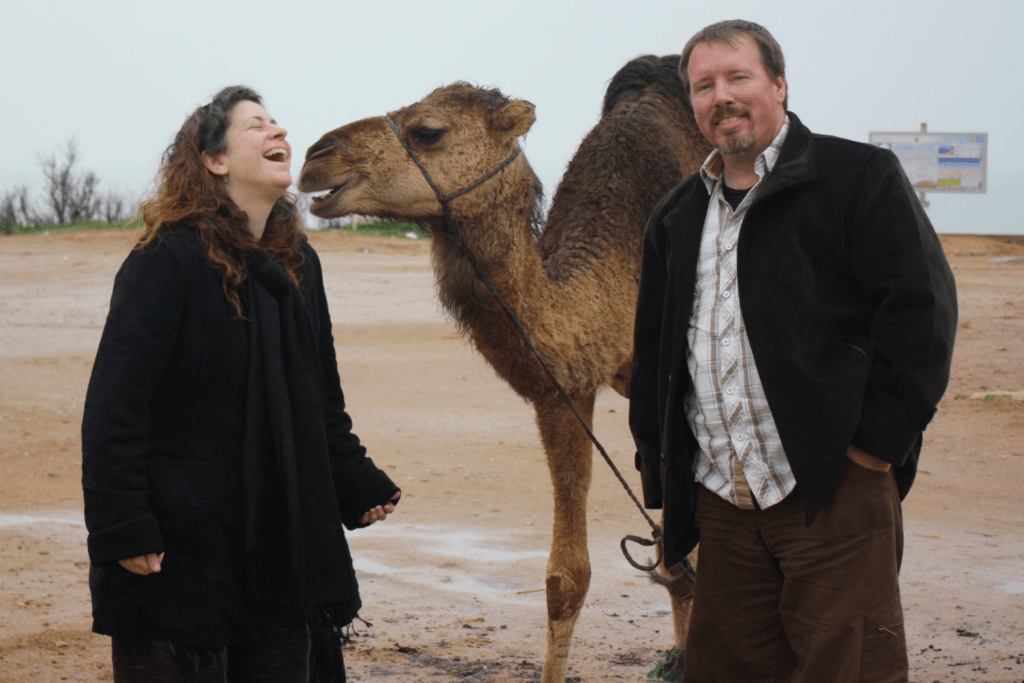
The author with his wife, poet Ilyse Kusnetz, who passed away in 2016. Photo courtesy of Brian Turner
This is really an extended love poem to her, isn’t it? You’re talking about the environment, humanity, the universe, but really you’re talking about your love.
Yeah. Before she studied English and focused on creative writing, she had hoped to be a biologist or something similar in that field. So it made sense to me to take from that initial poem that idea of “the wild delight of wild things,” as a doorway into a conversation that was very much hers. It was one that we shared, but it was one of her keen interests.
I might have to cry here. I want to say—we looked at you and Ilyse, your friends did, as people we loved who really deserved somebody in their lives. Somebody great. When you guys got together, it was Romeo and Juliet, Anthony and Cleopatra. You were a great love story to everybody who knew you. For all of us, it was a great tragedy. This book is very moving.
It was irrepressible. I was so fortunate to be in that kind of bond, a pair bond, and in that love. Even going to coffee shops—somebody once asked us, “When did you get married?” This was years into our marriage. They thought we were newlyweds because we were always kissing each other, holding hands.
You were always exuding joy. And it seems like her interests have become your interests—certainly her interest in science. You talk about wave theory, jellyfish, whales, blending the language of astronomy, neuroscience, marine biology with cycles of life, connection and disconnection. Some people think the science, instrumental reason, empirical method, is separate from the narrative, mystical, emotional mode of the arts.
How and why did you decide to integrate left-brain and right-brain, reason and imagination? What does it do for your poems?
I think of them all as landscapes of the imagination and the real. I’ve never been able to master or even have much of a grasp of mathematics. I love some of the concepts in physics, but I don’t know the language. And I really wish I did. If I had access to the language of physics, I know those formulas would be inside my poems.
It’s a wide-open space for poets to explore in their poems—one that isn’t used as often. Biology, math, the hard sciences—they’re not so foreign from what most of us are doing in contemporary poetry. I think all of them are taking human knowledge to the limit. We write a poem, and oftentimes we’re writing our way into some space we don’t fully understand. And it feels to me like that’s what scientists do, too. That’s their main mission—to move a little further into the unknown.
You have poems about angioplasty, plasma, oncology, Ilyse’s death. These have beauty but also sorrow, the inhuman aspect of our own decay, our incapacity to use science to conquer matter. But you also create extraordinary images of astronomy, marine biology, energy waves moving through matter. It seems like you’re seeing two things in science: a sorrowful uselessness (all the knowledge in the world can’t stop what’s going to happen) and a sense of connection and beauty, at least analogically, in the sciences.
It might be interesting to know how this book actually came to be, because I didn’t know I was writing this book.
If you rewind the tape, I was initially writing a novel about the wall with Mexico. I was thinking about [J. M.] Coetzee’s Waiting for the Barbarians. My favorite novelist is Ismail Kadare, the Albanian novelist. I’m such a fanboy I went to Albania to get a better sense of the landscapes that inspired his imagination. Ilyse handed me one of his books—and I fell in love and just kept reading. I asked myself: How would he write a novel about this wall? And I thought, Ah, the Americans would just keep building and building to an absurd height.
But the more I considered it, I realized I don’t know Mexico well enough, or the southern hemisphere, to write the full . . . Basically another writer could do it better. Which is a way of saying I was writing someone else’s book.
Like the governor in Waiting for the Barbarians. However much he wants to, he can’t really be the representative of the barbarians. It’s not his story . . .
In one section, I took from an NPR report about the Wind Phone (風の電話, Kaze no Denwa) in Ōsuchi, Japan, after the tsunami disaster. Somebody had taken a British telephone booth—those red booths—and put it in a field. The landscape had been erased, no homes left. It wasn’t plugged in, but people would come and talk to the dead.
I found that so powerful. I thought, I’ll put a phone booth like that in my novel. After I wrote the book, I realized the manuscript wasn’t really working. And I realized something common in my life as a writer: I get an idea I’m obsessed with, on fire with. It was a good idea to write about the wall. But it’s what I wanted to write, not what I needed to write. What I needed was that three-thousand-word section about what was happening inside that telephone booth.
And so I started over and wrote a completely different novel. Again, I focused on something I wanted to write and discovered a very short passage that I needed to write. This particular passage was based on nonfiction research. And so I used that to launch into a full-on creative nonfiction book focusing on nature and my life with Ilyse. Eventually, I realized that it didn’t fully work in a nonfiction mode—and so I had to shift the book somewhere between prose and poetry.
That’s where it is now. It doesn’t feel like a book of poetry exactly, and I’m still not satisfied with it formally. It’s kind of a beast. If it was one or the other, it might be easier for a reader. But that’s where it settled.
The form goes back and forth between prose poems and lineated poems. But even the lineated poems feel like essays in verse. You do deep dives into science in language usually forbidden in poetry. That’s the excitement: you find ways of making the scientific lyrical. You balance not just prose and poetry, but the prosaic and the poetic.
Yeah. Maybe people are expecting couplets or a form that feels comfortable, but I still feel like I’m learning inside this book. It’s breaking my normal patterns in a lot of places. Which was exciting as a writer.
This was published in 2023. If I was writing the book today, it would become a different book. Because I’m in a different space with my connection with Ilyse’s passing. It’s a growing relationship I have with her, and where am I now in my life in conversation with her. Just a little bit further back, I was more on fire with pain. Now I’m in a sunlit place.
Let me read you part of one of your poems and ask what you’d do differently now:
It may be a symptom of hypothermia, this slow dying I call my life,
but I find sweetness in the sight of lovers when the day blurs
and disappears around them. That electricity. Those blue sparks
firing in the cold air. The way they kiss and the universe pauses
to register the moment on the grand scale of time. I’m transported by it.
I’m reminded of you. Of the two of us.
And this is what I didn’t expect. That the world would help me to survive
after. That it would do so by revealing you within its myriad forms.
By feather and leaf and tangle of fur. Through water and air and fire and stone.
That I might find a way to continue falling in love with you, and that
I might do so by remembering how to fall in love with the world itself.
That’s my favorite moment in the book, actually. And it was a surprise to me. And maybe not therapeutic, but a very healthy process, in retrospect. It helped me, because I struggled with human beings at the time. But trying to learn from the world reawakened my curiosity and my ability to fall in love with the world. It was surprising to me to find my love for her inside my love for the world. It helped me survive.
The whole book moves toward that moment. There are poems about striving for rebirth, wanting those descents to turn into ascents, looking for immortality in jellyfish. In the middle, there’s the relentless destructiveness and suicidal self-cannibalism of humanity—you want the hurricane to destroy Florida, your pain is bad enough that you embrace the end of the world. But by the end, you’re embracing falling in love with the world again.
Thinking about this for a magazine about the environment: How do we live differently so we’re less self-cannibalizing, so we remember to fall in love with the world?
I think it’s through engaging our curiosity. That’s how it helped me to come back from grief. I still live with grief, but in a way where it doesn’t destroy me. I don’t cannibalize myself with it, and I don’t give up, and I don’t flatline in my life, or take my life.
I don’t want to sound cliché, “the writing saved my life,” but looking to the world around me and re-engaging my curiosity helped me fall in love with it. With global climate change and the climate disasters and trophic cascades and extinction events, I think the strongest medicine for us as a species is to help ourselves and each other continually fall in love with the place we’re in.
I’m reminded of the ant piece you were talking about earlier. That was directly influenced by my reading of The Lives of a Cell by Lewis Thomas back in the 1980s. In that book, there’s a beautiful essay about watching a single ant on a trail. You look at one ant, and it doesn’t seem to have a lot of intention behind it, necessarily. It seems to be driven by hunger. Or even aimless. But as you step back to observe a few more ants, you begin to sense the forming of an idea. Eventually, at the scale of the colony as a whole, you can see an entire organism at work.
How do we inspire each other at that individual ant level? Because individual action adds up. That’s how the mountains get moved.
***
Geologic
When I don’t have a body anymore. When
I’m ash and fragmented bone. I think about
the early people, trapped between one
geological era and another, unfathomable.
Their dust must yearn to rise but can’t.
So much pressure on their carbon, hydrogen,
trace elements we’ve lost, forgotten.
Will we all become diamonds? Will anything of us
beyond an uncertain glimmer survive?
Remember when we visited the animal refuge,
fed parakeets in the aviary from ice-cream sticks
glittering with seeds? The tickle and nudge
of their beaks, a perfect engulfment—
the wild delight of wild things, my love,
I hope we’ll have that again.
—Ilyse Kusnetz
The Immortals
Bell-shaped and translucent, jellyfish begin their ascent from the ocean floor.
They’ve completed a novel process in the animal kingdom: transdifferentiation.
It’s a reversal of the biological cycle as we know it—undoing the narrative arc
tracing birth to adulthood before the inevitable decline and death. The jellyfish
upend everything we know about death in flora and fauna. At the cellular level,
they grow younger when the time comes to die. They transform backwards
into a nascent version of themselves before starting the process over.
It doesn’t mean they are incapable of dying—it’s simply not in their nature.
They rise through the midnight-dark waters and into bands of sunlight
the way thought forms in the subconscious before burning in waves
across the neocortex of the human brain. And as they rise,
fathom by fathom, they become lighter. As each incarnation
returns, history unfolds and the world is made new. They rise
into the Age of Agriculture with its domestication of wild grain,
with the comprehension of seed to stem to fruit. They witness
the emergence of cities. Wheels and alphabets and metallurgy.
Buddha and Confucius, Jesus and Mohammed. The Age of Flight
and the Age of Information. The jellyfish descend to regenerate
and then rise through it all, limpid and curious, as astronauts
step upon the lunar surface and as armies kill each other
without cease. Humans turn their thoughts toward Mars
and beyond, as the jellyfish sink down into the ancient shadow
where they have always gone, as if death were a form of sleep,
a dream from which they are revived, one lifetime to another,
cycling through the stages of life as the elastic architecture
of their bodies is made strange and new all at once. Blooming.
Starfields glimmer in the wavetops above. Sunlight scatters at dawn
and dusk. The ocean is a silver film of moonlight stilling itself.
And through it all, the jellyfish. The immortals. They have come
to watch galaxies loosen their spiraling stars as photons
shimmer on the interstellar breeze. They are steeped in time.
They have learned to reinvent themselves in defiance
of the body’s undoing. They rise from their own deaths.
They rise from the bottom of the sea. Soft bells,
diaphanous and fine, the universe offers them wonder
and they gather in their multitudes to take it all in.
—Brian Turner
Brian Turner is the author of five collections of poetry, most recently The Wild Delight of Wild Things (2023), The Goodbye World Poem (2023), and The Dead Peasant’s Handbook (2023), all with Alice James Books. His other collections include Here, Bullet and Phantom Noise, and the memoir My Life as a Foreign Country. He served seven years in the U.S. Army, including one year as an infantry team leader in Iraq with the 3rd Stryker Brigade Combat Team, 2nd Infantry Division. Prior to that, he was deployed to Bosnia-Herzegovina in 1999-2000 with the 10th Mountain Division. A Guggenheim Fellow, he has received a USA Hillcrest Fellowship in Literature, the Amy Lowell Traveling Fellowship, the Poets’ Prize, and a Fellowship from the Lannan Foundation. He lives in Orlando.
Help us sustain independent journalism...
Our team is working hard every day to bring you compelling, carefully-crafted pieces that shed light on the pressing issues of our time. We rely on caring supporters like you to help us sustain our mission. Your support ensures that we can continue to provide deeply-reported, independent, ad-free journalism without fear, favor or pandering. Support us today and make a lasting investment in the future.
RELATED STORIES

Award Winning


Today’s environmental and social justice challenges are unprecedented, and require an unprecedented collective effort.


Stay updated on our latest features, events and more. Subscribe to our Note From the Nest newsletter!