
Where Coyotes Dare to Tread
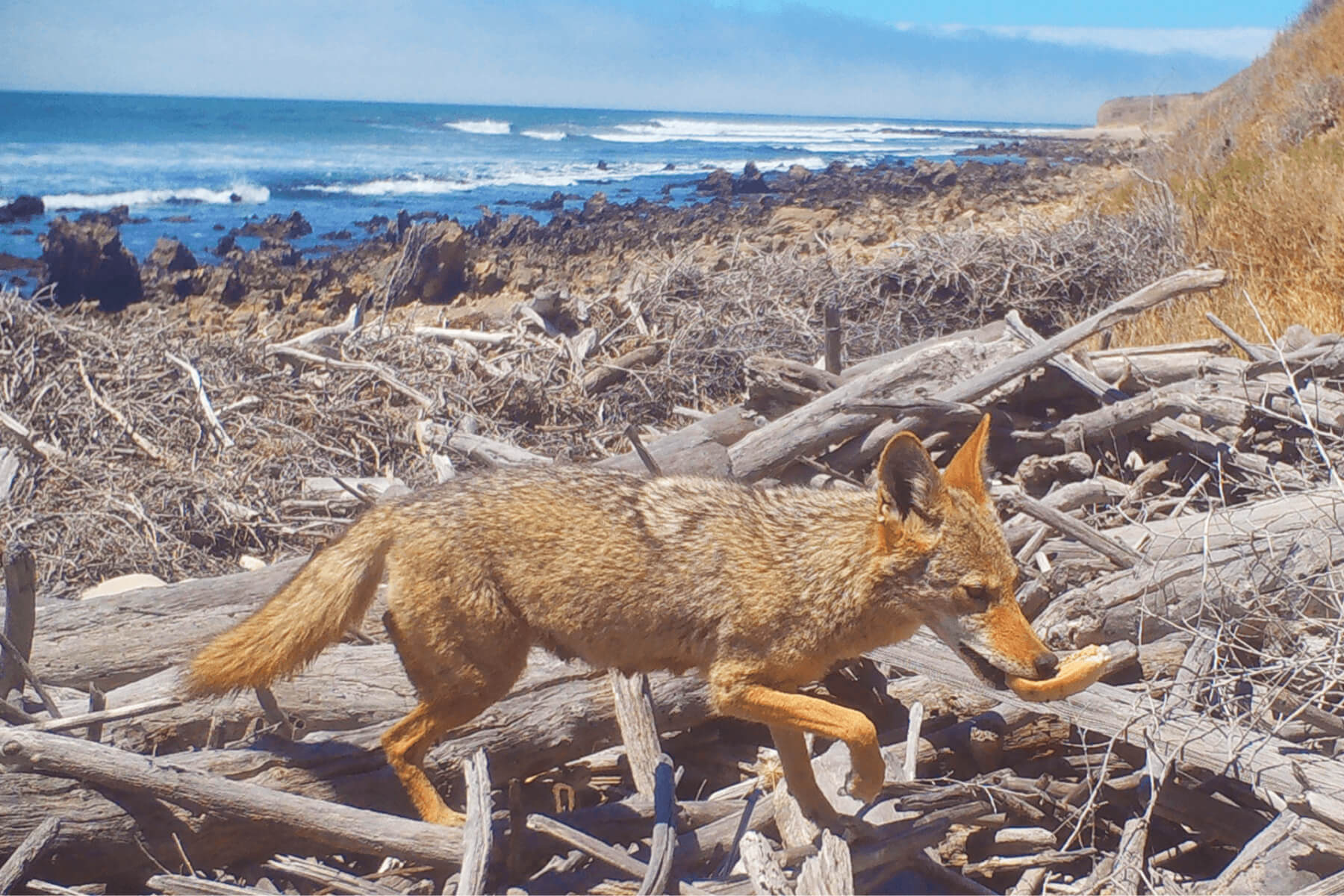
The wind battered the coast, hurling sand so violently that Zoë Zilz found it easier to hike backwards through the canyon. Zilz, a wildlife biologist researching Southern California’s rocky intertidal zone, had followed rumors of paw prints in the sand to a remote stretch of beach. She was anxious to see if her camera traps had captured whatever left them behind.
Zilz and her team had placed an array of cameras along the eight-odd miles of beach encompassed by The Nature Conservancy’s Jack and Laura Dangermond Preserve, a former cattle ranch and outdoor laboratory that has remained largely undeveloped for roughly a hundred years. The preserve’s terrain is truly wild. Truth be told, Zilz would be lucky if her cameras were even standing. Cows owned by the preserve use satellite field equipment as scratching posts. Cameras can get knocked down, blown away, or dragged out to sea.
Captivated by the coastal wolves of the Pacific Northwest, Zilz was attempting to determine if terrestrial mammals (like black bears and coyotes) were frequenting the California coast. She was hopeful the footage from her first retrieval trip would yield more than grass and waves. This was the winter of 2022, when Zilz was a PHD candidate at UC Santa Barbara’s Hillary Young Lab. Her research project was still just a shot in the dark.
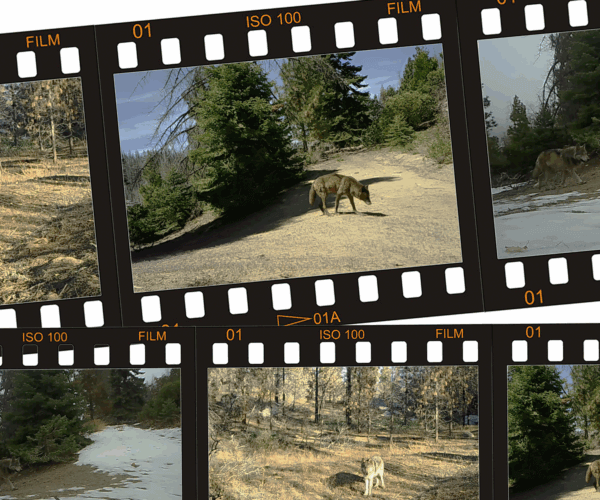
“People had just been telling us that they’d seen footprints on the beach,” Zilz recalled when we spoke, “so the first time I pulled my camera traps, and there were a whole bunch of pictures of coyotes on them, I was like: ‘Woah, this is actually going to work.’” Over time, the traps captured footage of coyotes dragging small fish, pelicans, and seal pup carcasses up the shore. In the case of the Dangermond Preserve and the adjacent Hollister Ranch, two coastal areas in north Santa Barbara County that have remained relatively undisturbed by humans, coyotes were using Southern California’s beaches.
The project began when Zilz’s then-advisor, Dr. Hillary Young, was approached by representatives from the nearby Hollister Ranch, who were curious how important their beaches were to terrestrial mammals. The ranch is just south of the preserve and, like Dangermond, is renowned for its pristine, wild coastline. Hollister Ranch (a private, gated community) has been keen to limit public access to its beaches, and evidence that coyotes forage there might help its case. After trials at Dangermond illuminated the importance of remote beaches to coyotes, the Young Lab set up camera traps at Hollister, confirming coyotes were foraging there, too.
When I spoke with Young, she detailed the significance of the findings. The California grizzly is long gone, and coyotes outnumber black bears and mountain lions. In theory, coyotes have become the state’s de facto apex predators. Their predation keeps small mammal populations from ballooning. But when the land dries up, and rats and mice are scarce, the wild coast of restricted-access areas like Hollister, Dangermond, and the nearby Vandenberg Space Force Base act as buffer zones that keep coyote populations vibrant. Young described the stretch between Santa Barbara and San Jose as “one of the world’s best wild coastlines.”
***
This past February, four years after Dr. Zoë Zilz pulled footage from her first camera traps, I rented a car and headed north from Santa Monica up the 101. I popped Phantom Planet’s “California” onto the rental’s Bluetooth speakers (like a dutiful millennial) and tried to picture the wild coast Young and so many others I’d spoken to had described.
Soon, I reached the unfinished Wallis Annenberg Wildlife Crossing, an animal-only overpass covering a broad stretch of the 101. The crossing is intended to reduce wildlife carnage over a 10-lane stretch of the highway. The overpass will likewise provide a way for inbreeding lions trapped in the Santa Monica Mountains to reach Santa Susana Mountain populations with whom they can mate, preserving genetic integrity. The structure signaled my departure from LA County, and as the hulking blue Mazda I’d rented passed beneath it, I pictured the parades of wildlife that would soon cross overhead. Like Zilz and Young’s coyotes, they too would need refuge from the state’s increasingly tumultuous seasons of drought and fire.
I was en route to the Dangermond Preserve, where Zilz first confirmed the marine foraging habits of the region’s coyotes. And though I’d hoped to visit Hollister Ranch, too, my efforts to schedule a sanctioned visit there proved futile. Unlike Dangermond, Hollister is notoriously cloistered and press shy, having faced decades of scrutiny due to its limited public access. While Dangermond is a research-focused, private conservation effort, Hollister is a gated residential community and active cattle ranch.
The crux of the access problem is this: California law requires every part of the coast from the mean high tideline to 1,000 yards inland to be openly accessible to the public. Generally speaking, that’s everything within half a mile of a beach’s wet sand. While in-the-know surfers insist Hollister’s shoreline can be accessed via boat trips or arduous hikes from its closest state parks, visitors would have to cross through private residences beyond Hollister’s gates to reach those same beaches from the mainland. The coast Hollister encompasses is likewise ancestral Chumash land. The issue of access has been an ongoing saga, pitting interpretations of public and cultural rights against private stewardship of prized lands.
Supporters of the Hollister Ranch Coastal Access Program (HRCAP) contend that the coastline is public land, and that restricting entry amounts to privatization of a public good and discrimination against those who can’t afford to live there. There has been mounting legal pressure to create more substantial public access to the ranch. In 2019, California Governor Gavin Newsom signed Assembly Bill 1680, which qualified as illegal any actions that “impede, delay, or otherwise obstruct” access to Hollister’s coastline. Part of the goal was to develop substantial public access by April 2021. That time has passed, and no such access exists yet. Hollister Ranch homeowners mostly argue that extremely limited public access is what allows the land to remain pristine.
Coyotes in the wilderness aren’t as fearless as their urban counterparts. Increased foot traffic could scare the animals away, damage the tide pools where they feed, and shrink their territory.
As I passed the final exits for the city of Santa Barbara, and continued toward Dangermond, I thought of the handful of locals I’d spoken to about Hollister. While public outrage over limited access is well-documented, others championed the ranch’s restrictions. Dr. Hillary Young is among them. When we spoke, Young was wary that the still-in-development Hollister Ranch Coastal Access Program might adversely affect coastal coyotes.
“The scale of that particular program is really unclear,” she explained, “but it’s potentially busing in people to this area [which has historically] been quite private.” Young wasn’t dismissive or callous about the cultural and social significance of public access. “[The program] has really good intentions,” she explained, “we’re all for trying to create more equitable access to beaches.”
And though the HRCAP aims to minimize impacts to “natural and cultural resources,” according to its 2021 draft, it also hopes to create a version of Hollister wherein “beach relaxation and walking, ocean play, surfing, coastal hiking or biking” and more activities are permissible. It likewise outlines potential “shuttle-based access, drive-in access, trail based access, and bicycle-based access.”
Coyotes in the wilderness aren’t as fearless as their urban counterparts. Increased foot traffic could scare the animals away, damage the tide pools where they feed, and shrink their territory. Young suggested the fallout could trigger boom-bust cycles between California coyotes and their prey (like with lynx and snowshoe hares in the Arctic), creating unintended ripple effects that harm the landscape. If terrestrial prey populations become inaccessible or dwindle during dry seasons, California predators can turn to marine resources, preventing swings in either population.
When I neared the preserve, cell-phone service cut out, and my GPS failed me. The road grew narrow. The grazing cows on the surrounding hills took no notice of my rental car, or my sweaty palms on its steering wheel. I pulled into a stranger’s driveway, just off Jamala Road, where I was greeted by a moderately friendly man, and an excitable, spotted dog. “Boscoe! Boscoe, come here!” the man called out to the dog as it leapt toward my window. “Hi there,” I said, “sorry to bother you. I’m looking for the Dangermond Preserve? I’m a writer. I’m here to meet a scientist.”
The man thumbed his mustache. “Oh. You want Jamala HQ. About 12 miles down the road, that’ll take you to Jamala State Beach,” he said, “about 2 miles before that… that’s the headquarters. It’s a big white house up on a hill.” I thanked him and apologized again for interrupting his morning. “So, I can’t miss it,” I said. He cocked his head, “No,” he said, “you could.”
Zilz had long since completed her research at the preserve, so when I finally reached Jamala HQ, I met Dr. Erica Nielsen, one of The Nature Conservancy’s (TNC’s) research fellows. Nielsen had recently published a piece in Frontiers about the crucial role rockweed (a kind of brown algae) plays in supporting intertidal ecosystems. She’d agreed to take me on a short walk along the coastline. It was hot, bright, and sunny.
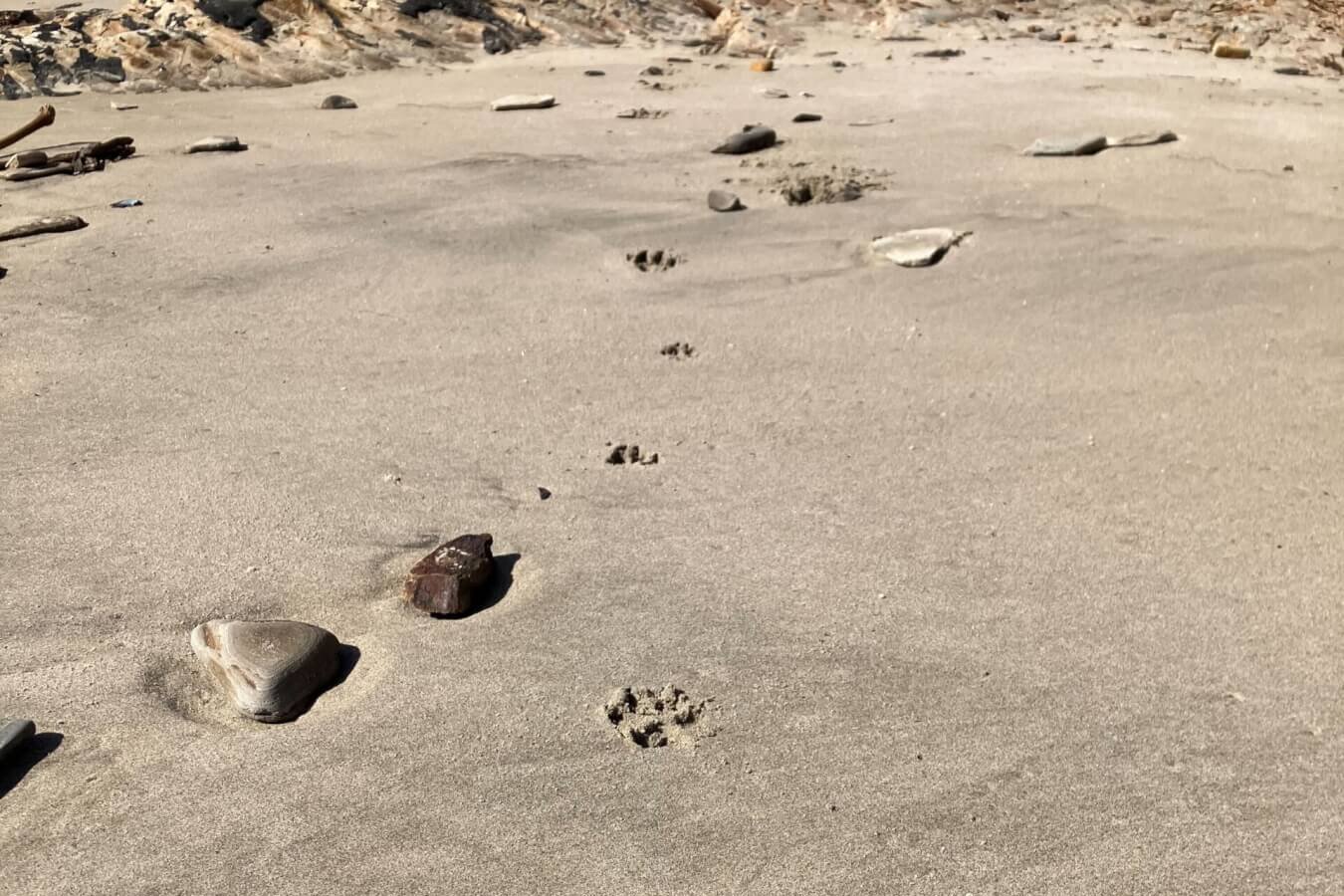
The push-pull of protecting natural spaces while allowing for uninhibited public access continues to define modern environmental policy. Photo by Nikolai Barkats
Zilz’s coyote research loomed heavy in my mind as Nielsen’s car curved along the preserve’s cliffside roads. Hollister Ranch loomed heavy too. Dangermond’s terrain mirrors Hollister’s. At one point on our drive, Nielsen pointed out a spread of rolling green hills that outlined the preserve’s boundaries and told me Hollister was “over that way.”
Nielsen was an attentive guide, well-spoken and deeply knowledgeable about the preserve, its history, and the wildlife that inhabited it. She spoke about her fascination with owl limpets; a kind of sea snail often found under the canopies of rockweed she was working to restore.
We passed over train tracks, which were rusted with sea salt. The car made a slight scraping sound as we eventually turned from paved to dirt road. I wondered if we should be worried about the noise, but Nielsen didn’t seem to be. Soon, we were among large herds of cattle, close enough to touch. The cows crowded the road. They were remnants of the preserve’s former life. Dangermond was once Bixby Ranch. But in the 2000s, a Boston-based hedge fund acquired it, hoping to develop luxury land plots. The California Coastal Commission halted development, which the hedge fund had started without the right permits. With the help of a donation from the Dangermond family, TNC was then able to acquire the land for $165 million in 2017 and transform it into the research-focused preserve it is today.
As we approached Perco’s Beach, Nielsen perked up. “Was that a coyote?” she said. “I saw a tail.” I looked around. The grass was lush and tall. A coyote tail would’ve blended right into it. But then, sure enough, the animal made itself visible. It had a familiar, wolf-like shape and was standing among the cattle, just up ahead. It was clear as day: tan and blonde fur coating its body, pointed ears and a bushy tail. Nielsen remarked that it was beautiful. Zilz had told me (anecdotally) that coastal coyotes tended to look healthier and more stunning than their urban counterparts. Nielsen moved her car forward slowly. The animal trotted along, picked up speed, and disappeared into the grass.
There were no clean-up crews or beach groomers here. This wasn’t a place for recreation. Anything that washed up stayed where it was. That meant everything from kelp to seabird carcasses, resources for predators to forage on.
It wasn’t the only time on our journey Nielsen spotted wildlife from afar. She was eagle-eyed, and her appreciation for and fascination with wildlife was palpable. She spotted and named several creatures throughout the morning, including an egret, a seal, an otter, a red-tailed hawk, and a roadrunner. The roadrunner I knew best was big and blue and could tunnel through vignettes painted on canyon rocks.
We walked the remainder of the way to the beach, hiking down a small incline. No wind howled, and no sand pelted my face, but the beach was covered in bleached bark and other debris. There were no clean-up crews or beach groomers here. This wasn’t a place for recreation. Anything that washed up stayed where it was. That meant everything from kelp to seabird carcasses, resources for predators to forage on. Nielsen guided me forward, across a wide stretch of wet sand. This was the rocky intertidal zone both Nielsen and Zilz had devoted so much of their time to studying. The path we walked wouldn’t be there soon. When the tide came in, it’d be completely under water.
Within minutes, Nielsen was pointing down at the ground. I looked around at the shoeprints my sneakers had made, unsure what I was looking for. But there, pressed into the sand, were a series of scattered paw prints. Some featured small pads, others featured pads and claws. The tracks were fresh. I snapped photos. Nielsen couldn’t identify them. Hard to say if they’d belonged to a coyote, black bear, or mountain lion. But there they were, the same prints that had kicked off Zilz’s research, and ultimately brought me here, too. But Nielsen, it seemed, was more excited to reach the rocks up ahead. She appreciated something about the space I couldn’t yet see.
It had been easy for me to develop a fascination with coastal predators. While urban coyotes get a bad rep for rooting through trashcans and snatching up pets, wild coyotes are majestic, appealing, and easy to anthropomorphize. They’re a prime example of charismatic megafauna: large, furry, or feathered wildlife species that people admire and rally behind, often used by conservationists to draw attention to larger ecological problems. But the smaller swaths of life in the intertidal zone were enchanting, too.
As she pressed us forward, Nielsen detailed what, to her, was the true appeal of intertidal organisms: their tenacity. “The amazing thing about rocky shore communities, in my mind,” she explained, “is that they live in this crazy dynamic ecosystem.”
Organisms that live on rocky shores have to be able to survive both underwater, and on dry land, depending on the time of day. When waves are strong, they face the threat of being dislodged from the rocks they call home. When the tide goes out, they can get dried out by the sun, blown away by the wind, or trampled on by humans and animals alike.
Like coastal predators, the rockweed Nielsen has been working to restore is imperiled by human activity. Even at Dangermond, climate change has threatened rockweed’s livelihood, driving water temperatures up, and increasing storm intensity. In other places, tide-poolers, hikers, and surfers threaten the algae’s livelihood further. If it were just about the algae itself, maybe those threats would be easier to dismiss. But Nielsen described rockweed as a kind of 3D habitat, a protective canopy that provided life and coverage for all the organisms within and beneath it, preventing things like owl limpets, and other algae species from getting washed away, trampled, or dried out.
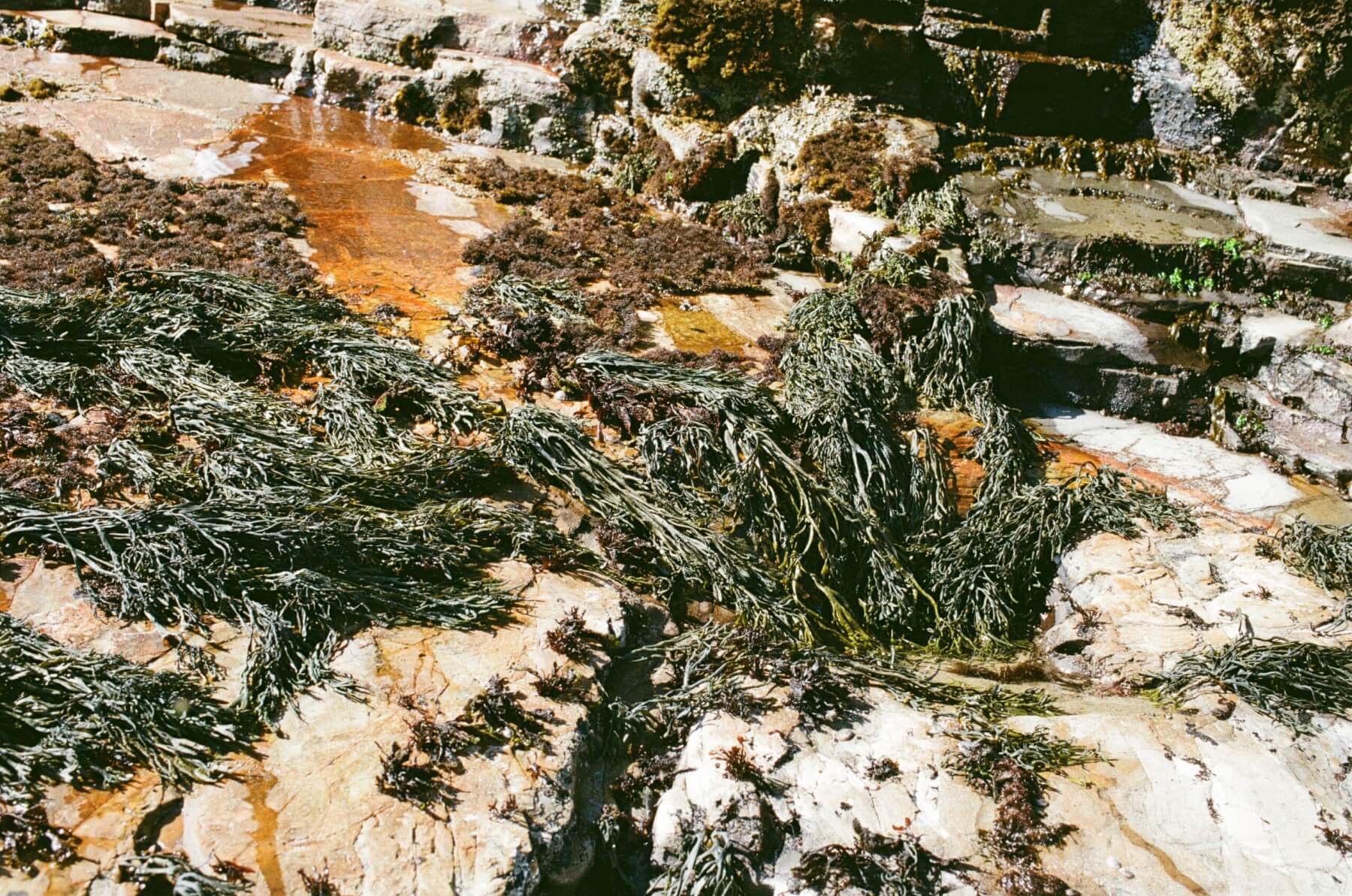
Rockweed like this is fundamental to upholding the ecosystems it finds itself in. Photo by Nikolai Barkats
We approached a set of what looked like overgrown moon rocks, craggy and porous. They were covered in rockweed, which Nielsen encouraged me to touch. It felt slick and stringy all at once. She pointed out a few owl limpets underneath the canopy. “So, take me through the worst case scenario, what happens if the rockweed goes away?” I asked, curious what made it so vital. “I think that we would have less, obviously biodiversity in our rocky shores,” Nielsen explained, “and there would probably be, I imagine a state change.” An ecosystem state change, Nielsen later explained, occurs when a foundation species is lost, triggering a cascade of changes that negatively impact an ecosystem’s stability.
If the rockweed perished, Nielsen theorized other algae might grow on the rocks, a kind less hospitable to other organisms. “So, I think for people that do come to the rocky intertidal for recreation, for science, for education, for enjoyment, [for] practices,” she explained, “it will not be the same. And potentially less vibrant.”
Nielsen and her team had gone through great efforts to determine how best to restore the organism: cultivating it both in the wild and in tanks in labs, using marine weld discs as artificial rocks. Alongside the restoration efforts she detailed, Nielsen suggested a handful of other approaches, such as increased education programs, guided tours, or the presence of docents in high-traffic coastal areas. Stationed volunteers could educate beachgoers about the right way to interact with the ecosystem.
I tried to picture a more accessible version of Hollister Ranch that employed these kinds of guardrails. After all, Nielsen insisted that the places most in need of restoration weren’t here at the preserve, but at state parks or other high-traffic beaches along the coast. It might sustain the rockweed, but it was hard to imagine how much these kinds of efforts would help in keeping coastal predators vibrant.
***
As the tide came in, Nielsen and I made our way back to Jamala HQ, eating packed lunches together before parting ways. With half a tank of gas left, I asked her if it’d be worth continuing north to the closest gas station to fuel up. She assured me I’d make it south at least as far as Santa Barbara on my half tank.
When I continued back down the 101, I once again passed grassy hills and stretches of ocean. I’d seen the kind of pristine, wild landscape I’d read and heard so much about, and now the question of who should have access to them followed me south. While limiting Hollister Ranch’s beaches to only private landowners may offend ideas about equity and access, opening it to the public, creating new infrastructure, and increasing foot traffic could impact a delicate ecosystem that has proved vital to coastal predators and other organisms that flourish on remote beaches. And with Gray Wolf populations currently rebounding in California, Zilz’s research around the significance Southern California’s intertidal zone plays in the lives of terrestrial mammals proves increasingly valuable.
When we spoke, Zilz clarified that as with wolves, coyotes are opportunistic carnivores. They hunt and forage in the spaces that provide the least resistance. Climate change is accelerating wildfires and droughts across California, pushing predators toward undeveloped beaches for sustenance and relief in periods of duress. That includes areas like Hollister Ranch. Scaring these animals away from the coast could kickstart unintended ecological ripple effects on both land and shore.
As I gassed up and routed home, I thought about the coyote Nielsen had spotted among the cattle. The image of its tan fur against the tall grass hung in my mind. I thought about how quickly it’d come into view. And how just as quickly, upon hearing Nielsen’s tires crunch against the dirt, it had disappeared.
Help us sustain independent journalism...
Our team is working hard every day to bring you compelling, carefully-crafted pieces that shed light on the pressing issues of our time. We rely on caring supporters like you to help us sustain our mission. Your support ensures that we can continue to provide deeply-reported, independent, ad-free journalism without fear, favor or pandering. Support us today and make a lasting investment in the future.
RELATED STORIES

Award Winning



Today’s environmental and social justice challenges are unprecedented, and require an unprecedented collective effort.


Stay updated on our latest features, events and more. Subscribe to our Note From the Nest newsletter!
