
The Thieves of Time
Be wise to-day; ’tis madness to defer:
Next day the fatal precedent will plead;
Thus on, till wisdom is pushed out of life.
Procrastination is the thief of time;
Year after year it steals, till all are fled.
And to the mercies of a moment leaves
The vast concerns of an eternal scene.
— Young. (first stanza)
The Aldine Press, Vol. 3, No. 8 (August, 1870)
This verse led a three column page in The Aldine Press, a popular New York magazine billing itself as a “Typographic Arts Journal,” reproducing images of the landscape of American Manifest Destiny. Printed from 1868 until 1879, the journal began publishing the year before the railroad tracks that had started at each American coast joined at Promontory, Utah. The cross country track’s final, golden spike cemented the nation’s future as one of hustle and commerce. The steam locomotive, and telegraph lines tracing its tracks, served as potent symbols of the speed of American industry spreading across a vast, resource-rich continent and began our transcontinental national quadrille of carbon-based commerce, finance capitalism, ecological degradation, and consequence avoidance.
The stanza is credited only, and with a certain perverse salesmanship, to “—Young.” Perverse because it led four full pages of advertisements for New York insurance companies selling life insurance policies — a rebuke in verse for not preparing financially for the inevitable. Life insurance, spurred by economic crises, modern industrial warfare and the novelty of mutualizing insurance companies, was booming. By the end of the Civil War, the life insurance industry was worth just under $600 million. A year after the above stanza appeared in The Aldine Press, U.S. life insurance policies totaled two billion dollars. Apparently, we have long been a nation interested in hedging financially against instability and yet still bound up in our inclination to not do much else about it.
Have you bought your policy?
Clearly in 2024, as each consecutive record-hot summer tells us, we have yet to find a suitable insurance policy to insulate us against the global-warming disaster accruing since the time of the Aldine Press. By now, the baseline statistics are well-known; the last 10 years have been the warmest on record, we stand today at an average annual atmospheric temperature anomaly of +1.17ºC/+2.11ºF over preindustrial baseline temperatures. On current trajectories it is estimated that we are likely to hit the +1.5ºC mark between 2030–32 and the +2.0°C mark sometime around 2043.
The 2018 IPCC warning that a +2.0ºC increase (the top-end warming goal of the Paris Agreement ratified in 2016) is substantially more destabilizing and dangerous than holding to a +1.5ºC mark seems not to have taken. Since driving that golden spike, Americans grew accustomed to technology bailing us out of hotspots, so to speak. Today, a monstrously big wildfire near recently incinerated Paradise, California threatens to burn for months and so far this year we face a tally of eleven billion-dollar weather disasters costing 106 lives. And still, we punt on changing our climate-warming paradigms, looking instead to ominous Hail Marys such as geo-engineering and “socially responsible investment” to save our butts while we sit on them.
“By nature’s law, what may be, may be now”
In 1965, the first grave American public warning that something was potentially seriously wrong in our atmosphere — and, apparently getting worse — arrived. This alarm was rung in the Johnson administration’s Science Advisory Committee report “Restoring the Quality of Our Environment.” With the solemn understatement of scientists hot on a theory, this report to President Lyndon Johnson urged:
“The climatic changes that may be produced by the increased [atmospheric] CO2 content could be deleterious from the point of view of human beings. The possibilities of deliberately bringing about countervailing climatic changes therefore need to be thoroughly explored.”
Unfortunately, at this point, the paper goes on to envision creating a greatly heightened reflective surface on the ocean to increase its albedo at the unmentioned, but unavoidable, expense of oceanic photosynthesis.
While this may seem a peculiarly dimwitted response to the urgency of the problem beginning to be grasped, it came proposed within the limited oceanic understandings of its day. Today, we are again considering altering the oceans, not hypothetically, but with serious scientific rigor, as we plan for breaching the critical +1.5ºC planet-warming tipping point, and beyond, by 2030. Up against that wall come proposals to seed the world’s oceans with “the mass of roughly 8,000 Empire State Buildings annually” worth of alkaline substances to re-balance oceanic acidity.
To their credit, the engineers posing this as a possible solution to dangerously acidifying ocean waters, state, “Clearly, this technique cannot be the sole solution.” They also recommend filtering the oceans through as-yet-nonexistent industrial-scale filters in a process called “bipolar membrane electrodialysis.” Chemical engineers are going to chemical engineer but unaddressed is where vast amounts of, say, alkaline calcite might be mined for oceanic dialysis, or what the consequences would be of such mining — the costs and who might bear them, of running the oceans through giant Brita filters.
The ocean already soaks up about a third of our annual carbon emissions, and is paying for it with increased heat and acidity that is doing sweeping damage to sea life and oceanic ecosystems. The notion that it could, or should, sequester more carbon to balance against our profligacy seems ludicrous on its face, but it is gaining ground, nonetheless. The most promising paths to increase the oceans’ swallowing carbon on our behalf, according to a 2021 National Academies of Science, Engineering and Medicine consensus report, are “nutrient fertilization,” “artificial upwelling and downwelling,” “large-scale seaweed cultivation,” “recovery of ocean and coastal ecosystems,” “ocean alkalinity enhancement” (see above), and “electrochemical approaches” (again, see above).
Pumping the oceans full of iron, phosphorous or nitrogen is nothing new. Fertilizer runoff from industrial farming is replete, with such nutrients feeding deadly algae blooms and choking coastal estuaries. Presumably, this would be different, but our oceans provide half the earth’s biological production and 17 percent of human animal food proteins (with coastal nations consuming much higher proportions). Substantially changing the webs of biological production in the oceans to regulate our carbon waste production should give grave pause.
Seas apparently haven’t yet risen enough to force the market’s hand.
As should the idea of pumping massive amounts of seawater up or down the water column to “mix” ocean water in hopes of increasing its uptake of carbon and diluting its increasing acidity. In addition to the wealth of sea life that natural upwelling sustains, oceanic upwelling influences the seasonal onshore weather patterns upon which agriculture depends.
Massive seaweed aquaculture might not add to the torrents of animal waste that badly pollute fish and shrimp aquaculture, but a 2023 paper links seaweed production to “a slew of negative outcomes,” including contamination, alien species introductions, disease spread and increased parasite habitats.

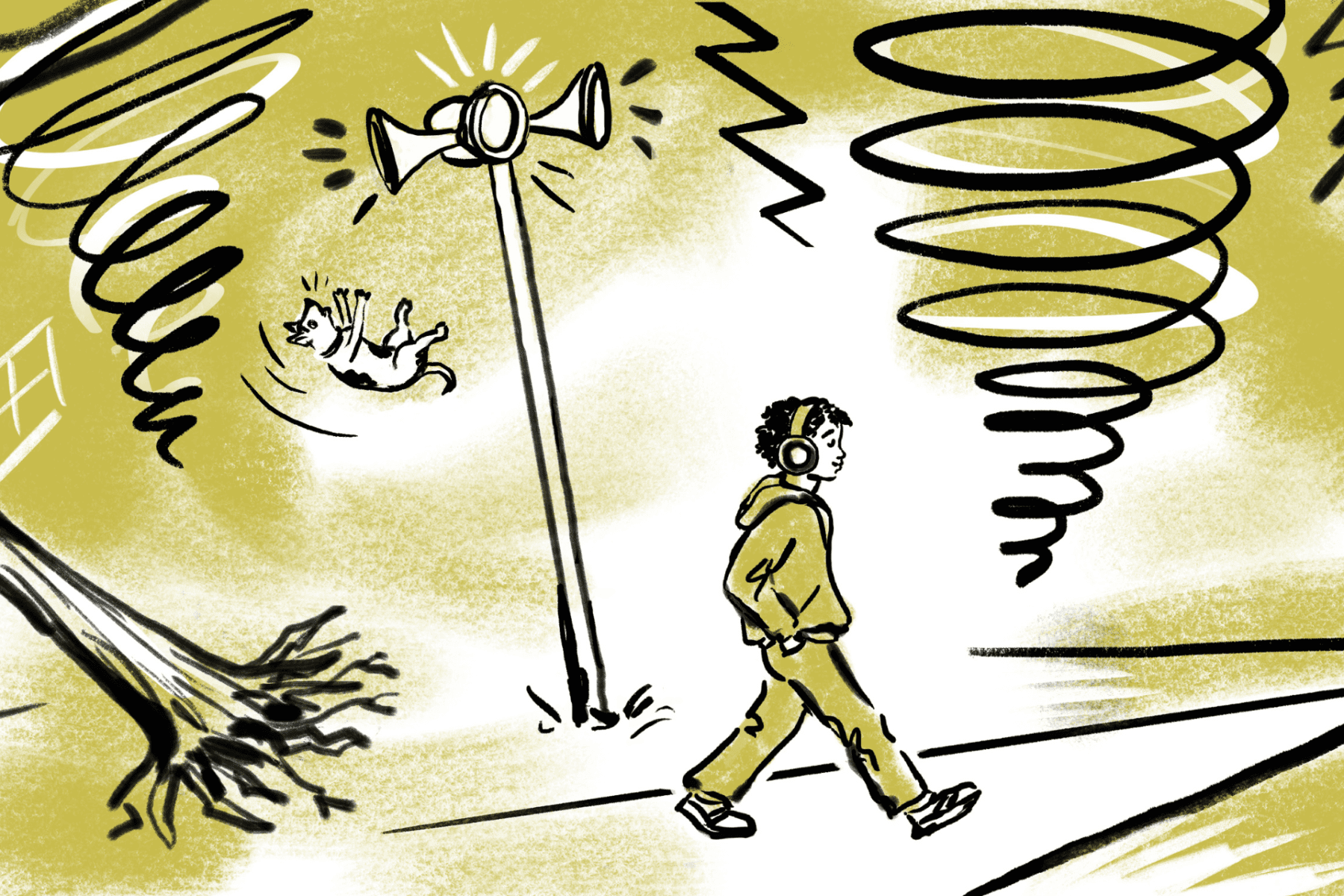
Illustration by Nancy Hope
That leaves us with, as the National Academies’ consensus report puts it, the “recovery of ocean and coastal ecosystems” — ecological work to repair the damage we’ve done to the natural systems supporting our existence. This is, in effect, the same as decarbonizing; working to allow natural systems to return to the equilibrium they evolved to find over millennia. Unfortunately, none of our present metrics measuring national well-being — stock indexes, consumer spending, GDP growth or employment — consider restorative benchmarks (or, for that matter, greenhouse gas pollution). And, of course, real estate along coasts is too valuable to turn over to restoration efforts. Seas apparently haven’t yet risen enough to force the market’s hand.
There are other ideas out there to mitigate global warming with technology; 100 million artificial carbon-sucking trees widely “planted,” shade umbrellas in space tied to asteroids, “enhanced weathering” of rocks to capture carbon, burning organic waste, seeding the stratosphere with sulfur oxides to create shading droplets above the earth. Make no mistake, these ideas are not coming from sci-fi writers, but from incredibly smart people working in the hard sciences. Make no mistake either, many of these considerations would tamper with foundational, life-giving planetary systems. And we certainly don’t currently know what we don’t know about such complex mechanisms.
Step back for a moment from our technological impulses, consider the phenomenal unrepeatability of the planet that we have — and take so imprudently for granted. This thought exercise lands inevitably at a suite of papers a group of six scientists published in 2015. Led by the Carnegie Institute for Science mineralogist and astrobiologist Robert Hazen, their findings showed the exact mineral diversity, and mineral quantities, of the earth are “unique and could not be duplicated anywhere in the cosmos.” This place is so unusual, our fanciest rocks could occur nowhere else in the universe. Who would possess the hauteur to presume to tinker intentionally with a system so complex as has assembled such an unrepeatable dwelling?
And to what end to take these risks? To prop up consumerism, shareholder capitalism, and carbon-fuel paradigms on a planet telling us that these paradigms are changing it faster than almost anytime in the earth’s history? Not in our history. The duration of modern homo sapiens’ tenure on earth is not likely long enough to recover even the changes we’ve made to the planet in just my 50-odd years alive.
“Procrastination is the thief of time.”
In 1988, atmospheric carbon dioxide levels hit 351.69 parts per million and temperature anomaly was +0.39ºC. At that time, atmospheric carbon dioxide levels had been roughly between 280 and 350 ppm for the previous 100 years. During this era, the earth was still in a climactic sweet spot for flora and fauna that evolved to thrive on the planet — including us. Passing that 350 ppm became the benchmark Columbia University atmospheric physicist James Hansen warned us about in a 2008 paper:
“If the world continues on a business-as-usual path for even another decade without initiating phase-out of unconstrained coal use, prospects for avoiding a dangerously large, extended overshoot of the 350 ppm level will be dim.”
Davis Guggenheim’s 2006 film, An Inconvenient Truth, documented former senator and presidential candidate Al Gore’s campaign to sound the alarm about global warming. The atmospheric carbon level was 382.09ppm and the temperature anomaly was +0.64ºC. Two years later, when Hansen rang his warning, atmospheric CO2 concentrations were 385.83ppm.
When the documentary hit theaters, Oklahoma’s Republican oil senator James Inhofe compared Guggenheim’s film to Mein Kampf, apparently with no concern for seemliness. His party circled the wagons and began chanting “drill, baby, drill” at rallies.
And here, by and large, we sit, with atmospheric CO2 concentrations of 426.9 ppm as of June 2024. Our window of opportunity to do something about the consequences suggested by the Johnson administration’s Science Advisory Committee way back in 1965 is closing. Our overheated summer of 2023 must be considered a premonitory reality check. It was, by any account, a rotten summer worldwide, the hottest in 2000 years according to Bloomberg, and one that set records for heat-related deaths. 2024’s summer is shaping up to be worse — we’ve already broken and set the record for the hottest day on earth twice on successive July days.
Why aren’t we smarter than this? Who doesn’t understand that there is no problem that can’t be made worse by avoiding it? Are we just hopeless procrastinators?
The man who in 1995 quite literally wrote the book on procrastination — Procrastination and Task Avoidance: Theory, Research, and Treatment — DePaul University psychology professor Deacon Joseph Ferrari, defines the dilatory trait as, “the intentional yet irrational postponement of a course of action despite knowing that this delay has negative effects.”
In a 2017 paper, Ferrari and Texas A&M psychology professor Thomas P. Tibbett discuss research that appears to define procrastination not as a Western trait but a human trait, with rates not much differentiated by nationality, gender or age. They cite literature that indicates chronic procrastination’s association with high levels of “depression, neurosis, self-awareness, social anxiety, forgetfulness, disorganization, non-competitiveness, dysfunctional impulsivity, behavioral rigidity and lack of energy” and suggest that “procrastinators are less future oriented and more oriented to the present.”
Factor in the reality that every of those postponement-inclining afflictions is compounded in the climate crisis by powerful actors who are advantaged by the combustible fuels, industrial and agricultural processes that are global warming’s principal drivers.
Inaction, while always the path of least resistance, becomes freighted with a grim moral appraisal once grasping that each of us in the U.S. is responsible for twice the global warming-causing emissions of the average Chinese citizen, and seven times that of the world’s poorest residents.

Illustration by Nancy Hope
I have listened to Pacific islanders plea for help: for us to care about our global warming which is scuttling their history, culture and identities as their islands submerge under rising seas. It is much worse than you even imagine, listening impotently to personal appeals that we not abandon them. Delivering their entreaties as they are from societal perspectives that predate our American culture by thousands of years, and practiced at living within the means of resource-limited atolls. They understand how to live on islands — like our earth.
Rather than hear this call, though, Americans and other wealthy in the West dig their heels into techno-optimisms, seeking exceptionalist solutions that will obviate our need to change habits and engage with the toil systemic change requires. It’s certainly the American way.
“The vast concerns of an eternal scene.”
Technologists have, with some regularity, characterized global warming as a “waste management problem.” The idea that industrialized society has accepted, and often needed to recover from, the waste polluting its commons is not new; it was a driver in banning CFCs when the real possibility of losing our ozone layer was established.
Waste management is in the public eye again at a more understandable, human scale than that of the faraway atmospheric ozone layer: 3M and Dupont’s dumping of products containing PFOS and PFAS, so-called forever chemicals, into the environment at points of both manufacture and use, are the most recent corporate behaviors to catch “waste management” hell for the scandal of PFAS’ insinuation into, well, absolutely everything, and everyone.
Consider plastic: who hasn’t seen at least one frightful photo of plastic dumped somewhere in what we now call the global South? We at the top of the global, corporate food chain bore silent witness as manufacturers sent single-use plastic streaming into places where waste-management infrastructure consisted of burning trash, dumping it on land, or at sea — or less. It is worth remembering that the developing world isn’t innately “dirtier” than anywhere else, but that our corporations force fed the world a product for which there is no suitable means of disposal (not even in rich countries). Now, our blood runs rich in microplastics and “forever chemicals,” no different than the blood of our planet’s poorest.
I have stood on a beach at the southern tip of the island of Hawai‘i where the oceans’ currents deposit the drifting detritus of our plastics addiction. The stuff is the beach; and the beach is accessible only by 4WD vehicles, behind gates that are often locked.
The despoiling is out of sight, out of mind to most Americans. This is what plastic and carbon-polluting industries count on: that the dumping grounds (our oceans, our atmosphere, far away places) are too removed from our experience to register as fair warning. So we continue despoiling the commons, unseen places, hard to conceptualize places like the atmosphere that provides us our every breath. “If you want to know what water is don’t ask the fish,” as the Chinese proverb has it. This is our waste management system writ large — pollute the places too ubiquitous, immense or faraway to reckon with. Like a fish in a polluted ocean we will eventually succumb — the scenes that might provoke urgency hidden from us, allowing for easy, continued procrastination.
And what, anyway, does it mean to manage waste at a planetary scale — especially when that waste is inherently without value, or consequence, in our economic or political systems? There’s always talk of a market fix, of somehow providing non-pecuniary value of some sort to “externalities” with corporate social responsibility (CSR), but it just doesn’t add up — to dollars or action — in the end. And while many investors appear to be willing to take lower returns in exchange for better corporate citizenship, the markets haven’t borne that out yet, and the markets still have the last word in this system.
In a nutshell, the more profits matter to a financial entity, the less likely it is to practice CSR. Hedge fund managers, for example, are still more likely to invest in “brown” or “sin” stocks (polluting industries or, say, arms makers or casinos) than green. Despite the Biden administration’s admirable investment in green tech and infrastructure, investors’ purported environmental concerns and the increasing atmospheric calamity, neither private equity or the financial markets at large are there yet.
Politically, it has become a wedge. Over the last 20 months, an establishment and right-wing Republican CSR backlash has pushed BlackRock and other large American investment firms out of the Climate Action 100+, an association intending to push the “world’s largest corporate greenhouse gas emitters to take necessary action on climate change.” Bank of America has reneged on its pledge to no longer finance new coal mines or coal-fueled power plants, among other fossil fuel endeavors, on basic account of the damaging nature of the enterprises — and it’s not a banking industry outlier. New investment in CSR-focused funds worldwide has plummeted from $558 billion in 2021 to merely $74.8 billion of investment in 2023. Clearly, this is what happens when there isn’t a price on everything, including waste.
Despite the Biden administration’s admirable investment in green tech and infrastructure, investors’ purported environmental concerns and the increasing atmospheric calamity, neither private equity or the financial markets at large are there yet.
This failure entrenches the market in a position of moral peril and heading into real, life-safety peril. Two recent studies described the carbon burden of asset ownership. The first study reports that 40 percent of total U.S. emissions in 2019 are “associated with income flows to the highest earning 10 percent of households.” Within this rarified group, the investment income of the highest earning one percent of Americans accounted for 38–43 percent of that amount. Their investment income is linked to 15–17 percent of national emissions overall. The authors state that “passive income accruing to [the wealthiest 10% of Americans] is a major factor shaping the U.S. emissions distribution.”
A second paper from December of last year, “The Carbon Footprint of Capital” by Lucas Chancel and Yannic Rehem, looks at France, Germany, and the U.S., and sharpens the point of the first: among the wealthiest 10 percent of the populations of these countries, “75-80 percent of emissions stem from asset ownership, not from direct energy consumption.”
This spans from stocks in coal plants to AirB&B ownership to just about whatever your 401k is invested in. In other words, if you are investing, you are more than likely investing in global warming: passive assets, no matter the type, cost us substantial greenhouse gas emissions. These two studies point to a path more effective than cap and trade or carbon offset policies — shareholder carbon taxes: assigning a cost to quite literally everything in the capital investment structure that has for so long avoided paying for the damage it causes.
“The thing they can’t but purpose, they postpone.”
On two occasions, I spoke at length with Angeline Kung for this piece. Kung was the first hire into Goldman Sachs’ Environmental Strategy Group in 2005 and has worked at the intersection of capital and environmental responsibility for twenty years. She was a founding team member in BlackRock’s development of its CSR program, has advised national environmental nonprofits and popular consumer brands. Today, she is in demand as an executive coach and strategist. Those places where her CSR efforts created investment guidelines have, for the most part, walked away from them.
Kung understands our economic system to be predisposed to procrastination and ceaseless technological optimism just as we Americans are; we who saw the realization of transcontinental rail travel, and a moon landing, just longer than a month more than a perfect century apart. Kung tells me no finance concern wants to be a “first mover”; there is an inherent inclination to let others take the risk where “the price doesn’t reflect [an] unrenewable resource” such as dumping greenhouse gas pollution in our atmosphere. This is expected of finance; like most entities, the industry shrinks from self-endangerment. It is responsive, not intrepid.
Responsive action as an agent of self-preservation in finance leads us straight away into fantastical solutions. Technological optimism does not demand regulation to benefit the environment and does not change difficult-to-modify social behaviors such as existing transit paradigms, dependence on problematic food systems or environment-gutting consumerism. Nor does it embrace the low-flash technologies already in hand to lower energy consumption and CO2 output — sealing up buildings so they don’t leak conditioned air, installing express bus lanes to get people out of cars, coating roofs to reflect sunlight and modifying diet — just a few means at hand among many. Technological optimism caters to U.S. anti-regulation bias, seeks flash over heavy lifting. It is our American-faith — saviourism — plain and simple and itself a damning procrastination.
Ferrari and Tibbett write, “The first step to recovery from chronic procrastination is a desire to break the cycle.” We will cease procrastinating climate action to address our dangerous energy and consumer patterns when we find a “desire to break the cycle.” According to Kung forcing a desire to break the global warming cycle means finding a way to “change human behavior, knowing that we are predisposed to procrastinate, to be caught up against the wall. So we gotta create the wall.” And how to create that wall? “There needs to be [a] regulate[d] free market — and put a price on everything.” At this point in our interview I suggest she’s speaking blasphemy as someone with substantial professional experience at Goldman Sachs, Barclays, BlackRock.
She replies, “It’s gonna be very unpopular. Slowing down profits [to price in social and environmental impact] doesn’t sound good to investors, shareholders or any boardroom. That’s a lot for a company to take on.” But Kung believes that is what it will take for the American economy to adequately address global warming’s consequences. This is not pie-in-the sky, Hail Mary techno-optimism, but a foundational change in American capitalism, a back against the wall moment imposed on it by the necessity of regulation — and externalities finally having a price — profit be damned.
It would certainly be a new maxim for American, and Western, civilization: Everything must cost us, because everything costs us.
Help us sustain independent journalism...
Our team is working hard every day to bring you compelling, carefully-crafted pieces that shed light on the pressing issues of our time. We rely on caring supporters like you to help us sustain our mission. Your support ensures that we can continue to provide deeply-reported, independent, ad-free journalism without fear, favor or pandering. Support us today and make a lasting investment in the future.
RELATED STORIES


Award Winning



Today’s environmental and social justice challenges are unprecedented, and require an unprecedented collective effort.


Stay updated on our latest features, events and more. Subscribe to our Note From the Nest newsletter!
