Flaming Portland
A City on Fire
“You’re not from around here, are you?”
At best, a question like this arrives as a punch line, some dry retort to an out-of-towner’s failure to read the room. Imagine Jeff Bridges’s blank-faced alien choking on his first cigarette in Starman, or some sap looking for the wine list at a local dive. In comedy, it’s a tried and true bit. In practice, however, as heard by Latoya Robinson of Sandy, Oregon, the question lands as a threat.
Robinson, who is Black, faced that question as she fled Oregon’s Riverside fire, which by then had been burning in the hillsides southeast of Portland for three days. Described as human-caused, the fire would eventually rip through 50 homes and 150 structures as it consumed some 138,000 acres across the Mount Hood National Forest before firefighters and cooler conditions gained the upper hand. On Friday, September 11, though, as the fires still raged, Robinson was with her family and headed for safer ground at a friend’s house in Corbett, an unincorporated town along the Columbia River Gorge.
The late summer’s fires burned some five million acres across the West Coast, polluting air as far away as New York City. Over Labor Day weekend, the fires ramped up in Oregon as the winds shifted, spilling a now-familiar noxious brown haze over Portland as the east winds roared across the state overnight. By the following Wednesday, some 500 square miles were burning and the towns of Phoenix, Detroit, Blue River and Talent had been, in the words of Governor Kate Brown, “substantially destroyed.” As the week went on, conditions worsened, threatening the Portland-adjacent towns of Sandy, Molalla and Estacada. Latoya Robinson had to hurry.
Fleeing under apocalyptic orange skies, she was forced to a stop by a group of armed white men who had blocked the remote junction of Louden and Littlepage Roads. As a situation far beyond anyone’s control closed in on them, a man with an AR-15 asked about Robinson’s plans while her children looked on. Finally, he settled on the question: “You’re not from around here, are you?” Eventually, the men let her pass.
This being 2020, fire was not the only force running rampant across the state. As a dangerous, well-established combination of overheated temperatures, high winds and parched conditions once again transformed the West to tinder, some searched for ghosts rather than confront an overheated, increasingly hostile world of our making.
On social media, a private Facebook group spread rumors of “antifa” stealing out of Portland and into the hills to start the fires. “The militants are burning out/up the rural folks closest to the cities,” one member of the Facebook group warned. Around the Riverside fire zone, heavily armed men questioned a public radio journalist at a roadblock in Estacada and three more journalists faced the same in Molalla. Finally, the Multnomah County Sheriff’s office issued a warning against such activities and police departments across the state worked to quell rumors that the fires were, somehow, an antifa plot.
In Portland, the fires felt like a final straw. Confined to our homes with a pandemic, the May death of George Floyd spurred over 100 nights of demonstrations, filling news feeds with images of raw resistance and authoritarian horror. The spotlight on the city grew as faceless, nameless federal agents in camouflage were caught on video sweeping demonstrators into unmarked vans. “LAW AND ORDER,” the president called, and we all watched tear gas, helicopters and distant sirens clarify those terms. Then, as that storm showed signs of subsiding, the fires took their turn.
First, the skies bore an eerie glow, a muddy orange backdrop that burned throats and eyes. Finally, as the smoke thickened for days, the color ran out of the city. Daytime streets once rampant with cyclists, skateboarders and runners fell still as smoke blotted out the sun and temperatures dipped well below their forecast highs. Downtown, the fires did what no one else could and silenced the unrest as activists pivoted toward providing mutual aid. As the winds died, visibility ranged from a shell-shocked thousand yards to just across the street for days.
Again sheltered in place and caught in the trap within a trap, the mood in the city hit bottom.
If you were lucky, your home could be sealed with the strength of new windows and maybe central air — a growing necessity as summer temps now spike to triple digits. If you weren’t, you faced a poisonous concoction with every breath. The EPA’s Air Quality Index tops out at 500. With estimates approaching 600, Portland earned the dubious honor of the most polluted air in the world for several consecutive days. At times, the air conjured a distant campfire. More often, it recalled the chemical burn of the city’s industrial Swan Island; an acrid, inescapable blend of all the supposed inflammable material in the stench of lost homes, family memories and hope.
Fortunately, we have grown accustomed to wearing masks.
At a primitive level, fire is the ultimate common enemy for humanity. Indifferent to weapons, mercy or reason, its threat has grown distressingly familiar to the West. But across the country, the disaster and unrest that have upended Portland for months should sound familiar. Rampant, systemic racism that runs deep across the city and its home state face a long overdue accounting. The economic fallout from the ongoing and unmanaged coronavirus pandemic has crippled the city’s economy with a skyrocketing homeless population and increasing numbers of shuttered restaurants, businesses and planned developments.
On the surface, Portland is a progressive paradise in a state with a Democratic governor and supermajority in its state representatives. Look deeper, though, and it’s a rural state whose conservative populations have grown increasingly angry and conspiracy-minded under toxic federal leadership that has sent both sides hurtling in opposite directions from solutions to any issue. And the fires keep burning.
If these issues don’t ring familiar where you live, their variations and mutations are echoed across the country in 2020. In a city of over 600,000 people, all of America’s ills are on the table. Welcome to Portland. You’re not from around here, are you?
A Dark Blue Dot in a Red Field: Portland Against Its Home State
Wherever you go in Western Oregon, the forest and its promised natural wonder casts a long shadow. Each year, as the city’s dreary default setting gives way to summer — “June-uary” is the longest month on the calendar — the city empties out with kayaks, tents and trailers in tow, bound for the wilderness. Promising tranquility and adventure in equal parts, the forest marks the strongest shared connection between Portland and the rest of the state.
Like Austin, Madison and Athens, Portland stands at an ideological distance from its surroundings. On the strength of urban populations, polls show Oregon as a Democratic stronghold for this upcoming election. But on the outskirts of town, there’s a clear, and at times seething, resentment toward the areas that dictate policy for the nation’s ninth-largest, 25th most populated state.
As depicted on IFC’s sketch comedy series Portlandia, Portland exists as a twee, unfailingly progressive fantasia in the popular consciousness. Despite its overwhelmingly white populace, Black Lives Matter signs have been sprouting from front lawns for years, and the abundance of four-way stop signs functions as stilted a testament to customs of deference and superficial courtesy.
Drive 15 minutes in any direction, though, and red hats, thin-blue-line flags and Second Amendment enthusiasts establish an off-kilter sort of equilibrium. If anything, Portland’s position as a haven for outspoken support for liberal causes seems to have animated its surrounding areas in the opposite direction. For years, racist groups such as Patriot Prayer and the Proud Boys have staged small acts of provocation toward Portland’s progressive heart in search of a headline-making response. In every case, the activists flying the banner of antifascism have been game to comply.
Oregon is a state of outdoor recreation, considered gender pronouns and an abundant marijuana business, legalized in 2016. This is also the state of Ammon Bundy and his 2016 occupation of the Malheur National Wildlife Refuge and of Republican candidate for U.S. Senate Jo Rae Perkins, who is an outspoken supporter of QAnon. Portland may be the Justice Department’s “anarchist jurisdiction” of choice, but across Oregon, the state’s conservative base has also grown more radical.
Along the state’s I-5 corridor, driving a Prius with California plates can invite drivers in lifted pickups with window stickers bearing the image of an AR-15 and the corrective ORY-GUN to rev their engines in provocatively close proximity, as if to offset the hybrid’s reduced carbon footprint.
As in much of the country, the pandemic somehow remains up for debate. On one recent trip to the coast, the state’s rural and urban divide was starkly illustrated. Both within Portland and at its coastal getaway favorite, Cannon Beach, masks are commonplace. Between them lies another world. Take a service station some 10 miles outside of Hillsboro, for example. There, a mask-less attendant genially approaches my car to pump my gas, his pocked face shaded by silver stubble (Oregon, like New Jersey, prohibits self-serve). Outside, another unmasked man lingers near the pumps outside his sedan, checking his oil in the late summer sun. Inside the nearby store, a short, middle-aged woman exchanges barefaced pleasantries with the attendant. She cheerily accepts her change before I approach the register behind an N-95 surgical mask. On the attendant’s head, a camouflage baseball hat reads “Trump: No Bullshit.”
The last time Oregon’s political divides stood in such stark relief was during the early ’90s clash between the environmental movement and the state’s logging industry. As the long shadow of the West Coast’s fires has grown, the distant fight between industry and old-growth forests has become a growing presence in pop culture with appearances in Richard Powers’ 2018 Pulitzer Prize-winning novel The Overstory and in Timber Wars, a podcast launched in September by Portland’s Oregon Public Broadcasting.
Over seven episodes, the podcast recounts the divisive battle to protect Oregon’s forests that became a flashpoint at the federal level. One veteran of those demonstrations, George Atiyeh, was a logger-turned-activist who fought to protect old-growth forests in Opal Creek outside of Salem. The area received protected status in 1996 to stem the advance of industry, and Opal Creek became a popular hiking area as the state transformed from a state built on environmental plunder to one more based in outdoor recreation. In late September, Atiyeh’s remains were recovered at his property, which was among the nearly 200,000 acres destroyed by the Beachie Creek fire.
Timber Wars draws a connection from the nonviolent environmental movement to the 1999 WTO protests in Seattle and, by extension, to the antifa boogeymen of the stump speeches of 2020. Like the rest of the country, Oregon’s most sustainable resource may be political division.
Oh, and racism. Oregon runs rich with that spirit as well.
Black Lives Matter and Portland’s Standing in a “White Utopia”
Coming to Portland, a white progressive easily grows intoxicated by a sense of being among like minds. In addition to the occasional ad hoc, Trump-denouncing front-yard display (“the PIG is not my President,” “Flush the Big White Throne”), American flag–striped placards declare the views within each home along various neighborhoods. “In OUR America … ” each begins before laying out a litany of progressive tenets valuing immigrants, LGBTQ rights and equality across every stripe. At a time when the president openly courts white supremacist groups in national debates, these can be comforting sights.
But words and signs come easily. Real equality is harder to build. Pending the results of this year’s census, Portland remains the whitest city (77 percent) of its size, and that stands as a direct result of the city’s grim history of racism. Despite its standing as the right wing’s avatar of liberal policies run amok, the state was founded to be a 100,000-square-mile Sundown town.
When it was established as a territory in 1844, Oregon’s founders prohibited any Black person from living in the region for more than three years. Upon joining the U.S. in 1859, the state’s constitution was more explicit: “No free negro, or mulatto, not residing in this state at the time of the adoption of this constitution shall come, reside, or be within this State, or hold any real estate.”
As Portland-based educator Walidah Imarisha told Oregon Public Broadcasting back in June, “These laws point to the fact that Oregon was founded as a racist, white utopia …. Oregon is a useful case study for the rest of the nation because the only thing unique about Oregon is [it] was bold enough to write it down.”
The state waited until 1959 to adopt the 15th Amendment’s right for Black men to vote. In 2002, Oregon voters finally removed the racist language from the state constitution — though 30 percent voted against its removal. It’s tempting to wonder whether those numbers would look any different 18 years later if the issue appeared on the ballot in November.
Like every American city, Portland was built on treating non-white residents with hostility. In the Albina District, North Portland’s bustling Mississippi Avenue is home to craft breweries, boutiques and multiple shows of support for the recent protests against police brutality. “No One Is Born Blue,” reads one sign atop a utility pole. Up until a few months ago, a banner atop a housing nonprofit posed an uncomfortable question to passersby: “How many Black families were displaced so you could be here today?” (Since the death of George Floyd, the banner reads “Abolish Police.”)
For decades, Albina was the city’s center of Black culture in Northeast Portland, but the neighborhood has been heavily gentrified. From 1990 to 2010, Albina’s demographics shifted from majority Black to majority white. Years ago, North Williams Avenue was regarded as “Black Broadway” with its mix of jazz clubs and Black-owned businesses. Now, glossy condo complexes cluster around a recently built New Seasons Market, a local take on Whole Foods.
Portland police, in another commonality with other liberal-leaning cities like New York, Chicago and Los Angeles, has a long history of racism and brutality that has fed the anger and frustration of the 2020 demonstrations. In 1981, Marine veteran and off-duty security guard Lloyd “Tony” Stevenson died in a police chokehold in an incident that received national attention. In response, two officers sold T-shirts within the department with the image of a handgun that read, “Don’t Choke ‘Em, Smoke ‘Em.”

In 2003, 21-year-old Kendra James was shot and killed by a police officer after trying to leave a traffic stop. Her name is a common presence at demonstrations, joining a long roster of Black lives lost across the country. In 2010, a police captain lost two weeks’ pay after posting a tribute to Nazi soldiers at a city park (following a lawsuit, the city agreed to pay him back and expunge his record four years later). In 2019, a lieutenant was found to have exchanged hundreds of friendly text messages with the leader of Patriot Prayer. After an investigation by the mayor’s office, the officer was cleared of wrongdoing.
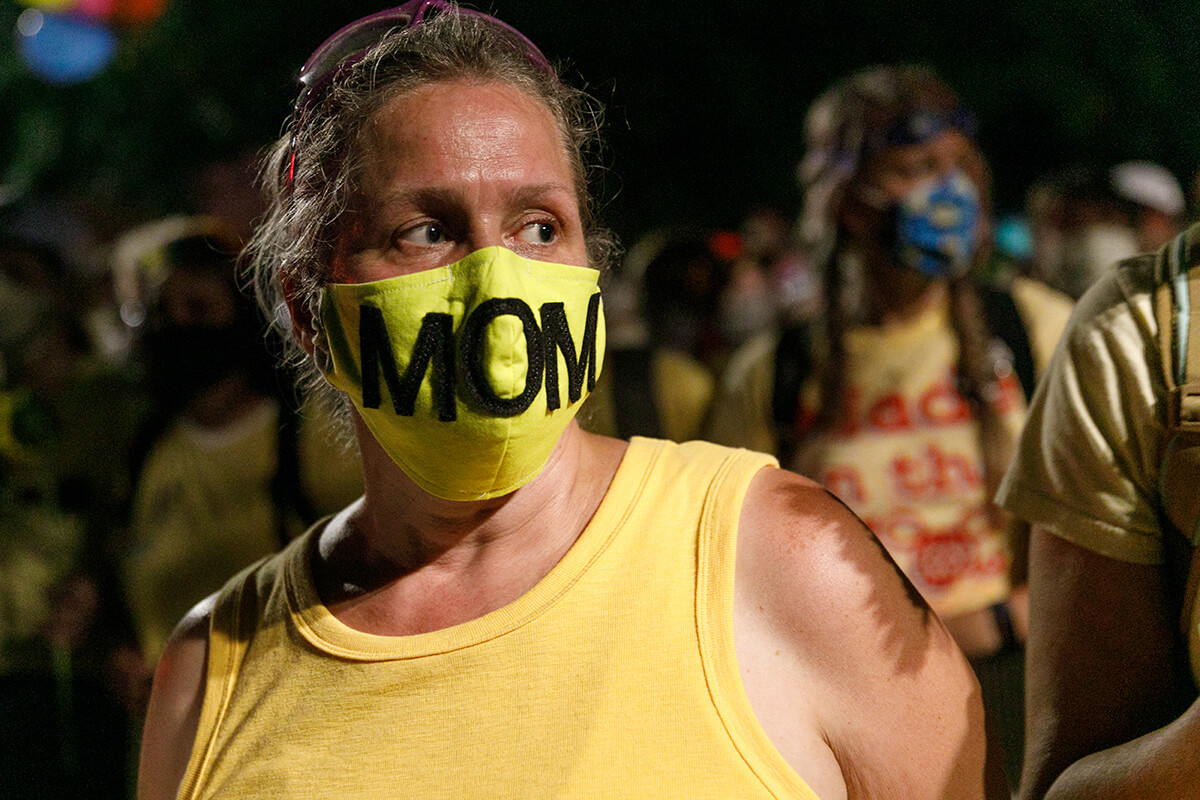
Even superficially inspiring moments from the demonstrations require a corrective lens. When the protests reached their peak in July, a yellow-clad (mostly white) “Wall of Moms” became viral darlings for offering a “Hands up, please don’t shoot me” lullaby to the police. That same month, footage of a (white) woman, naked and defiant before a wall of armed federal agents, became a national fascination. For every well-intended act of resistance to capture wide attention, the inevitable question must follow: “Who are these for?”
Despite these lens-grabbing events, Portland’s demonstrations are built upon the city’s Black population. Wall of Moms collapsed after just 10 days of action amid allegations that the group failed to adequately put the real racial issues at the center of the movement. Meanwhile, the nonprofit Don’t Shoot Portland, founded in 2014, has been a driving force in the demonstrations, and the organization’s executive director, Teressa Raiford, is part of a write-in campaign for mayor. And while armed men prowled for antifa in the hillsides, Don’t Shoot Portland and social justice group Snack Bloc pivoted to organizing donations of air filters, PPE and other essentials to fire-stricken areas.
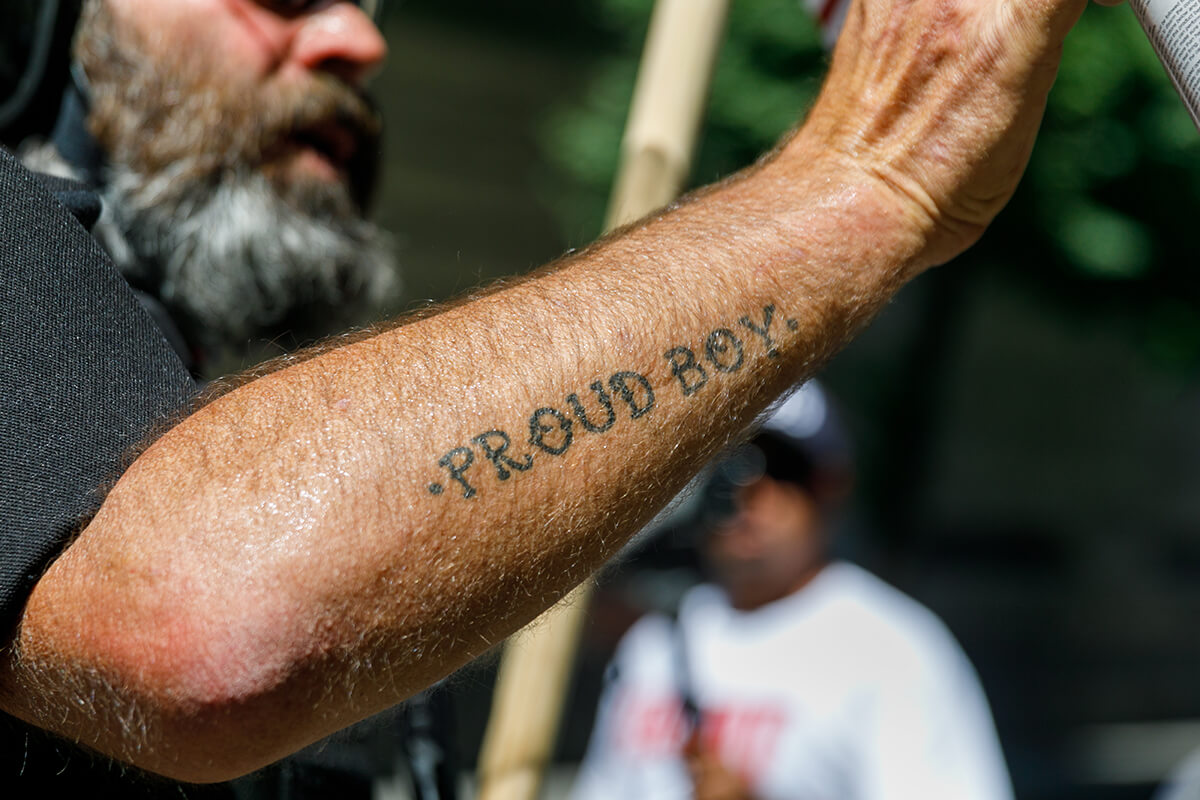
In late September, amid nerves already frayed by the fires, the Proud Boys requested a permit for a rally just north of downtown Portland in Delta Park with an expected 20,000 people joining from around the country. Citing COVID-19 concerns, the city denied their permit. The rally went on anyway.
In nearby Kenton, residents took to Facebook to announce cleanup plans for the next day amid fears of violence. They had their reasons. About two weeks before the fires, when the George Floyd protests showed no signs of relenting, what was called a “Trump 2020 cruise rally” brought a convoy of raised trucks and out-of-town Trump supporters into Portland. Bearing flags, paintball guns and concealed-carry weapons, multiple trucks veered off the planned highway route and poured into downtown as the sun set.
The resulting confrontation was as predictable as it was terrifying. Trump supporters fired paintball pellets and pepper spray into counterdemonstrators and accelerated through intersections as the counterprotesters tried to block their path. By the time the night was over, one right-wing demonstrator — Aaron “Jay” Danielson, 29 — had been shot dead.
Five days later, his suspected shooter, Michael Forest Reinoehl, 48, was shot multiple times before sunset outside Olympia, Washington, by a task force made up of local law enforcement deputized as U.S. Marshals. Details of the encounter are hazy but, according to a comprehensive New York Times report in which more than 20 witnesses were interviewed, the agents closed in around Reinoehl in front of a townhouse complex in two unmarked SUVs with lightning speed. Witnesses paint a picture of no sirens, no instructions to the suspect and a hail of bullets from the federal agents who gunned down Reinoehl seconds after storming the scene.
Officer accounts differ on whether Reinoehl attempted to produce the pistol he had in his pocket, though witnesses say he did not. A rifle was found in his car. Attorney General William Barr called the operation “a significant accomplishment,” and President Trump later told Fox News that “that’s the way it has to be. There has to be retribution when you have crime like this.”
It was against this backdrop that the Proud Boys — beneficiaries of another publicity bump when, during the recent debate, the President advised them to “stand by” — planned their return engagement. That same afternoon, Black Lives Matter activists scheduled a rally for the same time at Peninsula Park in Albina, the city’s historically redlined Black neighborhood, just three miles away from the Proud Boys’ rally. Governor Brown declared a state of emergency in advance of what was an otherwise sunny afternoon.
At times, Portland has felt like a pilot program for a looming civil war.
A Murky Path Forward for Portland — and Everywhere Else
As of this writing, six fires are still burning in various stages of containment across the state — a total that’s down from the original 17 since the crisis began over Labor Day weekend. Along with damage to lives and property, over a million acres of the state’s forests have been lost. But with cooler temperatures and more rain on the way, odds are that another brutal fire season has passed. For now.
The smoke has cleared, but tensions still run high. Protest actions have dipped from their previous nightly schedule, and most crowds only reach into the low hundreds. In late September, during a demonstration after a Louisville grand jury opted to not charge the officers who shot Breonna Taylor, a man threw a Molotov cocktail at the Justice Center. He was not apprehended. Mattresses, dumpsters and police barricades have burned outside police facilities, but organizers have disavowed violence and destruction of property. In early October, a crowd of about a hundred gathered outside a police building in East Portland. During a mostly peaceful demonstration, someone threw a water bottle toward the door, and the crowd shouted it down. “Non-violent, not silent,” they chanted.
In the hopeful beginning of the long season of demonstrations, the tide seemed to be turning. In June, the city’s Burnside Bridge drew massive crowds for a “die-in” that spilled into the city’s central Pioneer Square. A photo from that day has taken on iconic status: an aerial look at a city united against systemic racism.
That same month, the city council rerouted more than $15 million of the budget from the police to other programs — a figure below activist demands but still a success. Since that time, the results of the demonstrations have grown harder to discern.
With federal forces lurking, the city’s summer protests followed a steady, acidic rhythm. After peaceful beginnings, every demonstration ended around midnight in hails of rubber bullets and tear gas, which bled into the homes of nearby residents. In a surprising yet ideologically consistent development, even Ammon Bundy sided with the protesters. “If you think that somehow the Black Lives Matter is more dangerous than the police, you must have a problem in your mind,” Bundy said in a July post on social media. “Defund the police is the correct thing to do.”
Mayor Wheeler refused to ban tear gas from the city but eventually apologized for its use, blaming federal officers for their reliance on a tactic that only escalated the situation. In one especially absurd bit of political theater, Wheeler joined a protest outside the justice center in late July and was also tear-gassed. A close-up of Wheeler’s face, damp-eyed with a PPE mask under his chin, was pasted around town with the text “Gas Me Teddy” and “Fuck Teddy.” On September 10, Wheeler finally banned its use.
After earning praise for managing the city through the pandemic, Wheeler had difficulty getting a handle on the protest, which along with the police’s response have diminished his stature. City Commissioner Jo Ann Hardesty, who is Black, asked to take over overseeing the Portland Police Bureau for Wheeler, who refused the offer. The mayor’s resignation remains high on the list of demands from the city’s activists, and this November he faces a challenge from his left in Sarah Iannarone, who has outpaced his fundraising efforts. Last month, Wheeler’s campaign manager resigned.
Wheeler is a sixth-generation Oregonian with roots in the timber industry. Though his poll numbers have dipped, his defeat is far from assured. Though a recent poll showed Iannarone with an 11-point lead over Wheeler, she has her own problems as a candidate, including limited political experience and a penchant for exaggerating her academic credentials. Facing two white candidates for mayor, the write-in campaign for Raiford stands as a well-intended corrective. But after she garnered less than 10 percent in the primary, voters turning toward her will likely divide Wheeler’s opposition.
In contrast with recent events, the arrival of the Proud Boys in Delta Park in late September passed without major incident. According to estimates, their gathering and the nearby counterdemonstration drew a few hundred people who never crossed paths. As the peaceful protest drew to a close in Peninsula Park, a caravan turned down Martin Luther King Boulevard and dozens of young Black men and women raised their firsts or leaned out of car windows, honking horns in support as they passed toward the city center. Heading in the other direction, two panel pickups passed the caravan without notice. Each was loaded down with more than a dozen police officers, clinging to the sides like barnacles. Where Portland’s season of discontent takes us next remains in question.
Despite the months of volatility and unrest, though, there remains a strong likelihood that 2021 will look a lot like 2020. The same people will be in charge, the same deep-seated problems of institutional racism will remain, and an uncontrolled climate threat rages on. Every year, the fires just get closer and closer, and no one addresses the source of the problem.
Wherever you are in America, you’re from around here.
-
Photo Credit: John Rudoff
Gimme Shelter
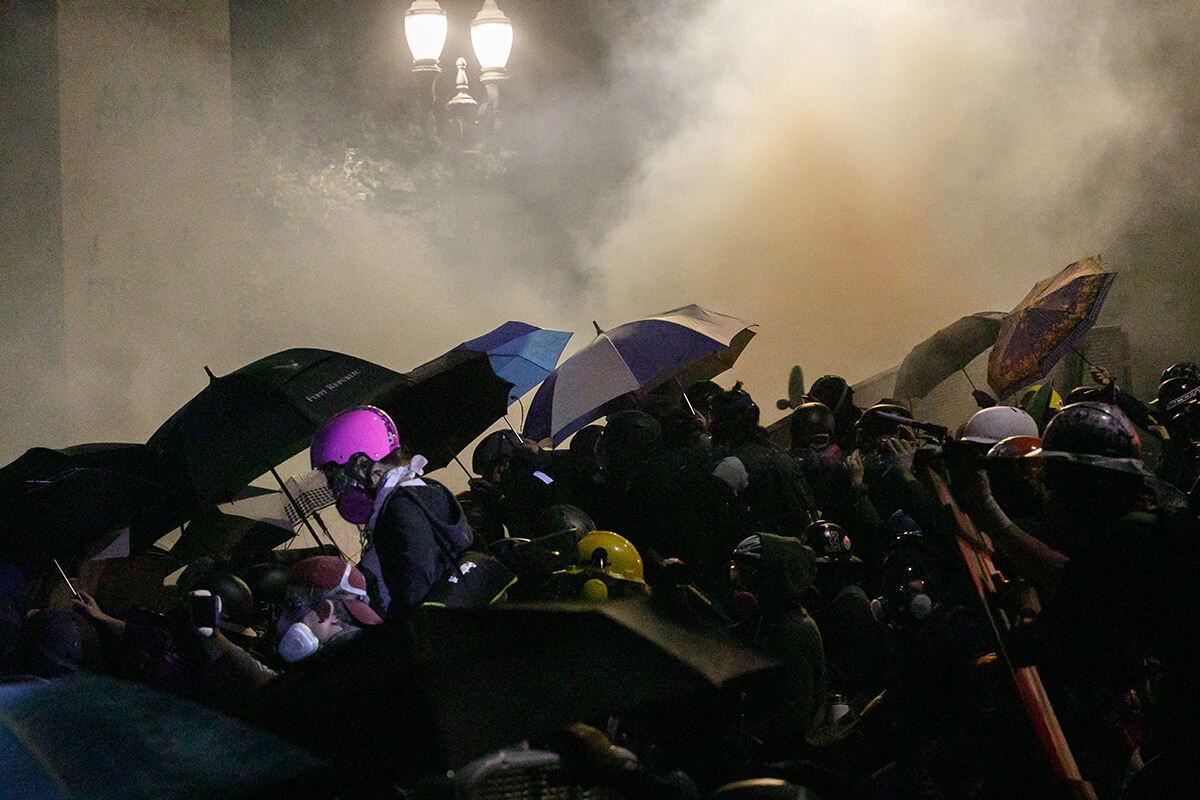
At the height of federal deployment, demonstrators in front of the Federal Courthouse use umbrellas and shields to protect themselves from feds firing tear gas, smoke grenades and impact weapons on protestors. -
Photo Credit: John Rudoff
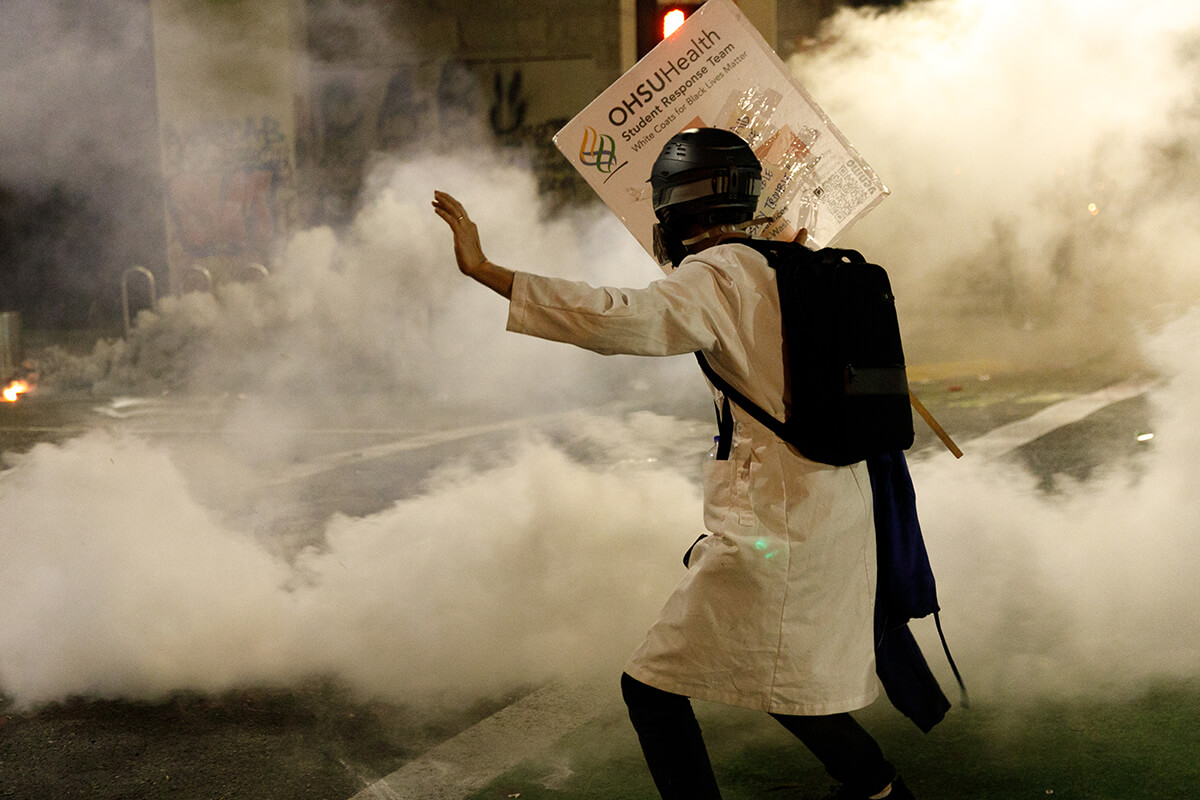
This physician is one of the cadre of street medics who tended to the wounded during the months of demonstrations. They were targeted so frequently by police and federal agents that the ACLU sued to protect them.
-
Photo Credit: John Rudoff
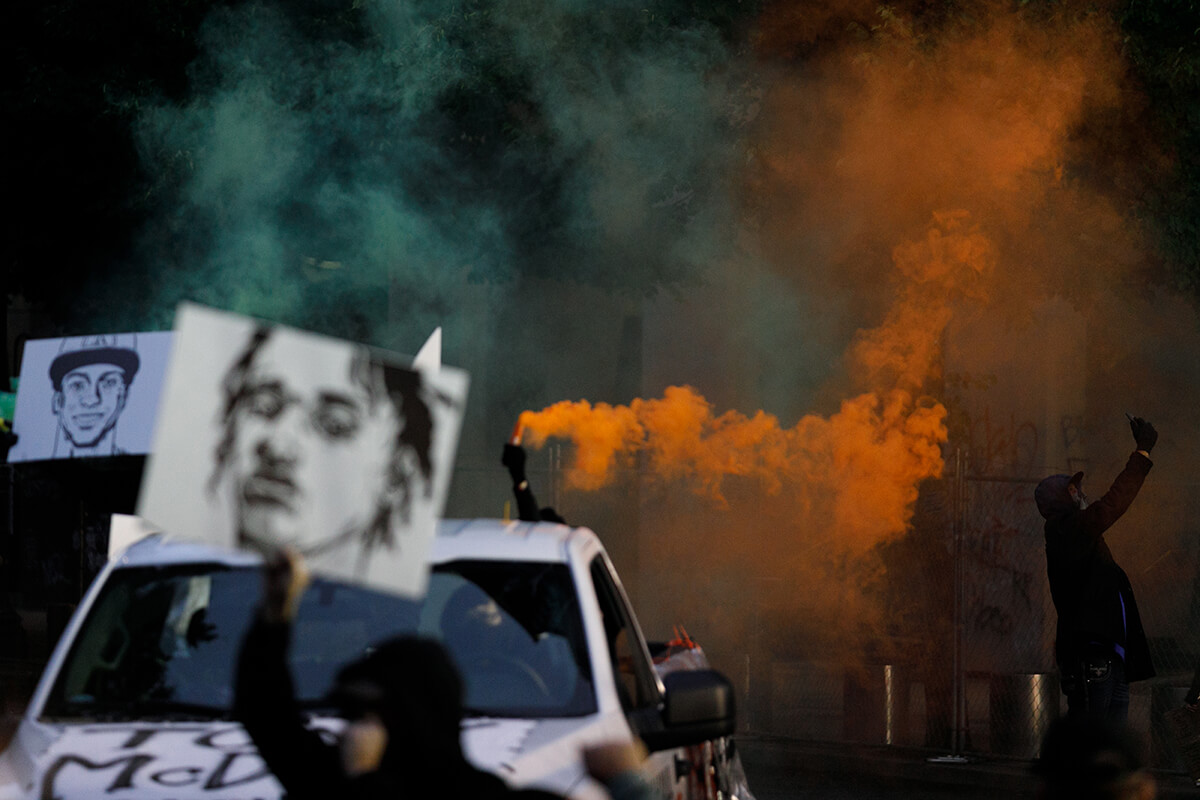
On the night of June 6th, 2020, Black Lives Matter demonstrators marched through Portland, carrying smoke flares, and photos of young Black men killed by police.
-
Photo Credit: John Rudoff
On the night of May 29, 2020, after a rally in support of the Black Lives Matter movement, demonstrators attacked Portland’s Justice Center, breaking windows and starting a small fire. This night is generally considered to be the beginning of the Portland uprising.
-
Photo Credit: John Rudoff
The “Wall of Moms”, a group of women demonstrating on behalf of Black Lives Matter, faced off on July 19, 2020 against Federal officers in front of Portland’s Mark Hatfield Courthouse.
-
Photo Credit: John Rudoff
Alan Swinney, a prominent member of the white-supremacist hate group “Proud Boys”, takes aim with a can of pepper spray against counter-demonstrators. Swinney is in jail pending trial for felony charges related to that demonstration and one the following week.
-
Photo Credit: John Rudoff
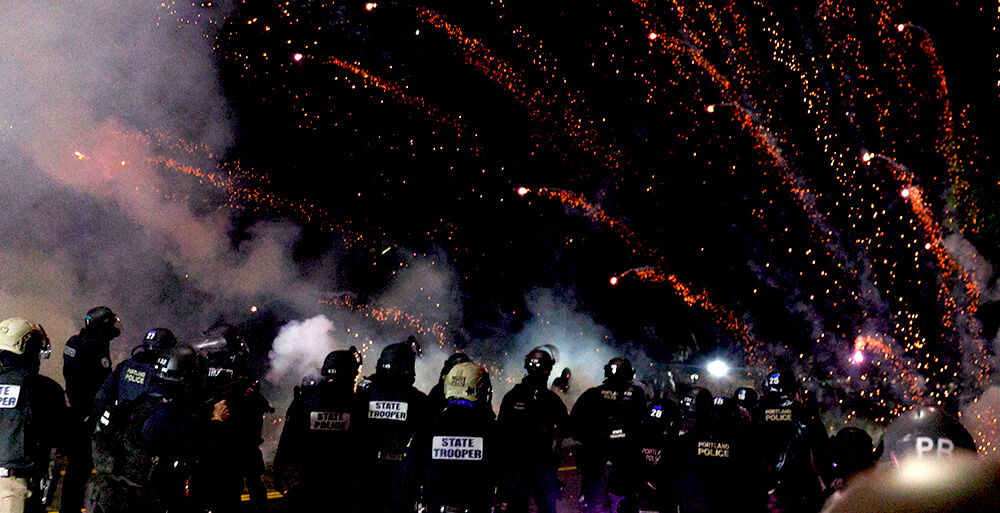
Police advance against demonstrators, who respond with fireworks.

Help us sustain independent journalism...
Our team is working hard every day to bring you compelling, carefully-crafted pieces that shed light on the pressing issues of our time. We rely on caring supporters like you to help us sustain our mission. Your support ensures that we can continue to provide deeply-reported, independent, ad-free journalism without fear, favor or pandering. Support us today and make a lasting investment in the future.

RELATED STORIES


Award Winning


Today’s environmental and social justice challenges are unprecedented, and require an unprecedented collective effort.


Stay updated on our latest features, events and more. Subscribe to our Note From the Nest newsletter!
