
The Wealth Myth

Someone once called Donald Trump a poor man’s idea of a rich man.
But Donald Trump and truly rich people — people who aren’t backed by oligarch-run state banks, or who earned or inherited legitimate wealth, or who hit the lottery — have one thing in common: They all know how vulnerable U.S. tax policy is to manipulation, and it’s a vulnerability they all treasure.
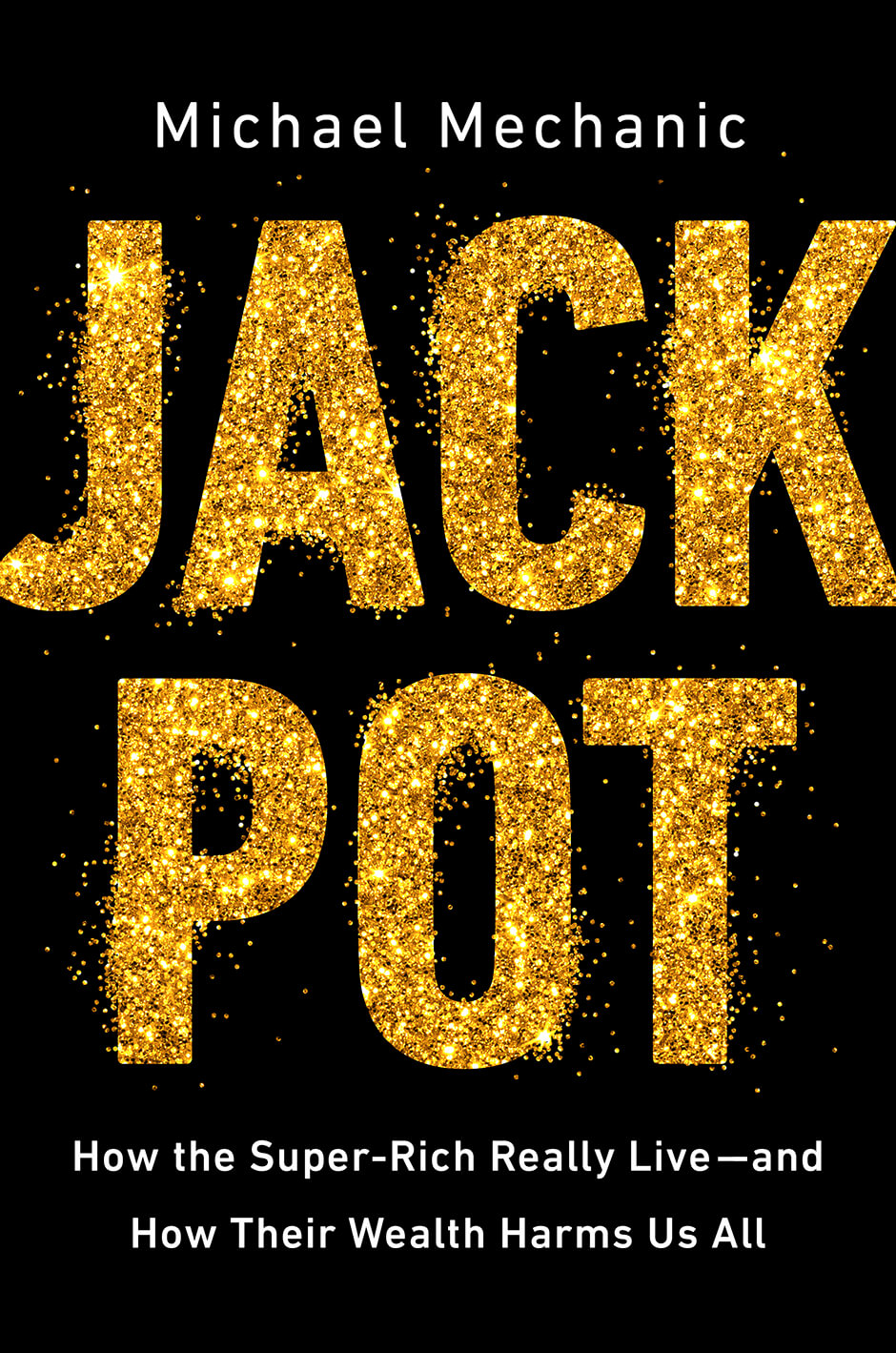
When Michael Mechanic, the first-time author of Jackpot: How the Super-Rich Really Live — and How Their Wealth Harms Us All (read an excerpt here), became fascinated with wealth and inequality in America some 20 years ago, he might not have envisioned Trump taking over the GOP, being elected president, and gutting the tax code and the IRS.

In fact, he says that if a literary agent had not called him “out of the blue” to ask if he had a book in him, “I probably would never would’ve gotten up off my ass” to write one. Doing this particular book, though, made perfect sense once that walking, talking affliction came along and gave kindred coveters of wealth the tax-relief ride of their lives — while the rest of America paid the bills.
In Jackpot, Mechanic not only takes us into that gilded world for a fetishized tour, he also attempts to make us angry about it.
He partly succeeds, in the way that we detest the tendency of obscenely wealthy people (who got rich by whatever means) to reap their capitalist fortunes and then use their influence to evade taxes, that necessary evil former Supreme Court Justice Oliver Wendell Holmes once described as “what we pay for a civilized society.” Or, if seeing Trump’s name appear 68 times in the book’s index reminds you that not only has he brainwashed a huge segment of the population and enriched other already-rich parasites, he’s an amoral tax dodger to boot.
Yes, the super-rich — and the overly leveraged rich, and the corrupt rich, and the fake rich — all have the same interest in hiding their money from the tax man and separating themselves from the hoi polloi, while consuming more than their fair share of public goods such as electricity and clean water. And no, this is hardly a revelation.
Americans are obsessed with the idea of getting rich, being rich or hitting the proverbial “jackpot,” Mechanic says, suggesting that tax avoidance coupled with massive wealth accumulation is a breach of civic responsibility that might have some of us reaching for the pitchforks. Jackpot also is a noble attempt to make a case for long overdue reform of our insanely regressive tax structure.
Mechanic not only takes us into that gilded world for a fetishized tour, he also attempts to make us angry about it.
But will reform-minded, cautionary-tale tomes such as Mechanic’s break the get-rich spell that holds so much of the American psyche in its sway? That’s a tough sell.
In all likelihood, rich people will probably love reading about other rich people to whom they can compare themselves. Progressives may hate-read it as a tale of gluttony and moral depravity that confirms their views on the atrocities of America’s war on the not-rich. Middle-of-the-roaders might shrug and think, “I’ve got to play the lottery more often.”
Yet the book, weighing in at 404 pages, including 295 pages of text, just under 100 pages of endnotes and an index chock-full of the aforementioned references to the 45th president, contains valuable insights.
We learn that the rich are good at self-rationalizing how they came by their fortunes. You know, they were just in the right place at the right time and had the unique skills to take advantage of the situation. A wealthy hotel owner informs us — or reminds us, depending on how much Ayn Rand you’ve been reading: “Over time, the top 10 percent of smart people figure out how to get all the power and all the money.” The author introduces us to individuals who have the pedigree to know that being rich means having money and being wealthy means having time. And we get to be comforted by the realization that rich people have anxiety, too.
Mechanic, a long-time senior editor of Mother Jones, wants not just to titillate us with anecdotes about the filthy rich, how they got that way and how they feel about it, he also wants us to think about how money divides our country.
As timing would have it, this reckoning comes after the American presidency morphed into a vulgar manifestation of how the GOP has made screwing over the government — and ostensibly 95 percent of Americans — central to its brand.
Mechanic’s tour begins with the premise that while Americans still fantasize over hitting the proverbial jackpot, the notion is a delusion more than a fantasy. That’s because in reality the way the jackpot is hit in America is by already having hit the jackpot. To access venture capital, the gateway to mega-wealth in America now, one must be an “accredited investor.” That’s basically someone who already has so much money they do not need the government to protect them from bad investments. “The government, in other words, protects the little guy by cutting him out of the action,” Mechanic writes.
Why would you buy a lottery ticket if you didn’t have some kind of fantasy about it?
To put it simply, the American economy is structured to ensure that capital keeps getting passed around the country-club tables of the already rich while the rest of us gawk through the window and dream of somehow getting a chance to sit there, too.
Redirecting some of that capital would require a scale of wealth-redistribution that has not been en vogue since former President Ronald Reagan rode in on the libertarian, greed-is-good, screw-the-common-good tide in 1980. Mechanic’s anatomy of the rich — and his dissection of the GOP’s devastation of the tax code and its kneecapping of the IRS — is detailed, thorough and disheartening.
But it’s still a bit like staring into an abyss of greed and moral bankruptcy that you knew was there all along.
More than anything, the hope (much less expectation) that such an economic, political and cultural transformation is remotely possible in America all but requires you to believe that rich people actually have a societal or moral obligation to contribute to solving what the author describes as “the profound problems our nation now faces.”
That’s harder than it sounds. Even before I read this thoroughly researched and reported book, I could say with a straight face that I didn’t believe rich people accept any such responsibility and that no amount of public shaming can make them.
I still don’t.
Jeffrey Anderson: What motivated you to write this book?
Michael Mechanic: I actually had the idea a couple of decades ago. The seed of the idea was to do a book about lottery winners, to kind of see what their experiences were like — because we’re all obsessed with the idea of instant wealth — and sort of to see what happens to people who it lands upon.
Yet, we get to meet all sorts of rich people.
So, you can get stories of these [lottery winners], right? But it would be kind of limiting. You’re going to get the same kinds of stories. So [my literary agent and I] kind of fleshed out this kind of bigger idea of the American wealth fantasy, not just of instant wealth but of people who had success in all kinds of ways.
How did you get so many wealthy people to open up on the record?
You can’t really cold-call people. For the most part it has to be friends of friends of friends. You have to have some kind of connection. And actually, the same thing happened to Rachel Sherman, who wrote a book called Uneasy Street. She’s a sociologist, and she interviewed a lot of 1-percenter families in the New York area. And I noticed all her sources were women and most of mine were men, because she reached out through her women friends, and I reached out to male friends. And men can have much bigger financial networks.
I might have guessed the percentage of truly wealthy people is skewed towards men.
Absolutely, yeah. Well, among the global, ultra wealthy, which is people with $30 million and up, it’s nine men per woman.
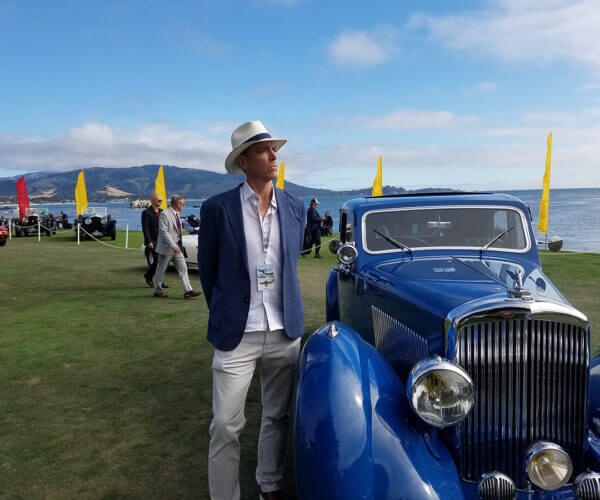
You go to Pebble Beach, the Concours d’Elegance, a super-ritzy car show. Did you go in feeling like a party crasher?
Well, anyone can go, but you have to buy a ticket for $450. It goes up to $5,000, where you get to stay at the lodge and hobnob with other super-wealthy people. I bought the $850 club tickets with guaranteed parking and a buffet breakfast and lunch, to go to luncheons and maybe meet folks who would be useful for the book.
Were rich people suspicious of you?
What I tried to do when I approached people, I said, This is not… I know I’m from Mother Jones, but this is not about bashing rich people, it’s about hearing from them.
Seems like you kept your word, at least on the anecdotal front.
You take from it what you bring to it. So, if you’re an old lefty and you read this book, you’re going to be pissed off and say, “This is infuriating.” And if you’re a conservative with a lot of money, you can go, “Oh, yeah. This is interesting.” I wanted it to be a book where you didn’t come away with my preconceptions. I didn’t want it to be a polemic.
We don’t hear much of anything from people who aren’t rich.
There are a lot of books that focus on the experiences of the poor. I wanted one that focused the lens on the rich, and our wealth fantasy, and see where it really takes us.
Are there really that many Americans so totally consumed with a wealth fantasy? I’ve met plenty of people who are content just trying to make a good living and striving to live well.
Well, I cite in the book how many people play the lottery, right? Half of all Americans play the lottery. Why would you buy a lottery ticket if you didn’t have some kind of fantasy about it? Beyond that, we fantasize about doing something that brings us great financial success where we can feel proud of that accomplishment and be rich. Starting a little company and selling it. Making just a really impressive investment at the right time and having it go crazy. Getting in on the IT market… I mean, the stock market’s a big casino. And look at everybody playing in the stock market.
There’s also the rags-to-riches component of the Great American Story.
There’s a chapter in which I attend the Real Estate Wealth Expo, and it’s this circus of “strike-it-rich fantasy”; all about flipping real estate. But it’s more or less a scam. And that’s where I talked to regular folks who aspire to be really wealthy and they really hold this myth of upper mobility with the rags-to-riches tale. They fantasize about that idea, and they think they might be able to make it because these other guys have. It’s a one-in-a-million tale, but our society makes such a big deal out of it that we believe all we have to do is work hard, put our nose to the grindstone and be a good person, and we’ll get there someday, right? But we won’t. I mean, there’s been all sorts of research and the thing that is most predictive of your income is your parent’s income.
Your book has an element of psychology to it. At times it sounds as if you had to be someone’s shrink. A woman you wrote about, Martha, who inherited her wealth, sounds like she struggles with her identity because of it.
Some people really try to stay grounded. But it can be really hard to stay grounded because society starts treating you differently. It’s hard to be sure, at a certain point, who to trust. Is that person who’s trying to befriend you just a cool person or do they want something from you? What about lovers, right? Someone you date. This was a big problem for Martha. When do you tell them, and how much do you tell them about your wealth? Her other fear was that she writes books, and she doesn’t make a lot of money writing her books. But that’s her identity, it’s what she enjoys doing. And she felt like if people knew she had all this money, they wouldn’t take her work seriously.
I suppose, in that sense, a rich person would have to get used to questioning people’s motives, like on the charity circuit.
Once you become a philanthropist, you become kind of a mark. And all the non-profits will want you to come to their things. It’s like, “Oh, are people being nice to me because they want me to donate or do they actually respect me?”
Being rich sounds like a job in and of itself.
That’s the thing we don’t think about when we say, “Well, give all your money away.” Well, that’s a full-time job. If you have the kind of money that some of these people do, you have to spend a lot of time thinking about how you’re going to give it away. You don’t just give it all to the United Way.
The interesting thing about [the philanthropists] who signed the Giving Pledge, all these people made so much money in the past year. They’re richer now than when they started. Rob Reich, a Stanford professor who I interviewed for the book, wrote a book called Just Giving and he said, “I think there’s probably only about two people on the Giving Pledge list who aren’t richer now than when they signed the pledge.” Because the money… it rolls up on you like an avalanche. You can’t shovel it fast enough in the system we currently have.
I’ve had to deflate the myth of the self-made man because nobody is self-made… So it’s like, don’t give me your libertarian crap and tell me you did this yourself.
After you hook the reader with profiles of the wealthy and their high-class problems, you pivot to how the GOP has rigged the tax code for exploitation by the rich.
I structured it so that it started with the jackpot moment. You get sort of a thrill of, in one way or another, having a lot of money come to you. But slowly, I was trying to bring the work and responsibility of wealth into focus, and then, ultimately, the last part of the book is sort of all about the way wealth is made and protected and the wild extents to which our economy is rigged to favor passive investment and people who already have money.
This is where the book becomes more academic, if you will. And you talk about the old industrialists and philanthropists, like Carnegie and Rockefeller.
That generation of industrialists came at a time of change when there was no corporate taxation, no individual income tax and no estate tax. And there also were not a lot of worker protections, and they were paying their workers [poor wages]. These guys were able to amass unbelievable wealth in a relatively short time, and they realized they could never spend it at all. What the hell are you going to do with it? I mean, you could leave it all to your children. When they first enacted an estate tax, they didn’t enact a gift tax at the same time. So with Rockefeller, he basically just gave everything to his son before he died. It took Congress 16 more years to pass an estate tax that was joined to a gift tax so that couldn’t happen.
Is there a moral aspect of managing wealth? I mean, if you aren’t breaking any laws, what’s a rich guy to do?
I mean, it’s really our system. We talk about billionaires. Is it moral to have billionaires? It’s like, well, we have billionaires because our system allows it. I mean, tax law is a moral code. So the budget is a moral document and it’s an expression of our priorities as a society. We get to decide how people are taxed and who gets the breaks and who gets the privileges, economically, and we have them favoring the people with all the capital.
Sounds like with a new administration the party could be over for the 1 percent.
So, when you favor capital over wages, and you don’t want to [tax the rich], you start getting a breakaway of the wealthiest people who just get richer and richer, and the poor tend to stagnate, which is exactly what we’ve seen in this country since the ’80s. Just now, we’re hitting a pivot point and maybe some of that’s going to turn around.
There’s going to be rich capitalists who read this book and convince themselves it’s not referring to them, that they earned every penny the hard way, and they are entitled to their wealth and privilege.
One guy says in the book, “Hard work is necessary, but not sufficient.” I mean, you need timing, you need luck, you need a support network, you need people who help capitalize your business endeavor. And the people who succeed and then think it’s all them — it’s just, please; it’s not. I’ve had to deflate the myth of the self-made man because nobody is self-made.
How do you ship your goods? You ship them on the roads. Did you pay for the roads? No, the government built them. How do you do e-commerce? Oh, the internet. Well, guess who started the internet? The government.
So it’s like, don’t give me your libertarian crap and tell me you did this yourself because even if you discount those things, you’re building on the efforts of a billion people before you and you’ve had people helping you all along the way. From your friends and advisors to workers who are doing the heavy work for you.
The book ends on an upbeat note, a person who attained peace of mind by redistributing her wealth. And in your Acknowledgement section, you hold out hope for a better, more united society. But the picture we are left with is still pretty grim.
What I learned doing this book is that we think we know how bad it is, but we have no idea. The devil’s in the details and the details are mind boggling.
Read an excerpt of Jackpot: How the Super-Rich Really Live — and How Their Wealth Harms Us All.
Help us sustain independent journalism...
Our team is working hard every day to bring you compelling, carefully-crafted pieces that shed light on the pressing issues of our time. We rely on caring supporters like you to help us sustain our mission. Your support ensures that we can continue to provide deeply-reported, independent, ad-free journalism without fear, favor or pandering. Support us today and make a lasting investment in the future.

RELATED STORIES

Award Winning



Today’s environmental and social justice challenges are unprecedented, and require an unprecedented collective effort.


Stay updated on our latest features, events and more. Subscribe to our Note From the Nest newsletter!
