
Essential Reading For Your Inner Environmentalist Vol. 2
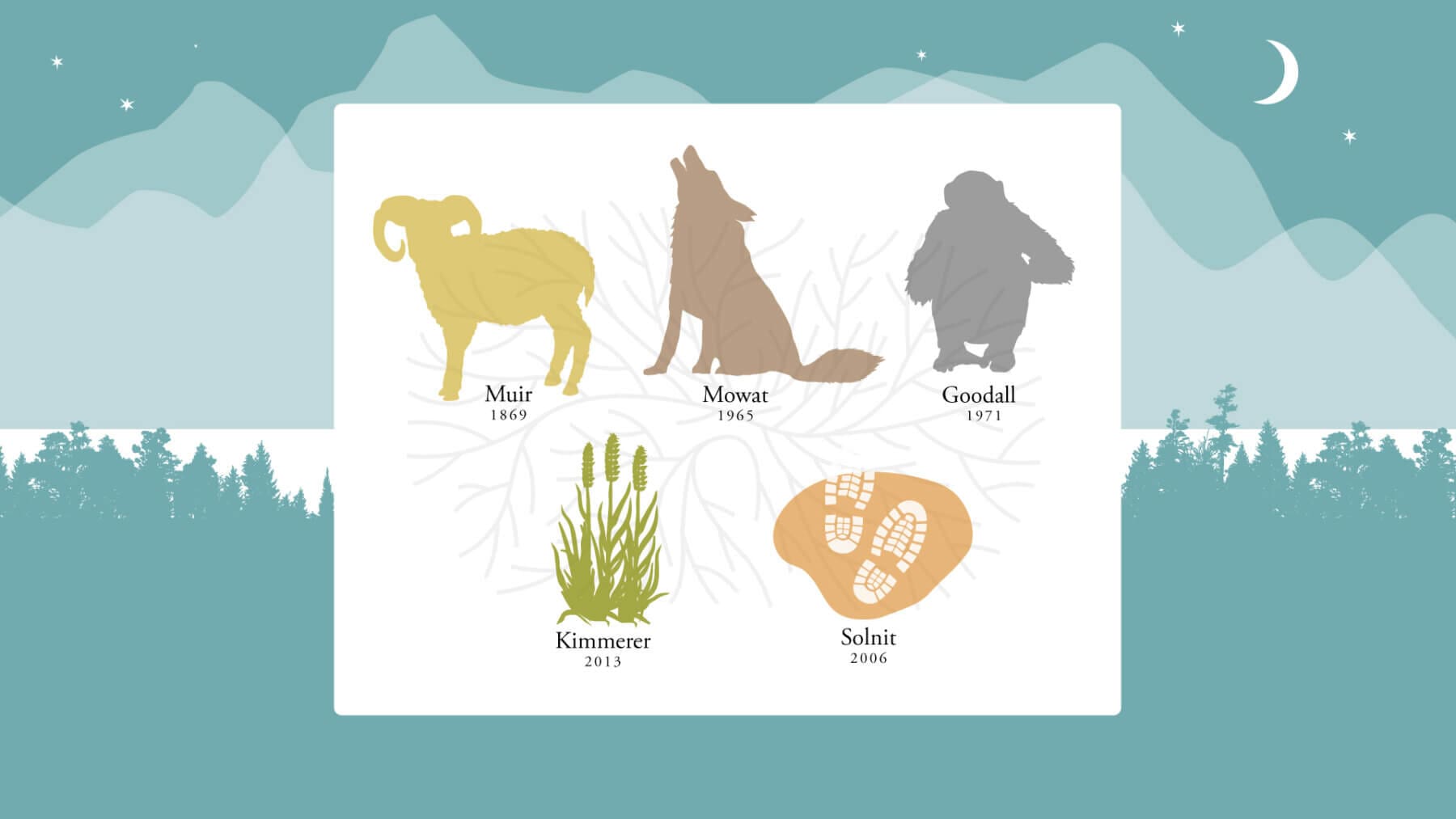
Welcome to our second volume of suggestions for your environmental reading library — our way of helping hear the wild geese, as Mary Oliver wrote, “announcing your place in the family of things.” We hope this can help you find gifts for environmentalists, or for your personal library.
In this moment, when climate change and mass extinction put the family of things under existential threat, we offer this ongoing list of essential books that draw from a sense of the sacred in nature, no matter how deeply buried. As John Muir wrote, “Every natural object is a conductor of divinity.”
These are books that change your life. They each present a different take on how our minds, relationships and material lives are shaped by the more-than-human world. This list of environmentalist books will grow and stretch — it’s not anyone’s idea of definitive — and it invites and demands your participation. Let us know what you’d add or subtract, and share your reviews. Upcoming volumes of book recommendations will follow.
We encourage you to read the following books as if putting on spiritual armor; nature needs a good, outspoken hero right now.
***
Never Cry Wolf, Farley Mowat
This delightfully entertaining yarn inspired an outpouring of love for wolves, even as it raised a storm of controversy about its scientific authenticity. In 1948 and ‘49 – two winters and a summer – Mowat was hired as a biologist with the Canadian Wildlife Service, tasked (as he described it) with affirming the concerns of sporting groups and legislators that wolves were decimating the caribou herds in what is now the Manitoba province and Nunavut territory.
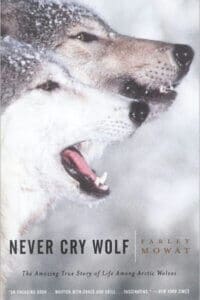
Instead, his official report and the ensuing 1963 book were met with outrage when he wrote that wolves only killed weak and sick caribou, therefore strengthening the herd. The real problem was humans, including sport hunters equipped with planes. Mowat took obvious joy in close observation of one family of wolves through the denning season in which they raised their pups, making a detailed study of the affectionate relationship of the two mates and a related male (“Uncle Albert”) who often babysat.
During that summer, when the caribou were sometimes out of range, he watched the wolves fill themselves on mice. And, following their lead, Mowat himself began experimenting with eating mice. His finding that the summer diet was heavy on rodents was met with derision, but subsequent studies repeatedly confirmed (including this one from 1998) that arctic wolves eat large numbers of ptarmigan (a kind of grouse) and small rodents such as mice, lemmings and voles, especially when ungulates are scarce.
Though Mowat’s supervisor pointed out he was actually stationed with two other biologists whom he never mentions in the book and wolf scientists pilloried his work, Mowat said in the introduction he “never let facts get in the way of the truth,” and later called the book a work of “subjective non-fiction.”
The public impact, however, was instant: when the book was published, the Wildlife Service was inundated with protest letters demanding that the government stop killing wolves, and Mowat was established as a beloved wildlife champion, writing scores of books.
***
A Field Guide to Getting Lost, Rebecca Solnit
The joy and surprise in many of Solnit’s books and essays is to find again that nature is bending our path, tugging at our imaginations, still whispering the original instructions. This “field guide” encourages the reader to trust our fundamental belonging to the Earth of dirt, water and sky, and to find out who we are when we go beyond the familiar — maybe even make a practice of doing so. A resulting transformation could be personal or planetary, or anything in between. Solnit writes: “Love, wisdom, grace, inspiration – how do you go about finding these things that are in some ways about extending the boundaries of the self into unknown territory, about becoming someone else?”
From the first essay about the spiritual, creative and even evolutionary necessity of risk, to the last which compares dreams of a childhood home — in which nothing is ever lost (reminiscent of Gaston Bachelard’s The Poetics of Space) — to the physical world in which so much is never even known, these related pieces explore what it means to be and how we earthlings know things. The entire book is filled with stories of people being not where they are supposed to be — search & rescue tales of finding a deaf and nearly blind 11-year-old lost in the woods, the wandering of would-be Spanish conquistador Cabeza de Vaca, Forty-niners following a bad map to their doom in Death Valley — which gives readers grounding in a familiar story type.
But Solnit stretches out beyond the geographical to use family history, personal travels, memories and beautifully curated research as her own “maps” to the unknown. The value of being lost, she finds, is not in some heroic overcoming of terrible odds, but in acknowledging that “dark waters” hold information we need. The more we know about the physical world, the more we’ll glean from this practice, and shape our journey by asking the right questions. This book is both permission and a how-to on finding new directions.
***
My First Summer in the Sierra, John Muir
We read Muir partly for the poetry of his descriptions, as when he first enters California’s Sierra Nevada Mountains accompanying some shepherds in Summer 1869: “Our flesh-and-bone tabernacle seems transparent as glass to the beauty about us … a part of all nature, neither old nor young, sick nor well, but immortal.”
But his writing also presents a deeper transition in ethical thought, as he boldly proposes that the natural world was not created solely for our exploitation. For instance, regarding poison oak, he writes, “the blind question, ‘Why was it made?’ goes on and on with never a guess that first of all it might have been made for itself.”
We still thrill to these passages today, because human society has largely not accepted this idea over 150 years later. The Scottish-American wilderness trekker, whose Christian family in Wisconsin was part of the religious Restoration Movement, would later convince President Theodore Roosevelt to make Yosemite a national park, found the Sierra Club and fight against the drowning of neighboring Hetch Hetchy Valley as a reservoir for San Francisco drinking water. On this trip, however, he glories in “God’s wild fields” and reveals the mystical powers that flow through deep connection to nature.
At one point, sitting atop the North Dome, he is suddenly possessed of an idea that his friend from Wisconsin, Professor J.D. Butler, was somewhere below him in the valley. Though he had not received any correspondence saying his friend would be in Yosemite, he descends immediately and, with great effort through a trail-less canyon, finds his friend the next day at Vernal Falls. Though he describes this experience as somewhat “supernatural,” he says he finds such happenings “comparatively useless and infinitely less wonderful than Nature’s open, harmonious, songful, sunny, everyday beauty.”
***
In the Shadow of Man, Jane Goodall
In 1960, young Jane Goodall and her mother, Vanne, set up a camp in remote equatorial Africa to study the behavior of chimpanzees, and so changed the world. The fact that she had little training and no credential other than the invite of famed anthropologist Dr. Louis Leakey was not the highest hurdle she faced. Those came from the (mostly male) scientists at Cambridge, from which she’d eventually earn her Ph.D., who told her that chimps could not have personalities, did not have minds capable of thought, and had no emotions. Back then, science lingered in a Cartesian world which regarded animals as soulless machines.
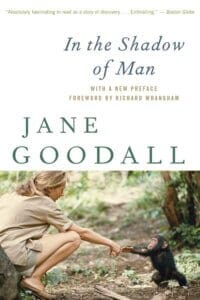
Goodall’s years of painstaking and refreshingly ego-less work to earn the trust of wild chimpanzees, in what is now Gombe Stream National Park in Tanzania, shattered the hard line between human and non-human. While doing it, she also shattered sexist notions that deterred women from dangerous field work.
And what an adventure! In her patient and gorgeous prose, she begins her 1971 book with the breakthrough moment when she was first allowed to sit on the forest floor with two chimps she’d been trailing through the bush for six months, David Greybeard and Goliath. Then, she returns back to the beginning, detailing – as a scientist – every fascinating discovery.
Evading poisonous snakes, centipedes, baboons, spiders and rampaging buffalo, she deals with drunk male staff, spends dawn to dusk in the bush, types notes half the night, falls in love with her husband Hugo when he’s sent to photograph her work for National Geographic, has a baby and steadily creates an indelible portrait of this chimpanzee clan that reshaped science — a clan that use tools, have well-defined personalities, are good parents and terrible parents, act on the learning of others, die of human diseases like polio and break our hearts.
***
Braiding Sweetgrass: Indigenous Wisdom, Scientific Knowledge, and the Teachings of Plants, Robin Wall Kimmerer
When Skywoman created Nanabozho, the original man of the Anishinaabe creation story, his first job was to walk the earth and learn the names of every creature. This was, and is still, a cure for the special loneliness we feel in a life separated from nature. “Names are the way we humans build relationships, not only with each other but with the living world,” writes Kimmerer, who is a botanist and a member of the Citizen Potawatomi Nation.
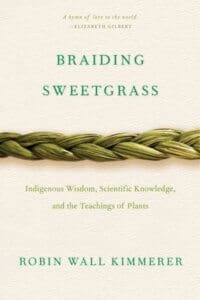
Her wildly successful book is a call to re-learn the teachings of plants that many once knew, but have forgotten in favor of a lonely modernity. A beautifully readable mix of botany and indigenous knowledge, Kimmerer’s exploration begins with the aromatic sweetgrass (Hierochloe), considered by her people to be the first plant to grow on the earth, which is plaited into short ropes for smudging and ceremonial uses. “When we braid sweetgrass, we are braiding the hair of Mother Earth, showing her our loving attention,” she writes.
Kimmerer moves on to pecans, strawberries, asters and goldenrod, maples, wild leeks. Each plant serves as a source of stories about the people, her family, natural history and our relationships to the breadth of the nonhuman world. As she weaves her narrative, the names and the connections thicken and we gradually start remembering a language – the “ssh of wind in needles, water trickling over rock, nuthatch tapping … the wordless being of others in which we are never alone.”
Interestingly, native stories depict Skywoman as falling to earth as an “immigrant,” hands full of shoots and seeds to begin growing a living world. There is an outsider’s perspective here that is particularly welcoming to the majority of us who came to North America from somewhere else. This book says everyone’s job is to become indigenous, making ourselves part of the community of beings. To decide, in other words, to stay.
Help us sustain independent journalism...
Our team is working hard every day to bring you compelling, carefully-crafted pieces that shed light on the pressing issues of our time. We rely on caring supporters like you to help us sustain our mission. Your support ensures that we can continue to provide deeply-reported, independent, ad-free journalism without fear, favor or pandering. Support us today and make a lasting investment in the future.

RELATED STORIES


Award Winning



Today’s environmental and social justice challenges are unprecedented, and require an unprecedented collective effort.


Stay updated on our latest features, events and more. Subscribe to our Note From the Nest newsletter!
