
Barbie through the Looking Glass
In her essay, “The Image-World,” Susan Sontag describes reality as having always “been interpreted through the reports given by images. Philosophers since Plato have tried to loosen our dependence on images by evoking the standard of an image-free way of apprehending the real.” Stanley Kubrick’s 1968 2001: A Space Odyssey opens with a scene illustrating early mankind at a transitional moment in relation to knowledge, technological advancement and violence. More than half a century later, writer and director Greta Gerwig’s much ballyhooed 2023 film Barbie begins with a satirical mirror of Kubrick’s 1968 iconic opener. Instead of a landscape filled with early mankind, Barbie presents one of bored little girls bashing their baby dolls to bits, exclaiming death to the baby doll, behold the emergence of Barbie.
Sontag’s observations of our contemporary reality contend with a philosophical bygone era. In our modern world, images and symbolic objects do not just intrude on our reality, but they also play a large role in its construction. The Cold War/atomic-age introduction of Mattel’s Barbie doll into the American psyche and marketplace gave rise to the ever-expanding and contentious role of Barbie — whose essence remains a source of debate — in the lives of little girls.
Barbie’s origin begins in the springtime of 1959, the year the doll first appeared on toy shelves. Ruth Handler, Barbie’s creator, credits the ideation of Barbie as a synthesis of young girls’ imaginative fascination with the lives of adult women during playtime, after witnessing the limitations her own daughters faced with the dominance of baby dolls.
Two Barbie prototypes debuted together — one blonde and one brunette. Clad in black and white striped swimsuits, sunglasses and matching red lipstick and manicures, Mattel proved successful at marketing their new doll to American consumers. Unlike other toy manufacturers before, Mattel’s strategy of marketing to little girls through the advent of television also placed the company in the ranks of American companies with a genuine edge for advertising.

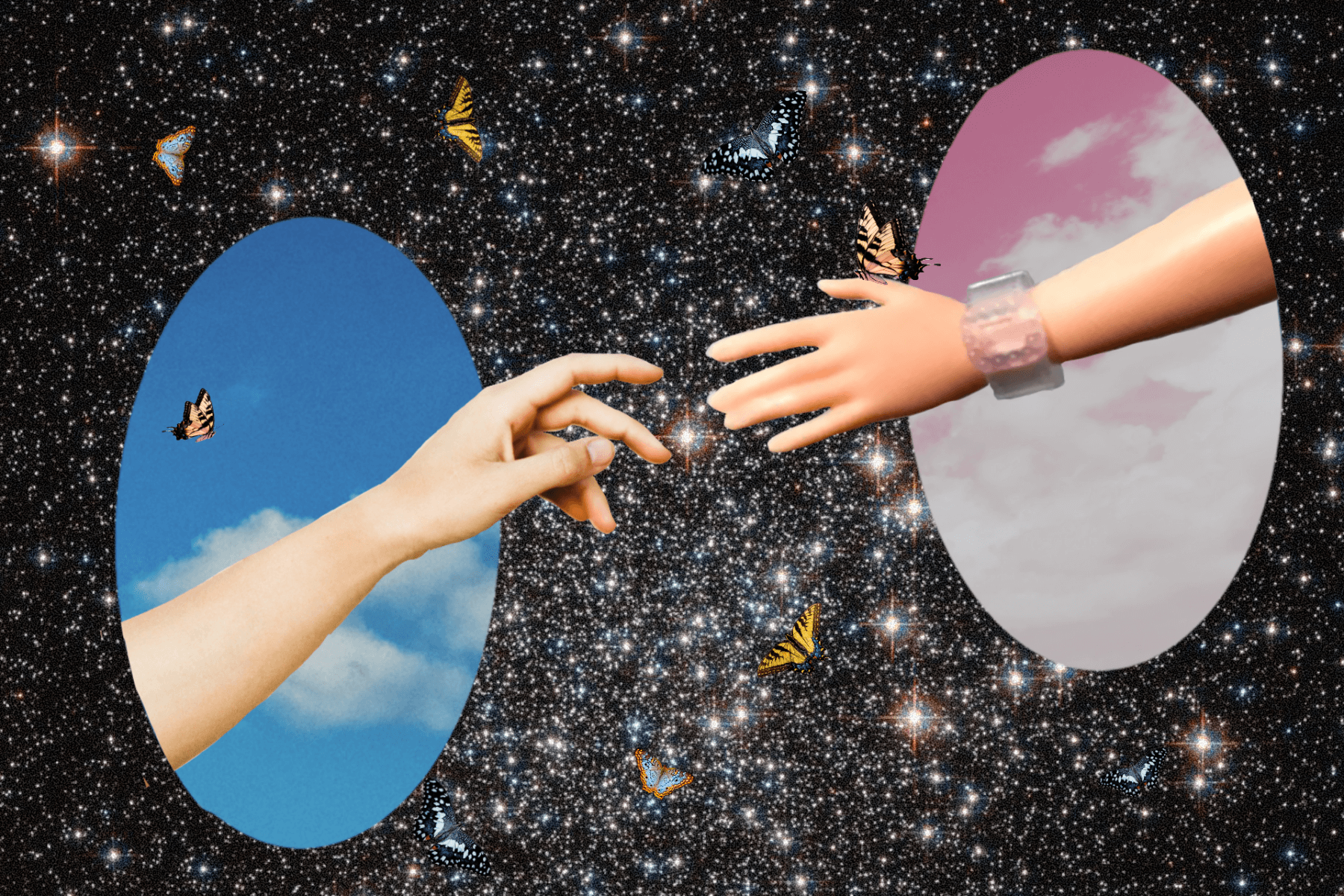
The world of Barbie, reflected in Barbie ads and packaging, presented an escape for young girls during wartime anxieties. Studies show that even the iconic hot pink logo color — often referred to as “Barbie pink” — has a calming psychological effect. lllustration by Tori O’Campo
Barbie’s first television commercial features a blend of thin, white, blonde and brunette dolls propped next to each other, showing off their different accessories and outfits. In one scene Barbie is dressed as the 1950’s quintessential homemaker, an intriguing visual escape born from the era of nuclear and Cold War anxieties. In another outfit, Barbie looks dressed for tea time with a friend. A jingle plays through the duration of the ad, the lyrics imploring: “…someday I’m going to be exactly like you.” Thus, Barbie was presented as an aspirational figure.
Mattel found success in advertising to the little girl directly, for better or for worse. The same Mattel that racked in an estimated $5 billion per year prior to 2023, launched one of the most successful and notable advertising campaigns for Gerwig’s 2023 film Barbie, which has currently earned over one billion dollars at the box office. The wildly popular Barbie comes packaged with both the capitalistic success and perceived sociological pitfalls some feminists have highlighted, including writers in Feminist Formations who offer, “Barbie’s longevity is, in part, due to Mattel’s deft repackaging of the doll to capitalize on emerging trends and niche markets, while retaining the preoccupation with appearance and prettiness that remains coded as white, slim, affluent and able-bodied.”
However, there is still ambiguity surrounding Barbie’s singular effect on those who play with her.
Mattel introduced the first Black doll, Christie, in 1968. By the 1980s, Mattel continued its attempts at diversifying Barbie to include Black and Hispanic dolls also named Barbie. Some critics see Mattel’s racial expansion of the original white Barbie prototype to include dolls representative of racial minorities as nothing more than “capitalizing on the concept of exotic difference.” In the summer of 1992, in New Haven, Connecticut, ethnographer Elizabeth Chin studied the anthropological side of Barbie’s “unbearable whiteness.” She entered the lives of elementary school-aged African American girls — a world of play, poverty and innovation. Chin’s ethnographic work that summer entailed learning and immersing herself in the behavior of young girls in the New Haven community, especially in regard to how they interacted with their dolls. In 1991, a year prior to Chin’s fieldwork, Mattel had released another line of Black Barbie dolls. During the entire duration of Chin’s fieldwork in New Haven, only one child had drawn attention to the race of their dolls.
Take Barbie off the shelves and the societal forces at play that have subjugated the plight of women still exist.
What Chin did find was that the young girls in her case study possessed a more imaginative conceptualization of race than the rigid boundaries of corporate marketing efforts. Photos taken during Chin’s fieldwork depict young African American girls with white dolls, with the dolls’ hair culturally styled in Black hairstyles such as braids. Through the girls’ refusal to play with their white dolls as if they were actual representations of whiteness, the girls in Chin’s study rejected what is now a long-standing strategy to get consumers to buy into the idea of purchasing racialized mirror products that look like everyone. The New Haven girls were ultimately successful at a kind of self-expression and imagination that exceeds the normative boundaries of how race is advertised in products.
My issue with the overwhelming social critique of Barbie as an agent of racism, patriarchy and class divides — especially as it has been reexamined through the lens of Gerwig’s film — lies within a consumeristic logic that is embedded within certain negative assertions applied to Barbie and its role on little girls. Critiques of Barbie assign a level of influence to an object that appears to exceed the effect it actually has on humans and society. Barbie sometimes emerges as a scapegoat, a symbolic representation of issues that affect women across ages, race, and social class, packaged neatly into a seemingly simple capitalistic solution to complex issues. Take Barbie off the shelves and the societal forces at play that have subjugated the plight of women still exist.
Although still somewhat tangled in the roots of consumerism, Barbie forces us to re-examine and contemplate our existing knowledge of patriarchy, girlhood, womanhood and the relationship between women and our physical appearance, which culturally bridges girls across racial and class divides. The cultural dissection of the Barbie doll perpetuates the hyperfixation of women on their physical appearance as well as the devaluation of widespread girl culture. Gerwig’s Barbie holds a funhouse mirror to the unequal gender dynamics of today, but more importantly, crafts a cultural event that speaks to girls as co-visionaries of our own fantasies.
Corporate America’s presence, beyond just Mattel, is magnified in the film. Moments of Barbie do feel like ads, with obvious product placements spread throughout with attention to car brands like Chevrolet and Hummer. Barbie’s Margot Robbie is draped in Chanel and Birkenstocks, with clear shots of their logos throughout the film. Gerwig pokes fun at the imagery of an all-male executive boardroom during the film’s depiction of Mattel headquarters. Fully leaning into the absurdity of a clearly feminist-led project funded by male-led corporations, Barbie walks a narrow tightrope that balances irony and social critique in its moments of humor.
Gerwig’s Barbie holds a funhouse mirror to the unequal gender dynamics of today, but more importantly crafts a cultural event that speaks to girls as co-visionaries of our own fantasies.
Lauren Greenfield’s photography book, Girl Culture, captures the sort of visual language that encapsulates the inner lives and shared experiences of young American girls that is recognizable to other women. Fraught with images of girls emerging into young adulthood at the complicated intersection of consumerism, over-sexualization, and joy, Girl Culture and Barbie share similarities not in their aesthetics, mediums, or overall tones, but rather, in their deliberate creative decision to bring young girls’ capacity for world-building to the forefront of their work. Both works assert young girls as equally self-aware as they are creative in tackling consumerism and femininity. In her book Barbie Culture, Mary F. Rodgers writes on the underestimated awareness and agency of young girls across social classes, “Sometimes they have more insights into the deals they strike with corporate America, popular culture and mass media than adults recognize.”
Think of America Ferrera’s presence in Barbie.
Ferrera plays Gloria, mother to middle-school aged Sasha, employee at Mattel, and champion of Margot Robbie’s “stereotypical Barbie.” To girls of a certain generation, Ferrera embodies the advancement of Latinas across film and television. Films like Real Women Have Curves and Sisterhood of the Traveling Pants and television shows like Ugly Betty not only echo the media landscape of growing up in the early 2000s, but have also broken barriers of Latina representation through non-condescending art forms. Mexican-American writer Sandra Cisneros channels memories of playtime with Barbie through the impoverished and non-white lens that colors many Latinas’ childhoods in her short story, “Barbie Q.” However impoverished and “othered” one may be, the appeal of traditional femininity offers girls a contrasted sense of comfort and entry way into a lifelong construction of the artificial version of themselves.
Several studies have drawn links between Instagram use and increased rates of eating disorders, depression and negative body image that disproportionately affect young girls. The American Psychological Foundation cites the increasing over-sexualization of young girls as one of the most detrimental impediments to young girls’ cognitive and social development. Aside from Meta’s leaked internal research from 2020 confirming this, additional research since then has found that teenage girls are not only aware of Instagram’s push to platform sexualized images of women, but young girls now perceive it as normal. Other studies continually find evidence of gender disparity in regards to degrees of nudity within visual advertisements. In Los Angeles, American Apparel ads still appear on billboards every few blocks, despite the brand’s history of employing photographers accused of sexual misconduct dating back to 2001.
The societal misery embedded in growing up as a girl is reflected in the feminist notion of the double bind. Girls’ agency and development of self-esteem are largely hindered through patriarchal punishments for seemingly everything they partake in or offer attention to. Girls thrust into the judgment of the public will always lose. In the political sphere, we’ve watched women like Dr. Christine Blasey Ford publicly testify in front of the Senate Judiciary Committee in 2018 in response to Brett Kavanaugh’s Supreme Court Nomination. Despite Ford’s account of sexual assault at the hands of Kavanaugh, the Senate confirmed Kavanaugh’s lifetime appointment to the Supreme Court, merely two decades after Anita Hill’s testimony during Clarence Thomas’s Supreme Court nomination in the fall of 1991. Barbie challenges one of the most insidious and archaic double binds that still harms girls today, this is the categorization of women as either invisible or sex objects. Women who fall into the physical dimensions of “conventional beauty” are dealt a constricted hand of how serious their ideas can be taken, for their role is that of the idea itself. Patriarchy and capitalism promise that “the grass is always greener on the other side.” If I was only prettier, more object-like, the humanness of uncomfortable feelings and circumstances would no longer exist. Who better to represent this plight than Barbie herself, an actual object?

A look into Barbie world, as Gerwig imagines it, allows audiences to reflect on their own relation to girlhood. Illustration by Tori O’Campo
As soon as Barbie, played by Margot Robbie, steps foot into the real world, she’s greeted with a slew of verbal harassment by men in response to her physical body. Of her time spent working as “briefcase girl #24” on Deal or No Deal, Meghan Markle has said, “I had also studied International Relations in college, and there were times when I was on set at Deal or No Deal and thinking back to my time working as an intern at the U.S. Embassy in Argentina in Buenos Aires and being in the motorcade with the secretary of treasury at the time and being valued specifically for my brain. Here, I was being valued for something quite the opposite.” Reflecting on her experiences of working as a model, Emily Ratajkowski writes in her book My Body of, “Facing the reality of the dynamics at play would have meant admitting how limited my power really was — how limited any woman’s power is when she survives and even succeeds in the world as a thing to be looked at.”
Why should we listen to Barbie? Robbie’s portrayal of stereotypical Barbie, which presents Barbie undergoing a crippling existential crisis and growing human-esque insecurities, offers a powerful resolution once Barbie uses her wit to save herself and her friends from being overtaken by a world of Kens. Barbie grants a form of humanity to the kinds of women who still are regularly the butt of the joke. Even real-life women we deem as physically perfect, as real-life “Barbies,” aren’t immune to the effects nor are they the sole propellers of patriarchy.
Girlhood has an expiration date that markedly arrives too soon. Girls are forced to become women, men are allowed to be boys forever.
My own memories of girlhood are clouded by the sinking realization that for the rest of my life, I would struggle to get others to uncouple my appearance from what I had to say. For me, my race and gender often dictate how others perceive my intellectual capability, which fuels a cycle of self-doubt that is far more hurtful to me than my perception of what I look like from day to day. The way I look does, however, make me a keen anthropologist, which I care about and value. I’m coded as traditionally feminine and physically small. I’m consistently let into the world of girls, especially young girls, without intrusion. Here, I blend in. I was raised by my mother, have two sisters, and am an aunt to only nieces. I experienced all four years of high school as a cheerleader, and later took on roles like music video girl extra. When I look back on my own past, it is hard to untangle the role of objectification from the experiences of when I was most aware of my gender. The collection of my own experiences are marked by being both an observer and active participant in the sometimes contradictory sociological condition of girlhood.
There comes a time during childhood when girls are expected to give up their dolls, and say goodbye to Barbie. While I never had my own quinceañera, a common occurrence during the celebration is the tradition of la última muñeca, or “the last doll.” Fathers give their daughters a doll, which their daughters then gives away to younger girls, symbolizing the end of childish interests and a readiness for marriage, motherhood and adult life. A major aspect of girlhood is undergoing adultification while still being a child. Girlhood has an expiration date that markedly arrives too soon. Girls are forced to become women, men are allowed to be boys forever.
My own farewell to my Barbies inevitably came in a more private and gradual goodbye. My Barbies migrated from my bedroom to a bin in the garage, collecting dust and containing memories of my younger self. I had always been reluctant to completely get rid of them. Maybe I could sell my collectible and rare Barbies and make a return on my parents’ investment. Over time, I was forced out of girlhood entirely. I traded my childhood bedroom for elite academic spaces. I exchanged confidence in my creativity for the loneliness of male-dominated industries.
I’m less concerned about what Barbie represents to adults than what she represents to girls. Barbie, at its core, is a complicated symbol of girlhood. Gerwig’s Barbie is essentially about and for girls. Mattel looms over Barbie’s legacy as a reminder of the inescapable presence of consumerism, just as racial capitalism seeps into and targets childhood, for both boys and girls. Trade in your superhero movies for a chance at revisiting the world of girls. Watch as all types of people dress up in shades of pink and bond with their friends, revel in silliness and revert for a moment to a time and space where existence and enjoyment were enough.
Help us sustain independent journalism...
Our team is working hard every day to bring you compelling, carefully-crafted pieces that shed light on the pressing issues of our time. We rely on caring supporters like you to help us sustain our mission. Your support ensures that we can continue to provide deeply-reported, independent, ad-free journalism without fear, favor or pandering. Support us today and make a lasting investment in the future.

RELATED STORIES


Award Winning



Today’s environmental and social justice challenges are unprecedented, and require an unprecedented collective effort.


Stay updated on our latest features, events and more. Subscribe to our Note From the Nest newsletter!
