How to Imagine a Better Place

James Rojas is an urban planner’s urban planner – trained at MIT, lived in Europe, former employee of the powerful Los Angeles Metropolitan Transportation Authority, founder of Latino Urban Forum – a volunteer organization where planning and other civic-minded professionals work to better communities – and in-demand speaker and now author. Which is all kind of funny, because it’s taken a couple decades – and 1,000 workshops around the country and globe – for the profession to begin to bring Rojas and his people-centric approach to placemaking into the fold. Or, at the very least, to come around to Rojas and frequent collaborator John Kamp’s refreshingly joyful, inclusive and engaging reimagination of the public process of planning.
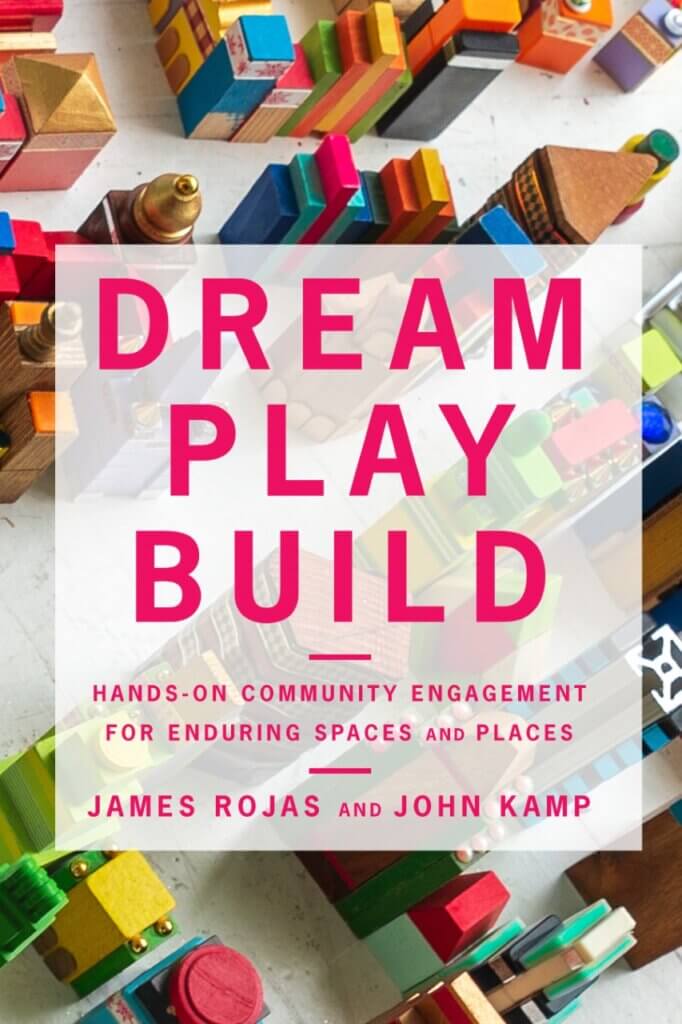 Rojas and Kamp have a new book out, Dream Play Build: Hands-On Community Engagement For Enduring Spaces and Places (Island Press 2022). In it, the duo share anecdotes from their “Place It!” workshops, site “explorations,” and pop-up city modeling sessions that Rojas, who was born and raised in East Los Angeles, has organized around the U.S. and globally. The book includes a case study about a three-year city planning project they were invited to do in the Southern California community of South Colton.
In Dream, Rojas and Kamp provide point-by-point instructions on how to replicate their process to other planners, politicians, facilitators – anyone willing to do what it takes to receive the genuine ideas of real people who care about how their blocks, burghs, and beyond should be built or unbuilt. And, in case there’s any doubt what we people really want, here’s a spoiler alert from Rojas: No one has ever asked for more parking lots. Yet, many places keep building them.
I first wrote about Rojas more than a decade ago, for Next City. Back then I described him as, “…planner, transportation guru, artist, gallerist, scene-maker, placemaker, and paradoxically placid one-man-whirlwind.” All that still checks out, other than he closed down his Downtown L.A. art space, Gallery 727. I remember participating in one of his “Place-It!” workshops. How do these sessions work? Rojas and company gather community members, do an icebreaker, put a bunch of nondescript everyday objects out on tables, and invite everyone to take a few minutes and imagine their dream city. Easy!
Sure, there is a deeper philosophy behind this, and a dedication to making public-government meetings participatory and pleasant, not regressive and rage-filled. But at their core, Rojas’ workshops allow you to be a kid again, moving around leaves or blocks or bottle caps or hair rollers and then telling the rest of the room what they symbolize. It’s fun and freeing and the least intimidating urban planning inquiry imaginable. This is one reason the technique wasn’t taken seriously for far too long.
When I reach Rojas for this conversation, he’s standing outdoors, X-acto knife in hand, a large T-Square on the table, lattices behind him, plants around him. As we speak, he works on an oversized abstract model he’s preparing as an engagement tool for a green-building conference. In the model’s rendition of Los Angeles’ “Figueroa Corridor,” there will be shade trees, medians, protected bike lanes, a bus lane, and the Zanja Madre – L.A.’s original “Mother Ditch” aqueduct that brought water from the pre-channelized Los Angeles River to the original Spanish settlements.
This interview has been edited for length and clarity.
You and John Kamp write that you’ve done 1,000 workshops. I feel like you’re Al Gore traveling around with his PowerPoint, prior to the Inconvenient Truth movie. Is the purpose of writing Dream Play Build to reach a larger audience? Is it to “train the trainers” – the nation’s urban planners?
I wrote the book to understand the phenomena, because we did over 1,000 workshops, and they work – but why? The book helps people understand the work on a more intellectual level, where just me talking about it as an artist or a “wacky guy,” it’s fun and games. It’s been well-received by a lot of folks, and it’s a way to get people thinking about this method as legit.
What took so long for some of your peers to understand your strategy?
I started out in the Social Practice art world – you know, my gallery Downtown – and that allowed me to experiment and develop this method. It worked a lot with nonprofits and a lot of marginalized people, because they need planning also. But now it’s reaching the urban planning world. It’s been sad because planners didn’t really value this kind of community engagement; they’re technocrats and they want to know technical data. They don’t want to know a place; they don’t want to feel a place. And if you can’t articulate that feeling that people have, your plan’s going to fail. So, for me, it’s really kind of bringing feeling and emotion into the planning process. A really critical part about cities is that people like to go somewhere based on their emotion. It has no rhyme or reason. That’s important to think about, because a lot of our planning falls flat. In L.A., we built all these schools in the `80s and `90s, and many of the schools feel like prisons. You got the land use right – with the feeling wrong.
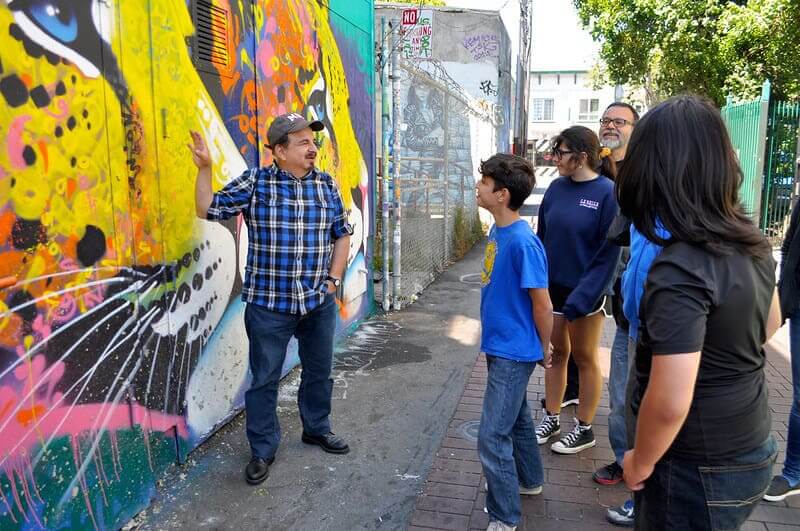
Rojas engaging with the local community to plan a better neighborhood. Photo courtesy of James Rojas
Over the years, what’s changed in terms of what people tell you they want?
It’s pretty much the same. People want to reconnect with other people and have a relationship with their community, physically and socially and mentally. A lot of young people like community gardens, so that’s become popular. So has biking and walking.
And a bunch of non-descript, found objects bring this out? Why not give people in your workshops literal items, such as Matchbox cars and doll houses?
The objects really provoke emotion and creativity. You want people to really think outside of the box. If I give everybody a house and a car, they will just build their models with houses and cars and things would never change. That’s exactly the problem with planning – they give people the house and the car all the time, so they’re in this hole they can’t get out of. But when you give people other things to play with, their mind is free to roam. They come up with more innovative ideas because now they have agency. These objects really provoke that kind of freedom of expression – there’s no right or wrong answer about the way to use a hair roller.
But when you give people other things to play with, their mind is free to roam. They come up with more innovative ideas because now they have agency.
Why do you ask people at the beginning of a workshop to share a favorite childhood memory?
If people just came in from a bad day at work, they’re not thinking about tranquility, they’re not going to plan tranquility. You’ve got to get people in that right headspace. The memories always focus on an experience – in nature with family, with people at the beach, climbing a tree, smelling a flower. It’s never about toys, it’s never about ownership. You have to strip away all the material baggage that people carry with them to get to their core values that really make them happy. And how do we set the tone to plan? Because so many people think, “I need more money and a bigger house and a better car and I’ll be happy,” but a lot of times, people’s ideal world is focused on public space, parks, nature, having access to trees.
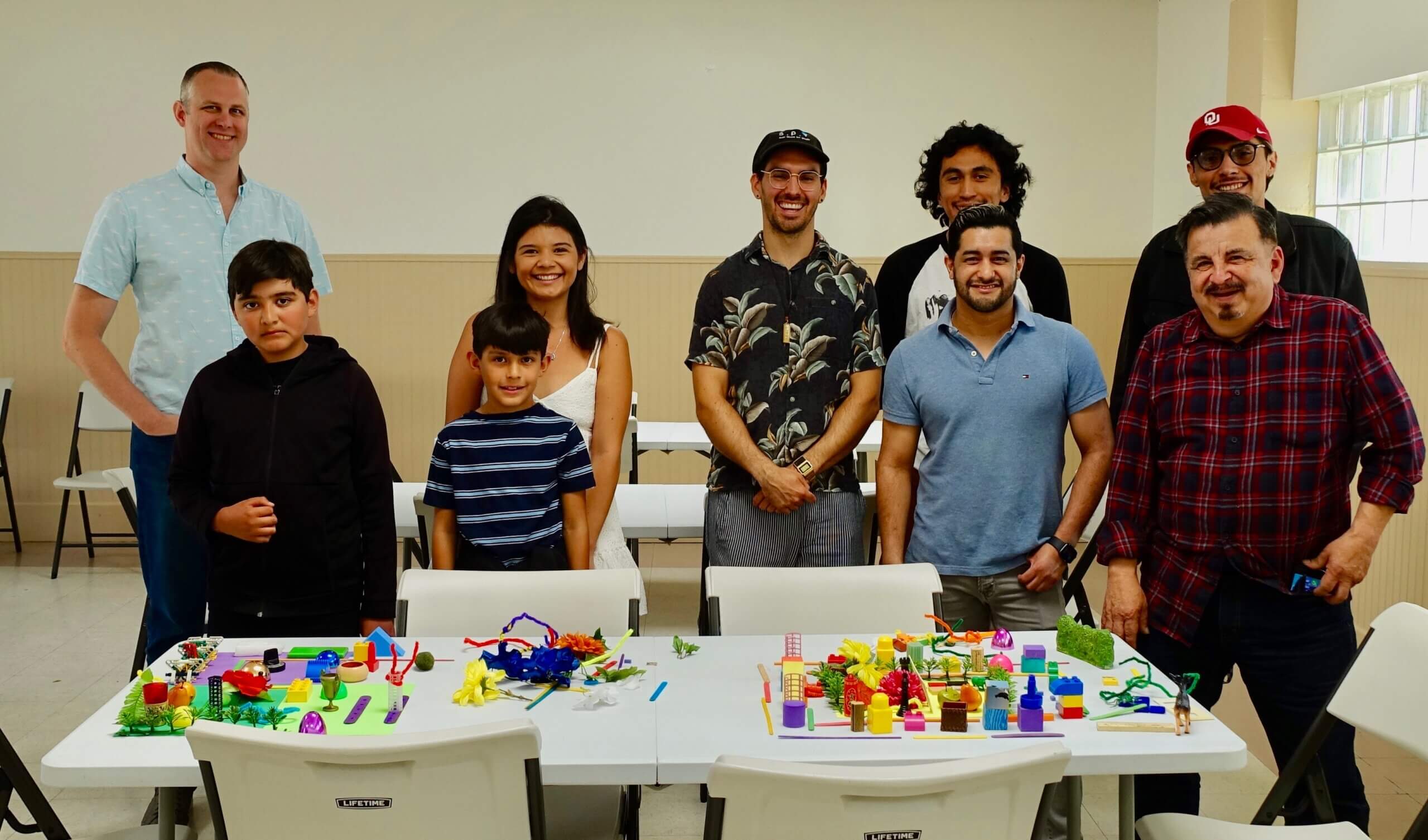
Community members at a “Place It!” workshop, models crafted with found objects included. Photo courtesy of James Rojas
You write about what takes place at some public meetings. In my experience, these meetings don’t necessarily work out in a way that makes me hopeful for the next one.
Yeah. It happens. Many people don’t go back. Therefore, the planners hear some angry people and it kind of falls apart. Most planners think that it doesn’t work. Part of my job is about convincing planners that community engagement does work. Lots are really jaded on the whole thing.
It’s been sad because planners didn’t really value this kind of community engagement; they’re technocrats and they want to know technical data. They don’t want to know a place; they don’t want to feel a place. And if you can’t articulate that feeling that people have, your plan’s going to fail.
You lived in Europe when you were in the Army and the Peace Corps. You went to grad school in Boston. Why come back to Los Angeles, when those other places already have so much of what you advocate for to make cities more livable?
I’ll always be an Angeleno. I have family and friends and connections here. And L.A. is such a multicultural, messed up, crazy place that a process like [Place It!] works here. It wouldn’t come out of New York or Boston or San Francisco because those are already perfect places—they just want to maintain a status quo. Where here and in China, we want to make something new all the time. How do you bring people from different backgrounds, lifestyles, income, languages – everything – together in one place and have them share thoughts and ideas? This is very much an L.A. process.
What would help make L.A. a “perfect place”?
Looking at the environment and giving people more of a stake, asking people the right questions, using the right tools. For example, if you ask people how they would improve mobility in L.A., they will just say off the bat: more parking, less traffic. If you have them build their mobility improvements to L.A., they build more trees, pedestrian streets to add walkability, quiet streets, nature. We just have to reframe and give people the right tools to create the solutions that we need.
A lot of times, people’s ideal world is focused on public space, parks, nature, having access to trees.
On a scale of one to Robert Moses, how much input should the public have in planning?
Planners have skills. Robert Moses had skills to build cities, but he was just building his way and not really listening to other ways. He would’ve built a freeway right through Washington Square Park in New York City; Jane Jacobs had to stop him. But he thought he was doing the right thing, and he did make the beaches of Long Island accessible. But the means of getting there were destructive. I think we always need more people in the room, because planning is about everybody.
How has L.A. changed, lately?
L.A.’s gotten really different; its energy has really changed these ten years. It’s more expensive, more congested, a lot more aggressive. It’s not the kind of creative place it was ten years ago. The city feels more divided, more problematic. You have so many homeless people now, there’s not a way to solve it, it seems like. And you have these homeless folks riding Metro. That’s really disappointing because [the city] worked so hard to get [rail lines and bus lines] built, and then it’s full of homeless people and other people don’t use it. The whole idea has been, we’re going to build this utopian city with the train – that hasn’t really happened. I do think people are more accepting of transit. They finally realize that we need transit to solve our problems, we can’t build more freeways. Which is good. [Editor’s note: Following this interview, longtime community opposition paid off in the L.A. area, and a $6 billion freeway widening was cancelled.]
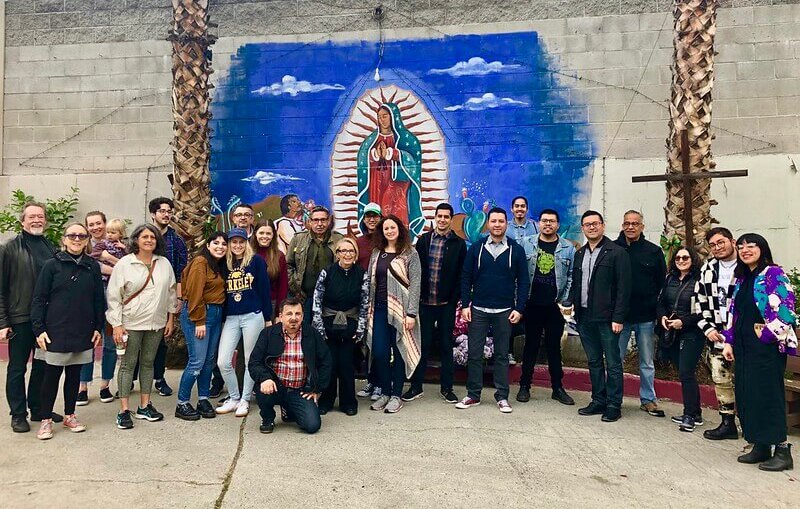
Rojas and local community members on another site exploration. Photo courtesy of James Rojas
Way back when, I would write and say, ‘let’s turn Wilshire Boulevard into a public park, 16 miles long, from Downtown to the Pacific Ocean.’ L.A. was about to build a subway under Wilshire, so the timing was perfect.
We’ve done 1,000 workshops plus, and nobody’s ever built a parking space.
You write in Dream Build Play: “Through my wanderings and explorations, I began to realize that what separated Latino USA from the rest of L.A. was how people used space. Latinos were transforming the hostile, auto-centric streets of Los Angeles into intimate, sensory-rich urban places… to enhance the social cohesion of the neighborhood.” Is that a uniquely Latino scenario? And what is the history that led up to this?
It’s probably not uniquely Latino. People use space differently, but maybe the circumstances are uniquely Latino because we’re half Indian and half European, right? We’re both the conquered and the conqueror. We have both in our blood, so we have a different connection to land. I think a lot of our ideas about land are based on relationships. If you think about the 13 colonies, there were all seaport cities from Boston to Savannah and the British gave the go-ahead for trade and commerce. In Latin America, Spain set the tone and had a lot of control over how cities were designed and functioned. It was set in a certain way to develop a sense of settlement; our community really enhances these relationships. Where if you think about Monticello, it was a factory that grew tobacco for Jefferson.
Let’s say your methods are universally adopted. Down the line, what will change in our cities?
Other than parking requirements? You’d have a lot less asphalt. A lot less problems. You would see a lot more environmental awareness, a lot more trees, a lot more shade, and a lot more nurturing the body and the mind.
Help us sustain independent journalism...
Our team is working hard every day to bring you compelling, carefully-crafted pieces that shed light on the pressing issues of our time. We rely on caring supporters like you to help us sustain our mission. Your support ensures that we can continue to provide deeply-reported, independent, ad-free journalism without fear, favor or pandering. Support us today and make a lasting investment in the future.
RELATED STORIES
Award Winning


Today’s environmental and social justice challenges are unprecedented, and require an unprecedented collective effort.


Stay updated on our latest features, events and more. Subscribe to our Note From the Nest newsletter!
