Parable of the Surfer
- Examines what the new climate normal looks like for urban New York surfers and beachgoers at Rockaway Beach
- Highlights the changes in marine life around the beloved surf spot and what that signals
- Delves into the conservation versus development conflicts, especially around a proposed gas pipeline
It’s a glassy July morning out in the lineup off of the 70th Street jetty in Rockaway Beach, New York. The extreme weather catalyzed by a gathering “super El Niño”—gales, flash floods, even a couple of tornadoes—has brought portents of what’s to come for disaster planners, but a rare window of decent surf for Northeastern surfers. This is one of the anomalies of surfing: There are often opportunities in unrest. Which is why I’m up at dawn navigating an hour commute by subway, surfboard in tow, hoping to catch a few waves before the workday begins.
El Niño is a naturally occurring phenomenon related to the warming of seas in the equatorial Pacific, which in turn increases global temperatures, alters weather patterns, raises sea levels, and disrupts marine ecosystems. While the phenomenon originates on the West Coast and historically plagues the Pacific, this year in particular, it has been threatening to turn New York City tropical—accelerating a warming trajectory that has been long underway. I try to forget about this as the A train barrels away from the steamy metropolis towards plein air, the Manhattan skyline faintly visible under a thin layer of smog.
This morning in the water, everyone is scoring rides. But that’s not always the case. More often than not, the Rockaway surf forecast reads generous, and the conditions turn out to be subpar. And far from what one might have in mind of surfing—something like a longboard dancing its way across the open face of a peeling point break—most days at Rockaway you’re lucky to catch a split-second of sweet, up-and-riding suspense before the wave closes out. I often wonder if the ends justify the means, and I know I’m not alone. But my day will be better because I’ve gotten in the water. I’m not alone in this, either.
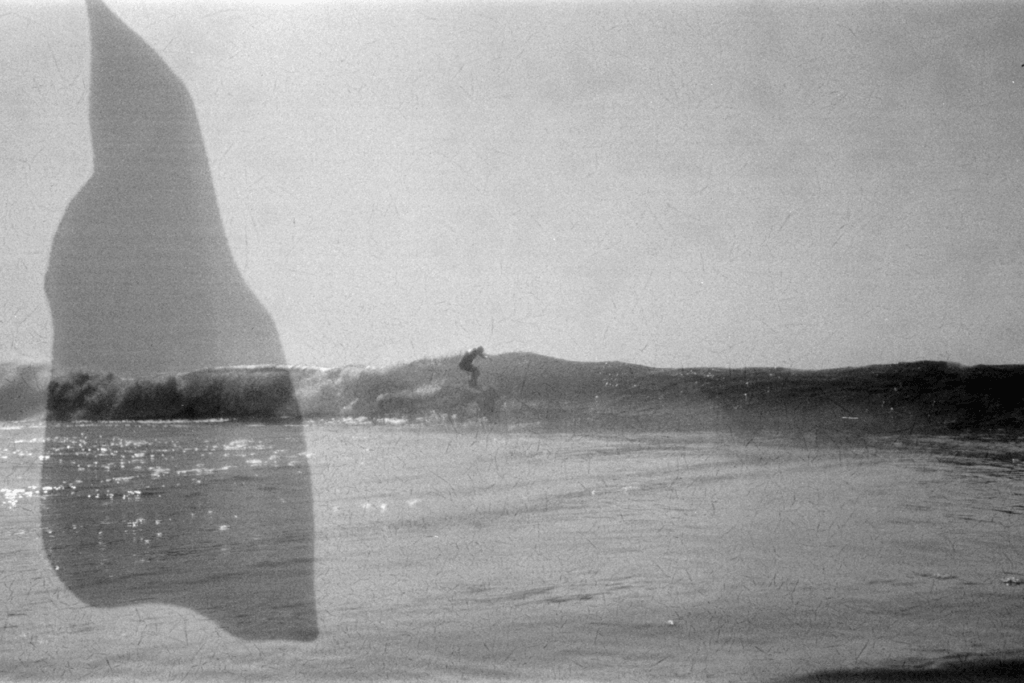
35mm film still from “Film Drains, Rockaway Beach” (2022). Courtesy of Em Joseph
Flash forward to press time. It’s late hurricane season in New York, and the Rockaways have seen a mere weeklong stretch of swell during a September nor’easter, plus a brief two-day window of surf in early October as remnants of Hurricane Isaias made its way up the East Coast. Fall is typically the most active time of year for surfing in the Northeast, but this year, upper-level wind shear caused by the previously mentioned El Niño weather patterns has stalled most seasonal storm action on the East Coast, stopping any hope of swell in its tracks.
It is worth noting, however, that the two storms which resulted in waves for the Rockaways thus far were not an exception to the El Niño rule, but a symptom of it. Such is the paradox of this new normal. The late September nor’easter that struck New York was the result of a moisture-packed Pacific jet stream making its way across the southeastern U.S. and up the East Coast—an abnormal pattern attributed to the El Niño phenomenon. And October’s Hurricane Isaias was fueled by a warming Gulf (approximately 2.7 degrees higher than normal), allowing it to overcome the previously mentioned wind shear during a weaker moment. Both storms brought with them significant power outages and heavy flooding as they made landfall across the Eastern Seaboard.
Meanwhile, on the other side of the country thanks to El Niño, sixteen storms—including two Category 5 hurricanes—have formed and thrived, with Hawaii alone facing three tropical systems in less than a month, while the California coast gets battered by high tides and big waves. For a surfer, it’s easy to yearn for the waves these storms have brought to more marquee surfing destinations. But to just about anyone else, it’s terrifying to think about the damage they’ve done to coastlines and communities as they make landfall—and this is just the beginning.
***
If it’s not already clear, New York City is by no means a surf destination. The swells are inconsistent, the waves break fast and steep, requiring a specific type of dexterity to maneuver, and the water is frigid for three-quarters of the year. Not to mention, the endless summer lifestyle that gave rise to surfing in many warmer locales is antithetical to the life of most New Yorkers. Nearly every New Yorker, regardless of tax bracket, will at some point find themselves lugging grocery bags home from the store at the mercy of public transit delays or shutdowns, or caught (likely ill-prepared) in torrential rain, snow, or some mucky combination of both. Unfortunately, due to global warming patterns, these occurrences are becoming more frequent.
Nobody moves to New York City to surf. But some come here because you can surf, while also enjoying nearly endless arts and culture experiences, pursuing a career in nearly any industry and experiencing the cultural diversity that comes with a place where roughly 37 percent of the population was born outside the United States and some 800 languages are spoken. Or perhaps I’m just biased from growing up here.
In recent years, this diversity has extended into the Rockaway Beach surf lineup, traditionally—as with many other breaks—a white-dominated space. This is in no small part thanks to groups such as the Laru Beya Collective, a nonprofit “dedicated to empowering the historically excluded youth of the Far Rockaways through surfing,” among other grassroots efforts including promoting water safety and environmental awareness.
And while actual surf destinations have to contend with jagged rock or reef bottoms, sharks, stingrays and other wildlife, and even the wildfires that have burned their way down to the beaches at some Southern California and Hawaiian breaks, the biggest issues for surfers in the Rockaways have been navigating crowds of novice surfers and the occasional riptide. That is, up until recent years.
During that aforementioned summer morning at Rockaway Beach, a shark fin surfaced about a half-mile out. Several of us spotted it. We all exchanged uneasy glances. A couple of surfers paddled in. “Don’t tell them what post you’re at,” cautioned a local. He was referring to the beach patrols, who would likely mandate evacuation from the water if they caught wind of the shark sighting. And on this perfect morning, the waves were too good to risk that.
Thanks to the films Jaws (1975) and Soul Surfer (2011), and perhaps a bit of generalized anxiety, there’s not a single session during which I don’t think about sharks while paddling out or flinch when something grazes my ankle underwater. But this fear always seemed irrational, like my sister’s worry about a tsunami hitting New York when we were growing up. Suddenly, it wasn’t. I hope her fear never materializes in this way, but in the current climate, I can’t be so sure.
This shark sighting took place just a few days after the Fourth of July holiday weekend, during which multiple sightings—most notably a swarm of bull sharks spotted close to shore and an attack at nearby Jones Beach on Long Island—intermittently closed several stretches of coastline in the New York area at the peak of an intense heat dome that had pushed temperatures past the century mark. According to the New York City Department of Parks and Recreation, 16 sharks were spotted off Rockaway Beach between July 1 and July 5 of this year. Later, drones would capture two massive great white sharks passing by, as well as a tiger shark and her calf.
“We’ve always had sharks,” said Del Felicien, a longtime Rockaway surfer and owner of the local surf shop and board rental company Breakwater Surf Co. “But this year, we’ve seen different sharks coming in a little closer—more spinners, more [great] whites; I think someone said they saw a hammerhead shark the other day.”
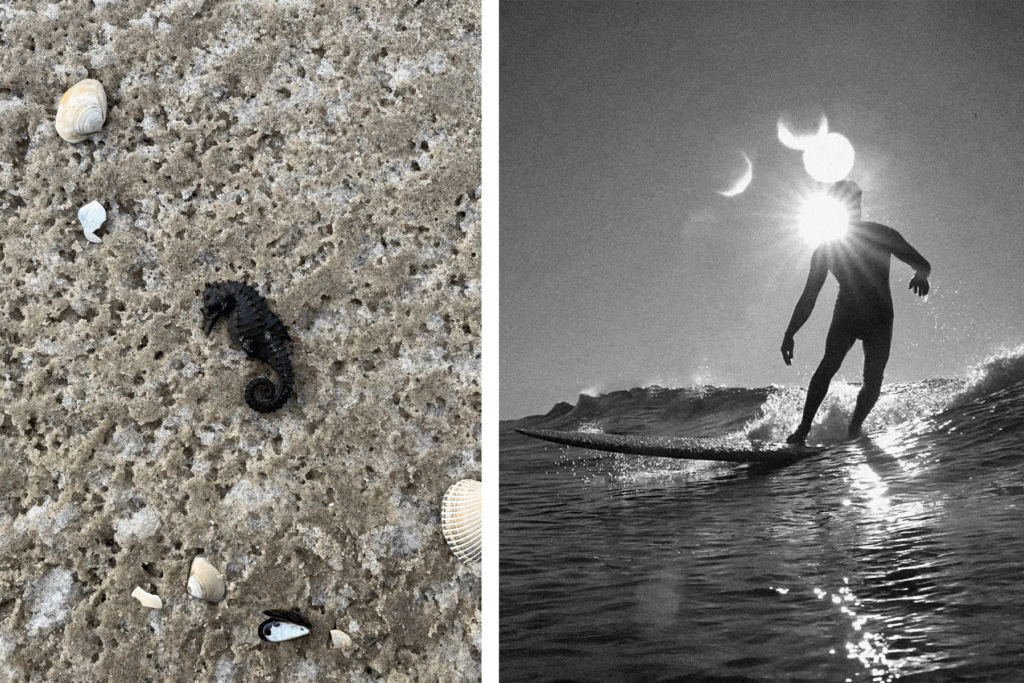
Left to right: “God is on the beach #12” (2025–26); “Zane Elias, Autumn Equinox” (2024), HD video still. Both courtesy of Em Joseph
Spinner—and hammerhead sharks in particular—are historically native to warmer waters such as those off the coast of Florida, Southern California, or Australia. But apparently, New York is not far behind. In 2020, the U.S. National Climate Assessment reclassified the city from a temperate climate zone to a humid subtropical climate zone.
Felicien told a harrowing story from a session in early July, when a shark he described as having a distinctly long tail—uncharacteristic of locally common varieties—“cruised within six feet of the lineup.” He shuddered as he recalled the sense of panic as the sea creature wove its way through the 10-person crowd before retreating back to deeper waters. “Everyone just froze,” he told me.
Sharks have existed long before us, and they are likely to remain long after. They are a class of cartilaginous fish that predate humans by over 400 million years. Most shark attacks are the result of mistaken identity or confusion. But overfishing, coastal development, and new migration patterns caused by warmer waters have brought shark prey closer to shore and, as a result, put sharks in closer proximity to humans.
About a month and a half earlier, at the end of May, an 18-year-old swimmer drowned just a few blocks away, off Beach 73rd Street. This took place amid a 90-degree hot spell, just days ahead of Memorial Day weekend when the lifeguard season officially begins. Footage shows search parties forming a human chain in the water as they look for the young man. His body was found 10 days later. This was unfortunately not the only drowning to take place at Rockaway Beach this past summer.
These incidents may seem isolated, but they are not. Rising air and water temperatures alter migration patterns, bringing different marine life to new regions, and drive beachgoers into the water at times of year previously too cold for swimming. If such events are characteristic of a new normal, how can a city such as New York adequately prepare and protect the safety and best interests of surfers and beachgoers alike?
At beaches such as Bondi Beach, among others in Australia, shark nets have been used to curb attacks, with questionable success, while bringing a slew of environmental concerns. The nets, which work by trapping sharks (as opposed to blocking them), often catch and kill other marine life, unnecessarily reducing wildlife populations across all ends of the food chain. Besides, who wants to surf in a cage?
Another modern measure for shark safety is drone surveillance, which has proven successful in increasing sightings and identification in New York, as well as somewhat effectively preventing drownings by spotting and facilitating water rescues for swimmers in distress. But one day as I sat on my board amid murky water stirred up by a recent storm, I looked up at the sky and couldn’t help but imagine it filled with tens, even hundreds, of these drones. In my head, it started to look like a modern warzone, as opposed to a place for retreat.
***
Along with relentless heat, this past summer also endured the Trump administration’s ongoing attacks on environmental protections for agriculture, clean air, and water, and an equally relentless push for fossil fuels—the primary climate-change culprit. As we staggered into the administration’s tawdry 250th anniversary parties, it was spending billions of dollars to buy back and halt green energy and conservation projects while redirecting funds and resources away from public conservation and safety efforts towards fossil fuels and private enterprise.
A haze of wildfire smoke from massive fires in northwestern Ontario and Minnesota, where warmer-than-normal temperatures and dry conditions resulted in a wider and faster-spreading fire season, settled over the city during yet another July heat wave. The smoke lingered for over a week, adding fine particulate pollution to already high-existing ozone levels.
On the day the smoke finally cleared, a friend and I went out to Rockaway Beach to surf. By the time we got out there, the waves were just one- to two-feet high and the wind had turned onshore (far from ideal for surfing). But we made the most of the afternoon: swimming, bodysurfing, and throwing ourselves into the shore break. Unbothered by the poor surf, we were just glad to be able to see the sky again.
Part of the beauty of surfing in New York is the chance to leave behind—even for just an hour or so—the stressors of the world and what might lie ahead for it if the earth continues to warm at its current rate. But lately, it’s been harder to let go of this worry. Getting out of the water one August morning, I overheard a muffled voice coming from a transistor radio on the boardwalk. We’re in yet another heatwave, the voice reported. Each heatwave seemed to blend into the next. We wonder if the heat is no longer a wave.
***
Sea levels have risen an average of 1.2 inches per decade in New York City since 1900—over a foot by now—and are expected to rise by up to 39 inches by the 2080s, with the upper estimate predicting a six-foot rise by 2100. This will increase the frequency and intensity of flooding and place water resources further at risk of storm surge inundation.
In 2012, Hurricane Sandy struck the Eastern Seaboard, providing a dismal look at the city’s readiness for flooding and coastal degradation. Rockaway Beach was among the hardest hit communities with flooding that caused irreparable damage to infrastructure. Residents went without power for weeks.
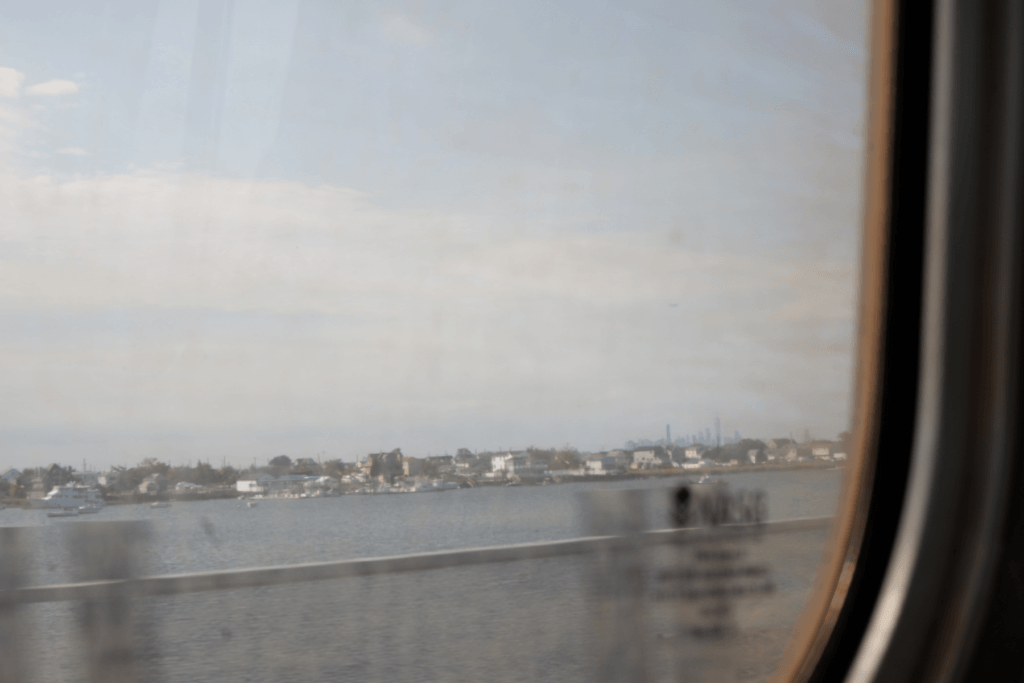
A view from the train. Photo by Anabel Gullo
While the natural disaster laid bare many of the socioeconomic disparities and gaps in funding and urban planning that had plagued the peninsula for years prior, the community made a remarkable comeback through a series of restoration and coastal resilience projects, reinforcing shorelines and modernizing infrastructure and boardwalks to prevent future flooding and erosion. This rebuild has drawn an influx of surfers and beachgoers from the inner boroughs, bringing economic growth to the area while raising concerns about gentrification and displacement, as well as increased beach litter and pollution.
Felicien, the local surf shop owner, moved to New York City from Barbados in 2001. He has watched the area transform from what he describes as a desolate zone of “dirt, brush, and a few houses” to a commercial and residential hub as well as something of a surf town. Hurricane Sandy and the changes it brought has allowed businesses like Breakwater Surf Co. not just to open, but to sustain.
There’s the direct connection between surfing and environmental optimism: Spending time in nature inherently requires us to consider our impact on it and consider ourselves part of it. Surfing is one way of doing so. The same goes for hiking, gardening, or rock climbing. Any of these outdoor activities can be a means for fostering an environmental ethos, one which is arguably harder to access in cities like New York. The surf community here today is a byproduct of the post-Sandy redevelopment and it’s proving integral to a growing grassroots environmental activism.
Back in 2018, Williams Companies, the developers behind the massive, interstate natural gas pipeline known as Transco, proposed the Northeast Supply Enhancement Pipeline, a fracked gas pipeline that would run straight through the Rockaways. According to the Surfrider Foundation, the project would “churn up arsenic, lead, DDT, and PCBs from the sea floor,” in addition to harming sea life and undermining the city’s green energy commitments. The 400-member-strong New York chapter of the Surfrider Foundation, a surfer-run nonprofit dedicated to protecting coastlines through engagement with the ocean, fought the project successfully, preventing it from beginning construction in 2019 and again in 2020.
But the battle continues. Last year, Williams Companies resubmitted its application to the Federal Energy Regulatory Commission with the same proposal that had been rejected for permits twice thus far. Given the current administration’s thirst for fossil fuels, one can’t help but wonder how long the Surfrider Foundation and others can hold off this construction.
***
This past September, the previously mentioned Laru Beya Collective held its annual fundraiser at the Brooklyn surf and supply shop Pilgrim. During a speech, one of the nonprofit’s organizers spoke of how surfing naturally orientates us towards the future—the next wave, the next swell, the next set—forcing us to think in a way that not only considers what comes next but looks forward to it. I find this interesting in the context of “being present,” which surfing also encourages (by necessity), and in recent years has become a common cure-all prescription for future dread by mindfulness podcasters and psychologists alike.
I’ve always been focused on the direct connection surfing has to the present moment as a means for promoting an environmental conscience that might—even in some small way—curtail New York’s climate trajectory towards tropical status. But lately, I’ve been thinking more about this process of reorientation towards the future, and how in a city like New York—where the past and present occupy so much of our mind space—this might unlock new ways of thinking about what lies ahead.
Some of the photos used in this story are courtesy of artist, filmmaker, and educator Em Joseph’s “God is on the beach, 2025-26” series. From her artist’s statement: “These pictures were made on the ancestral, unceded homeland of the Rockaway (Rekawakie) and Munsee Lenape peoples between September 2025 and March 2026. The name Rockaway is derived from Indigenous expressions such as Reckonwacky (“place of our own people”) and Reckanawahaha (“place of laugh water”). The series is a meditation on these invocations of the divine as it is rooted in place, exploring its unfolding through dimensions of time, indigeneity, birth, death, loss, desire, refuse, addiction, ancestry, ritual, faith, and other pathways of interconnectedness, and situates these portals against, within, and through the ever-shifting containers of freedom and control that organize human life.
“The collection speaks to the way in which ‘trash’ and different elements of discard, death, and belief punctuate the shores of Rockaway Beach, simultaneously describing the ways in which we fulfill ourselves and the ways in which we allow our natural ecosystems to absorb the consequences of this satisfaction.“
- Sign up to be a volunteer with the Laru Beya Collective
- Check out the current surf conditions before you head out to Rockaway Beach
Help us sustain independent journalism...
Our team is working hard every day to bring you compelling, carefully-crafted pieces that shed light on the pressing issues of our time. We rely on caring supporters like you to help us sustain our mission. Your support ensures that we can continue to provide deeply-reported, independent, ad-free journalism without fear, favor or pandering. Support us today and make a lasting investment in the future.

RELATED STORIES

Award Winning


Today’s environmental and social justice challenges are unprecedented, and require an unprecedented collective effort.


Stay updated on our latest features, events and more. Subscribe to our Note From the Nest newsletter!
