
End of Watch?
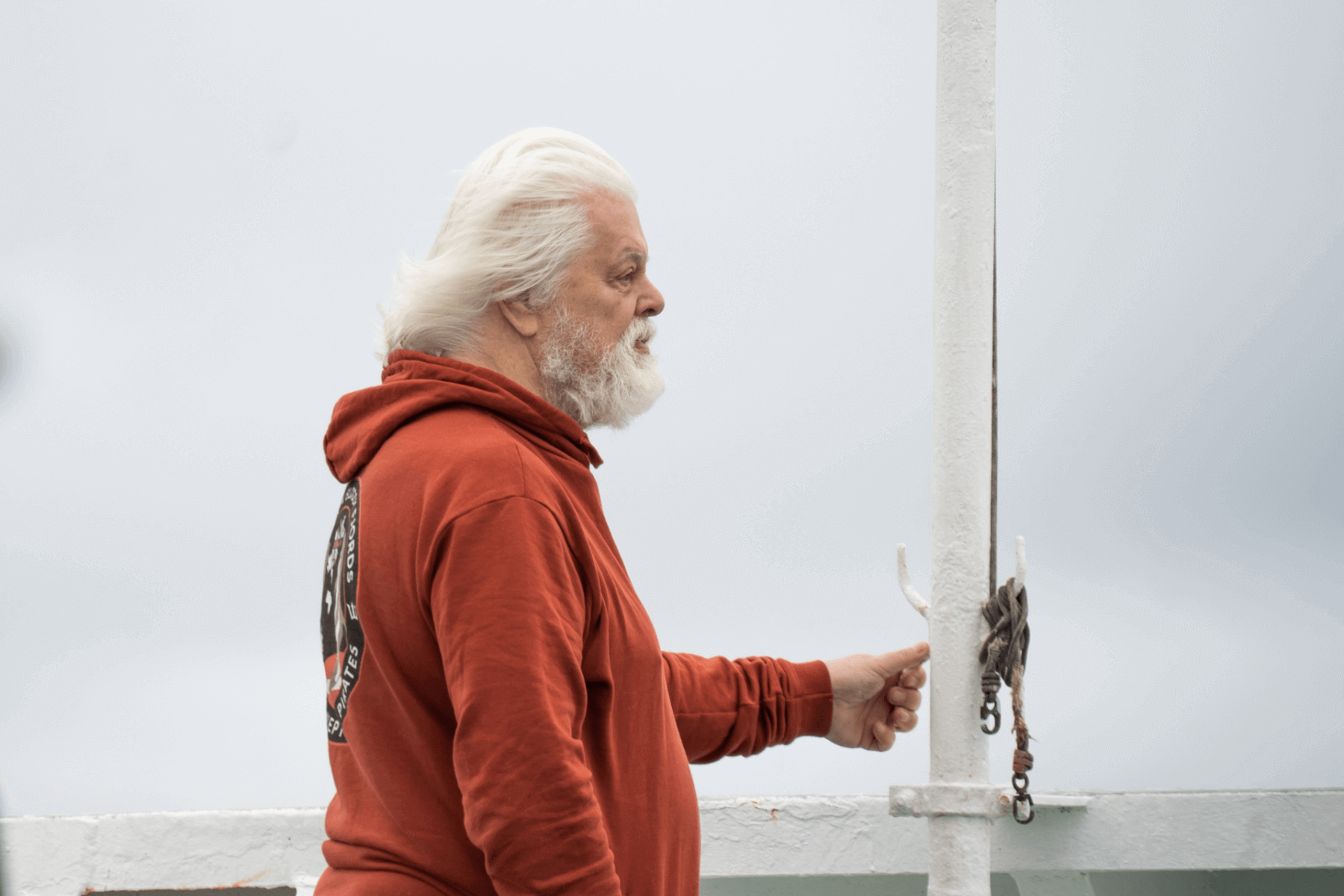
UPDATE (as of December 18, 2024):
Paul Watson Is Free!
On December 17, anti-whaling campaigner Paul Watson was unexpectedly released from a Greenland prison, where he had been detained for 150 days awaiting possible extradition to face charges in Japan. He was arrested on July 21 after stopping in Greenland to refuel his ship, the John Paul DeJoria.
In a statement, Danish justice minister Peter Hummelgaard announced, “Today the Danish Ministry of Justice has decided not to fulfill the request by the authorities of Japan for the extradition of Paul Watson. The decision is based on an overall assessment of the case.” He further explained that the ministry had released him after Japan would not give assurances that, if Watson were to be tried and sentenced, he would be credited with the five months he’d already been in prison.
That story sounds a bit thin, given that Watson, who turned 74 in prison, had expected that any sentence in Japan might last the rest of his life. Watson is wanted in Japan after a 2010 incident on the Southern Ocean near Antarctica, when Japan claims that members of the Sea Shepherd Conservation Society interfered with their allegedly lawful whaling operations and injured two Japanese crew members. Watson was then captain of Sea Shepherd and filming his Animal Planet reality television series, Whale Wars.
This also means that Watson could be re-arrested. In an article in The Japan Times, government spokesman Yoshimasa Hayashi announced that Japan would continue to seek justice, saying, “The Japanese government will continue to deal with it appropriately based on law and evidence.” This spring, Japan launched a brand-new factory whaling vessel, the Kangei Maru, and has plenty of incentive to keep Watson off the water.
For now, Watson says he is happy to be able to celebrate the holidays with his wife and two small children in France, where he currently resides. The French government of President Emmanual Macron has been active in negotiations for his release, and Watson has requested citizenship there.
Watson said in a statement, “Sometimes, going to jail is necessary to make your point. Every situation offers an opportunity, and this was another chance to shine a global spotlight on Japan’s illegal whaling in the Southern Ocean Sanctuary. If I had been sent to Japan, I might never have come home. I’m relieved that didn’t happen. Thanks to the efforts of my lawyers, Lamya Essemlali of Sea Shepherd France, and the French government, I have been freed today.” See story below.
***
The arrest of former Greenpeace and Sea Shepherd activist Paul Watson, though long threatened and perhaps inevitable, is bad news for whales. Danish authorities detained the 73-year-old Watson in remote Nuuk, Greenland on July 21 during a refueling stop while he and his Captain Paul Watson Foundation (CPWF) crew were shipping out to confront a brand-new Japanese factory whaling vessel, the Kangei Maru. Over his 50-plus-year career, Watson has saved the lives of thousands of giant cetaceans using direct non-violent interference, and his crews are the only ones out on the water doing it. With him in a Greenland prison, no one is monitoring the Japanese whaling fleet, even as it currently deploys drone technology to take stock of whales in the Pacific.
Though international bans have attempted to curb whaling by the Japanese — as well as Norway, Iceland and the Faroe Islands, which continue to kill whales — Japan has claimed a right to “lethal research” and set quotas for taking as many as 1,454 whales at its peak per year. Regardless of their offers to cut down on this quota, much of this “research” still ends up as food in Japan. The newly deployed Kangei Maru has already taken aboard a few whales this summer, including fin whales, which are listed as “vulnerable” by the International Union for Conservation of Nature.
The arrest may also be very bad news for Watson. It could be the end of the line for his pirate life. He’s been in detention for almost three months while Greenland, a self-governing Danish territory, holds hearing after hearing about whether it will extradite him to Japan. There, he is wanted for allegedly endangering crew members of this same Japanese company whaling near Antarctica in 2010. His next hearing is on October 23.
It is not the first time Watson has been detained — or exiled, or accused of crimes — having been one of the earliest members of Greenpeace in the 1970s and then at the helm of the Sea Shepherd Conservation Society for 45 years. His campaigns usually expose such shameful behavior — from harpooning whales to clubbing baby seals to finning sharks — that public outcry gets him released, and that may happen this time, too. French President Emanuel Macron and 68 French and European Parliament members have demanded it, along with hundreds of thousands of supporters.

Watson was detained when more than a dozen Greenland police boarded their ship upon docking for a refuel in Nuuk. According to the CPWF, the ship and its crew were headed to intercept a Japanese whaling ship. Courtesy of Fiji Chambaret
But there is no legal mechanism to differentiate between activists who harass whalers in the service of preserving life, and true pirates or terrorists who take boats and endanger or kill crews for profit, or for the furtherance of a political or religious agenda. This moral dilemma has been true of all activists who promote or use nonviolent direct action, from Thoreau to Gandhi to Dr. Martin Luther King, Jr., especially when property destruction is involved; the law is simply not designed to take intention into account. On the contrary, in the case of environmental activists, it is often specifically designed to equate them with terrorists and punish them accordingly. At this juncture, Watson depends on opaque back-channel negotiations between Japan and Denmark and whomever else to decide his fate.
What lands Watson in continual trouble are his pirate tactics, which get media attention and drive his targets loony. In the spirit of Edward Abbey’s 1975 comic novel, The Monkey Wrench Gang, whose protagonists famously burn billboards and sabotage bulldozers in defense of America’s desert West, Watson and his eco-buccaneers relentlessly harass their oceangoing foes, deploying drones, shooting damning videos, jet skiing and rafting between harpoon guns and prey, slamming ships into ships, hurling stink and smoke bombs, and generally doing anything they can to physically prevent the killing of marine life without hurting anyone. As head of Sea Shepherd, Watson has also taken credit for sinking at least three whaling boats while they were in harbor and unmanned.
You may have seen some of this on his reality TV show, Whale Wars, which ran on Animal Planet for seven seasons from 2008 to 2015. Watson welcomed public scrutiny of his high-seas antics because, legally, he and the Japanese operate under the same logic: in international waters, there is no police body to stop the Japanese from whaling, even though their “research” permits have been proven in international courts to be bogus; similarly, there is no police body to stop him from harassing them, although, technically, his actions sometimes could be construed as piracy and piracy is illegal under international law. In many instances, Watson has been granted police authority by particular countries, as when he worked with Guatemala to arrest a shark-finning boat in 2002, or with Australia and Gabon in 2014 to stop a notorious poaching ship that was illegally taking Patagonian toothfish in the Antarctic.
But Watson sees his crews as nature’s police force. They are making citizen’s arrests and hoping the rest of the world will take up the cause, which, as is evidenced by his current plight, doesn’t always happen. Since the Japanese whaling company Kyodo Senpaku is a public-private collaboration, at least partly owned by the Japanese government, he finds himself fighting a nation with significant investment in the outcome.

Danish Naval vessel P572 follows the vessel of Captain Paul Watson Foundation marine activists back to Canada after Watson’s arrest in Greenland. Courtesy of Fiji Chambaret
Watson’s recent arrest also finds him in new circumstances. He lives in France with his wife and two children, ages three and eight. Can he keep using the lack of enforcers regulating behavior on the high seas as his defense? His direct-action tactics have often drastically reduced the number of whales taken by the Japanese, saving what he says are 6,000 whales to date. But they also carry inherent risk: his targets can, and have, retaliated with violence. He used to carry guns on board for this reason (though, he no longer does). His targets can also spin his actions as violence, as Japan is doing here, accusing him of injuring a couple of their sailors. In an age when huge corporations have increasing power and governments steadily redefine “terrorism” to include environmental and climate action, the high seas may be getting too rough.
Watson has been unavailable for interviews, but Locky MacLean, captain of the CPWF ship John Paul DeJoria, who has sailed with Watson for 25 years, shows no signs of backing off.
“I think we’re living in such a strange time, where you’ve got sort of like fingertip activists,” says MacLean. “You can do an action on your phone just by following a petition or joining an app that promotes a cause or whatever.
“But as far as actual direct results … there’s no better way to stop whaling on the high seas than to stick your boat right behind the slipway of the mothership to block the harpoon ships from transferring over these whales. That is super effective and it’s real. If we were lulled into some kind of sense of doing only actions online, then Japan would just go about their merry way and keep whaling. So, something needs to be done in a concrete manner.”
***
Japan’s case against Watson amounts to three charges that allegedly happened in the Southern Ocean off Antarctica while filming Whale Wars in 2010.
The first count is that Sea Shepherd activists injured Japanese sailors when they hurled on deck a glass bottle of butyric acid, a stink bomb that smells like human vomit and is meant to foul the whale meat and make it unfit for consumption. MacLean says Animal Planet has helicopter footage showing no one was anywhere near the bottle when it broke, though Japan insists its sailors suffered facial burns. It is also said to show that two Japanese sailors wearing spray rigs were squirting pepper spray, or mace, at the Sea Shepherd activists off the port rail, but doing it straight into about a 20-knot wind, which blew the spray back into their faces and possibly injured them. So far, this footage hasn’t been allowed in court proceedings.
The second charge is a count of piracy. While Sea Shepherd was skirmishing with the Japanese fleet in January 2010, a super-fast New Zealand trimaran called the Ady Gil (formerly Earthrace) that had joined Sea Shepherd was struck by the Japanese harpoon vessel Shonen Maru 2. The Japanese craft cut right through the bow of the Ady Gil, crippling it, and its crew had to be rescued. One suffered broken ribs. Watson ordered the boat scuttled the next day. In February, Ady Gil owner and skipper Pete Bethune left a Sea Shepherd ship on a jetski and boarded the Shonan Maru 2 to make a citizen’s arrest of the captain for attempted murder and to present a demand for $3 million in payment for the lost boat. He was detained by the crew and tried in Japan, where he was held without bond for five months and then given a two-year sentence, suspended, and deported back to New Zealand.
“The systems that they’re living within, the conditions that they’re living under, are so untenable that they’re going to take a risk.”
As the then-captain of Sea Shepherd, Watson is wanted for at least nominally being Bethune’s superior officer when he illegally boarded the Shonen Maru 2. The third charge is conspiring to impede commerce — which is a little ironic since Kyodo Senpaku claims the whaling is for research purposes.
In 2012, Japan issued these charges as part of an Interpol Red Notice, which calls for other countries to arrest the accused. Watson ducked this notice for years until it expired. A dual American-Canadian citizen, he avoided some countries, though U.S. Secretary of State John Kerry, who openly stated his admiration for Watson’s work shutting down the toothfish crew in 2014, allegedly assured Watson it was safe to enter the U.S. during the Obama presidency.
When Japan launched the brand-new Kangei Maru in May, Watson announced he would monitor it, and Japan immediately issued a new order for arrest. This one, however, was a bilateral request communicated only to Denmark and never on the Interpol network, allowing them to take Watson by surprise.
As he and his attorneys fight extradition, Watson issues only brief vows of resistance and resiliency on social media. But the CPWF is taking the charges very seriously.
“All our resources are going into getting Paul released,” says MacLean. “Regarding going to Japan; it’s a life sentence. We’ve had colleagues that have spent time in Japan, in prison. It’s very, very rough over there. He goes to jail in Japan, they throw away the key.”
And what about the future of direct action?
Lauren Regan, an attorney with the Civil Liberties Defense Center in Eugene, Oregon, who has represented radical activists in court for more than 20 years, says that judges are starting to consider why activists risk legal hazards and potential suffering. In 2019, for example, five activists from the anti-fossil-fuel group Extinction Rebellion planted a garden on the railroad tracks leading to a petroleum terminal owned by Zenith Energy, blocking the delivery of tar-sands oil for storage there. In her defense of the five, the judge allowed Regan to use a rare necessity defense, hearing testimony that climate change is such an emergency that radical actions are justified. They were not convicted.
“It’s an acknowledgment that people have gotten to the point where they are willing to be dead rather than live in the circumstances that they’re in, whether that’s prison or actual death. They have decided that the systems that they’re living within, the conditions that they’re living under, are so untenable that they’re going to take a risk,” Regan says.
MacLean says he’s not having any trouble finding new activists to take that risk. The energy is there. “I had 25 crew on the ship this summer. A lot of young people in their early twenties. Super gung-ho, and super keen to go for it. So, I’m not worried about that. I think the courageous, passionate kids are out there and that’s really heartwarming actually, to see that it’s still a cause that people can get behind.”
***
A heart full of love can get you a boot in the ass. This is what Dr. Martin Luther King Jr. called “unearned suffering.” He saw it as redemptive, with strong educational and transformative possibilities. And the worse the punishment, the more edifying and transformative it might be for everyone. We remember the U.S. civil rights actions led by Dr. King, John Lewis, Jesse Jackson and others, in which peaceful marches were met with water cannons, dogs, beatings, bombings and, in some cases, outright murder.
As a reporter focused on the so-called radical environmental movement in the 1980s and ‘90s, I witnessed the stakes going up and up and up, with a new application of domestic terrorism charges, increasingly violent responses from targets and law enforcement, and civil litigation designed to saddle activists with monetary payments big enough to break them. It got so dangerous that you’d think everybody would quit, and a lot of people did. Yet right now in the U.S. — and all over the world, from London to the Amazon — a steady stream of hearts full of love are stepping up for an ass-kicking. This is either evidence of a new dawn of moral purpose, or abject desperation, or both.
“Direct action is still alive and well. It’s just that the stakes for it are much higher at this point in time.”
Young activists in Atlanta have battled a new militaristic police training center, dubbed “Cop City,” with encampments and blockades, swarming city hall, marching and resisting police attempts to clear them out. Indigenous North American communities have shut down construction of oil pipelines and other fossil fuel projects, while monkey wrenchers have attacked oil infrastructure with fire and chemicals, or accessed valves to shut off the flow. Trains full of coal and oil and chemicals are being blockaded. Extinction Rebellion folks have attacked famous artworks, which is controversial even within their ranks. Animal activists are risking enormous sentences to liberate farm and lab animals. Single trees have become battlegrounds.
“I think direct action is still alive and well. It’s just that the stakes for it are much higher at this point in time,” says Lauren Regan, the Civil Liberties Defense Center lawyer.
“The risk assessment really hasn’t changed,” she adds. “The risk assessment is: you’ve got to plan for the worst and hope for the best, and the worst has not really changed. The worst is you could do decades in prison.”
Direct actors by the thousands, from unknown lone wolves to larger, named organizations, who rose in the early 1970s to intervene directly in defense of the planet have since then been systematically infiltrated, bombed, killed, attacked, arrested, prosecuted, jailed or fined, litigated and co-opted in a sometimes-coordinated attempt to take them off the field.
On the environmental front, Greenpeace led the way, sailing in 1971 to Amchitka in Alaska’s Aleutian Islands in an old halibut seiner to put themselves in the way of a U.S. nuclear weapons test. They weren’t going to attack anyone; their presence in the water would simply require stopping the test. President Nixon did that, postponing the test before the feckless crew got anywhere near the blast zone, but the resulting frenzy in the press created what crewmember Bob Hunter called a “media mindbomb.” The public started asking questions about the tests. It was a tactic that stuck, and Paul Watson has been an enthusiastic practitioner, leaving Greenpeace to form Sea Shepherd in 1977 and deploy mindbombs in defense of marine life.
Those mindbombs attracted real ones: in 1985, the Greenpeace ship Rainbow Warrior was at wharf in Auckland, New Zealand, with crew on board preparing to protest one of the 193 French nuclear tests on Mururoa Atoll, when French secret service divers — with the help of an infiltrator — fixed explosives to the hull and sank it, killing Greenpeace photographer Fernando Pereira. Shockingly, the French government admitted they had ordered the bombing.
The radical group Earth First! debuted in 1981 by unrolling a black plastic “crack” down the face of the Glen Canyon Dam on the Colorado River. The act was inspired by Abbey’s novel, in which the Monkey Wrench Gang plots to blow up the much-hated dam, and Abbey himself gave a speech at the action. The funny fake crack was a harbinger of real midnight hijinks, as the movement’s publication, Earth First! Journal, quickly filled with hundreds of true tales of tree-sits and blockades in defense of forests, attacks on development projects, encampments resisting oil and gas pipelines and other fossil fuel projects, arsons of Forest Service offices, and similar acts.
The movement considered property destruction to be acceptable, as long as no people or animals were hurt. This logic would eventually lead to some extraordinarily costly attacks attributed to a network called the Earth Liberation Front, such as the 1998 fire at Vail Ski Resort’s Two Elk Lodge, which caused an estimated $12 to $24 million in damages, and the $50 million arson of a La Jolla condominium project in 2003.
Earth First! co-founder Dave Foreman created the rubric for this sort of action with his 1985 book Ecodefense, a detailed field manual showing how any wannabe eco-teur could, say, drive spikes into trees to discourage logging or disable a road grader or scuttle a U.S. Forest Service timber sale survey.
How-tos such as The Anarchist Cookbook, or the 1972 book Ecotage by members of the group Environmental Action, had been previously available, but as environmental awareness increased across North America, more and more people were putting Foreman’s book to nefarious use.
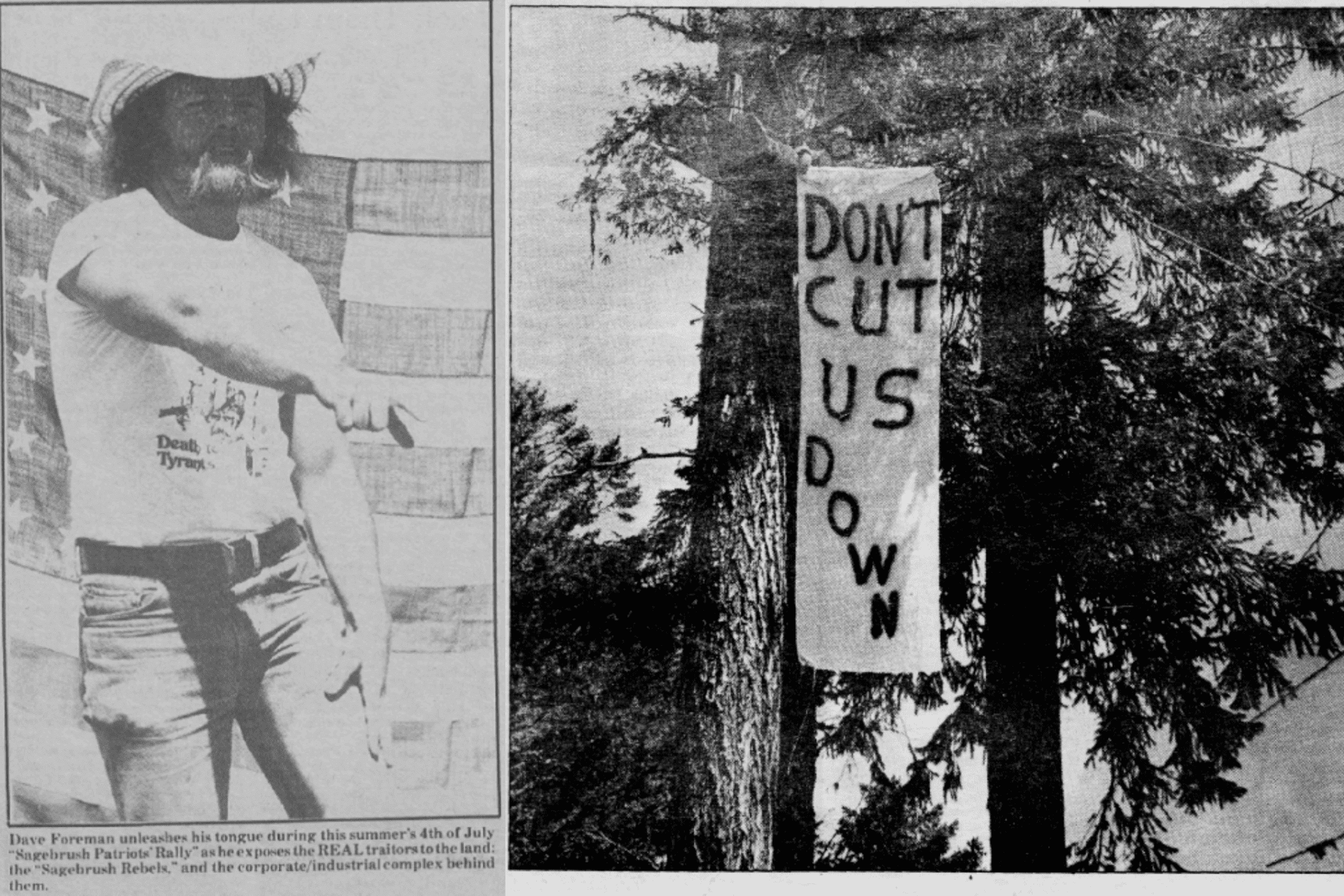
David Foreman at a Sagebrush Rebel demonstration in Grand County, Utah, in 1980. (Left) “Doug Fir,” a prodigious tree-climber, hangs a banner from an old growth tree in the Willamette National Forest in Oregon. (Right) Courtesy of EarthFirst! Republished by the Environment & Society Portal, Multimedia Library
Federal authorities responded by sending an agent provocateur named Mike Fain to infiltrate Earth First! in Tucson in the late 1980s and entrap Foreman and four others in an agent-led scheme to take down some high-voltage powerlines. After the FBI spent years and $2 million to build a case, Foreman pled to a misdemeanor, paid $250 in fines and went free. Four others did jail time. But Foreman did step back from being involved with Earth First! and focused on rewilding efforts including advocating for wildlife corridors all over North America.
Probably the best-known of Earth First! actions was the 1990 Redwood Summer campaign, in which thousands of activists swarmed the woods of Northern California to save the last of the old-growth forests, sitting in trees, chaining themselves to gates, penetrating safety perimeters to stop tree felling, playing cat-and-mouse with law enforcement and protesting sawmills and Forest Service offices. The campaign was later used by novelist Richard Powers as the rough inspiration for his dreamy novel, The Overstory.
On the ground, however, the reality wasn’t so dreamy. Three years before the campaign began, a sawmill worker had been gravely wounded when his bandsaw hit a 60-penny nail that had been driven into a tree, and emotions in the north woods were high. Redwood Summer organizers Judi Bari and Darryl Cherney, who both vocally denounced tree-spiking and emphasized timber-worker safety, were carbombed during a recruiting swing through Oakland, CA. Bari was nearly killed and lost the use of her legs. During the summer that followed, hundreds of activists were arrested and prosecuted. Timber companies used Strategic Lawsuit Against Public Participation (SLAPP) suits to go after organizers for money damages. Vigilante groups calling themselves “Stompers” and other creative monikers wrote letters and posted flyers threatening organizers Greg King, Cherney, Bari, and others with violence or death.
***
Preparing for the worst is exhausting. Not many can keep on doing it like Watson has. Legendary animal rights activist and former Sea Shepherd campaigner Rod Coronado, who lived the radical life for decades, notes that above-ground organizations are constantly under tension to pull back from risky direct action campaigns and find a safer, more comfortable way to express themselves. In his opinion, this conflict is what drove Watson out of Sea Shepherd in 2022, to continue on as head of the Captain Paul Watson Foundation.
Both Sea Shepherd USA and Watson have agreed not to talk about the split in the press, but Watson did issue a letter on the event of his resignation, which reads in part:
“The present Board wants to convert our fleet into non-controversial research vessels rather than using our vessels to stop unlawful poachers who prey on endangered animals. While research has always played a role in Sea Shepherd’s work, it has never been and never should be our top goal. We have fulfilled a special role by acting as a bold voice against poachers on the high seas, recording and putting an end to illicit activities that would otherwise go unreported and uncontested. Sea Shepherd has always gone where others are afraid to go, said what needs to be said, and faced challenges head-on and with great determination. I cannot, in good conscience, endorse or be a part of the new trajectory that Sea Shepherd USA’s current board has chosen.”
Sea Shepherd USA has called for Watson’s release from Greenland, but the fleet of ships that Watson’s work helped assemble is no longer involved in confronting whalers.
Coronado knows a thing or two about the pressure to drop direct-action tactics, as his own actions helped shape the legal landscape that makes this work so risky.
In 1988, he and another young Sea Shepherd crew member flew into Iceland and sank half of Iceland’s whaling fleet. Under cover of night, they discovered two unmanned boats at anchor, Hvalur 6 and Hvalur 7, and opened their seacocks and sent them to the bottom of Reykjavik Harbor. They got away and the ships never went back into service.
Coronado, who is of Yaqui ancestry and deeply concerned about North American wildlife, then went after the American fur-farming industry, targeting the university research that supports mink and fox farms. Working alone, he burned labs and decades of research at Michigan State University and Oregon State and other locations, liberated mink, and even posed as a wannabe fur farmer to buy animals and gear outright. He rehabbed two rescued lynx and returned them to the wild. He was eventually nabbed on the Pascua Yaqui reservation near Tucson and served prison time for arson.
This was going, as Watson had said, “where others are afraid to go.” Then the law went there, too.
Coronado was mentioned by name in Congress as one of the inspirations for the passage of the federal Animal Enterprise Protection Act of 1992, which specifically criminalized the act of interfering with farms or labs using animals. Many states took this a lot further and passed so-called “ag-gag” laws that also criminalized videotaping such operations to expose abuse or poor conditions. Some of those have been rolled back. But after the 9/11 attacks, the U.S. Patriot Act of 2001 expanded the definition of terrorism to include domestic environmental or animal-rights-motivated actions that were intended to “intimidate or coerce” the public or the government.
It’s not a long stretch to find coercion or intimidation in acts like the Two Elk Lodge arson, which the FBI called the country’s worst case of eco-terrorism at the time. Other legislative action also extended the use of “terrorism sentencing enhancements,” which can add as much as 20 years to a domestic terrorism sentence.
This leaves us in a legal sphere wherein stealing a live turkey from a factory farm to keep the turkey alive is somehow comparable to flying a plane into the World Trade Center. Those laws have not been rolled back.
This was going, as Watson had said, “where others are afraid to go.” Then the law went there, too.
In 2021, Iowa climate activist Jessica Reznicek received a terrorism-enhanced sentence for damaging the Dakota Access Pipeline, doubling her sentence from four to eight years. She lost a 2022 appeal. This kind of threat changes the calculus for many activists. Coronado, for instance, did two stints in prison that totaled about six years, but in this new legal climate, it might have been 10 or 20 instead. He has a strong desire to participate in the lives of his now-college-aged children, so he’s changed his tactics.
For eight years, he went out in the woods monitoring hound-hunters in Wisconsin who intentionally run their dogs through wolf denning sites. It’s risky to be around so many armed hunters, but Coronado was careful to always be on public lands and the one time he was prosecuted, he managed to get the state hunter harassment law thrown out and was vindicated. Now he does similar wildlife advocacy on the East Coast as Vermont Wildlife Patrol, and he finds particular joy in being the “former radical” who talks sense to state wildlife officials.
“I’ve put myself out there as somebody who’s familiar with the issues and can be scientifically based in my criticism and not just friggin’ operating on 11,” Coronado chuckles. He notes that other wildlife advocates he encounters mostly berate local officials and make no effort to find a common cause. “It’s funny because I’m not seen as the most radical person here,” he adds.
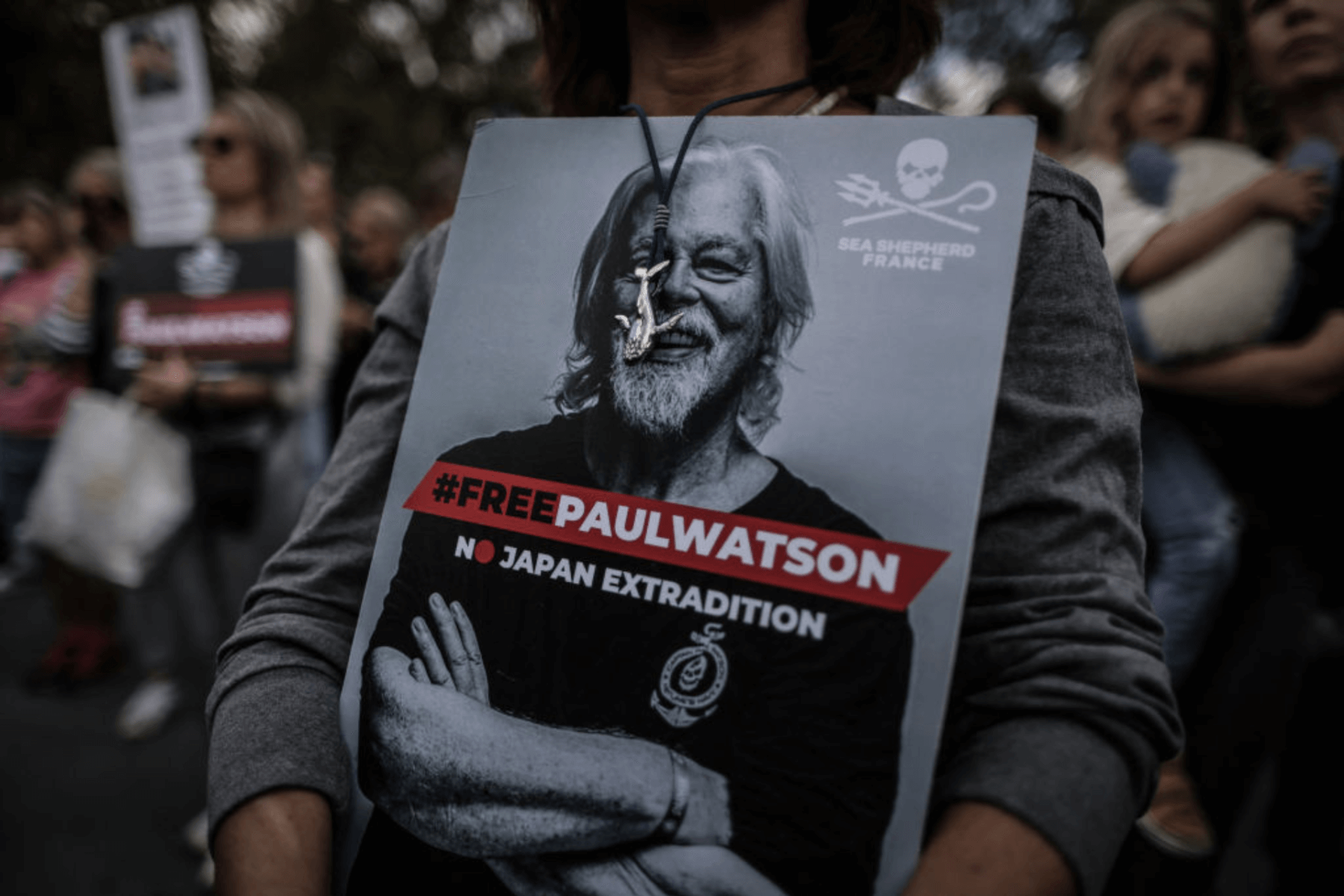
Watson, and supporters, await his fate. Photo by Thibaud Moritz / Getty Images
He studies proposals and finds items like wildlife corridors that he can support, and then advocates for them in meetings. “It took about a year before they even started acknowledging us in the room, when me and my one friend would go to the meetings and be the only people representing wildlife and talking. And eventually, the Commissioner and other employees started having conversations with us. So that’s my goal.”
If Watson is extradited to Japan, however, Coronado does not rule out getting back on the boat. The rules on the open ocean are different.
“If they keep him in jail and if he gets extradited to Japan and if he is sentenced unfairly, it’s going to change my life,” Coronado says. “I want to do the work that he was going to do. I don’t want Japan to know that they can remove one person and stop the entire movement. I really feel that a lot of us are going to be called to take up that role.”
Help us sustain independent journalism...
Our team is working hard every day to bring you compelling, carefully-crafted pieces that shed light on the pressing issues of our time. We rely on caring supporters like you to help us sustain our mission. Your support ensures that we can continue to provide deeply-reported, independent, ad-free journalism without fear, favor or pandering. Support us today and make a lasting investment in the future.

RELATED STORIES

Award Winning



Today’s environmental and social justice challenges are unprecedented, and require an unprecedented collective effort.


Stay updated on our latest features, events and more. Subscribe to our Note From the Nest newsletter!
