1.5 Degrees Celsius
Recently, I woke up in a panic. The cause of the panic was not novel, but on this day, the knowledge that we have damaged the Earth beyond repair felt like an elephant squatting on my chest. Most mornings start similarly terrified, or nihilistic — a common response to being overwhelmed. Hobbies feel pointless, days passionless. I cannot appreciate the subtle metaphors within my favorite songs or feel excited about a new pair of shoes when the world is literally on fire. But this morning brought more than those dull sensations. It came with a sharp panic.
I am a recent college graduate with a paper signifying my Bachelor’s degree arriving soon in the mail. I might set fire to that, too. After four years of studying political science and environmental justice, my biggest takeaway is that a malignant cancer of greed is metastasizing throughout the only planet we have. The panic is consuming me, and I am not sure how to handle it.
In school, I developed a habit of running from one meeting to the next, purposely preventing introspection. I was busy on campus, working as the News Editor for the school paper and serving as President of our Model United Nations club and Pi Sigma Alpha, the national Political Science honors society. I was also a competitive swimmer. Busy.
When I didn’t have time to take a breath, I did not have as much time to notice how thick the air had become. Those distractions are not available to me now that I have finished college and I’m keenly aware that I, like everyone else, am breathing air that’s getting thicker and more polluted.
When I didn’t have time to take a breath, I did not have as much time to notice how thick the air had become.
According to the National Oceanic and Atmospheric Administration (NOAA), global average atmospheric carbon dioxide levels in 2023 reached an all-time high — 419.3 parts per million. Since the 1960s, annual emissions from burning fossil fuels have increased one decade to the next. Currently, the growth rate is 100 times that of previous natural increases. This is not natural — nor is it natural to pretend it is not happening.
The weight on my chest, though, is natural. It is appropriate. And now that I’m exiting the shelter and distraction of college life, I can no longer keep the pressure at bay.
***
Several years ago, when the world came together to stop pretending dangerous global warming was not happening, it committed to keeping the global rise in temperature below 1.5 degrees Celsius above pre-industrial levels. The international community did so at the behest of scientists who have long warned that we are approaching irreversible damage to the planet due to global warming. The UN’s Intergovernmental Panel on Climate Change had declared 1.5 degrees Celsius as the threshold beyond which the impacts of climate change would be catastrophic. The extreme heat and drought, calamitous natural disasters and unpredictable weather patterns we already experience will increase exponentially if we exceed this threshold. Every day will be a mini-armageddon.
To postpone doomsday, 196 countries adopted the Paris Climate Agreement at the UN Climate Change Conference (COP21) in 2015. The international treaty is legally binding and holds its signatories to a higher standard of action to keep global warming below the 1.5 degrees Celsius threshold. All parties to the treaty agreed to take a more aggressive approach to reduce their national greenhouse gas emissions and improve climate adaptation strategies. Included in the plan is an agreement to cut greenhouse gas emissions by 43 percent by 2030. To achieve this, emissions must peak in 2025 and go down from there. That deadline is upon us, but emissions continue to rise, and temperatures are rising with them.
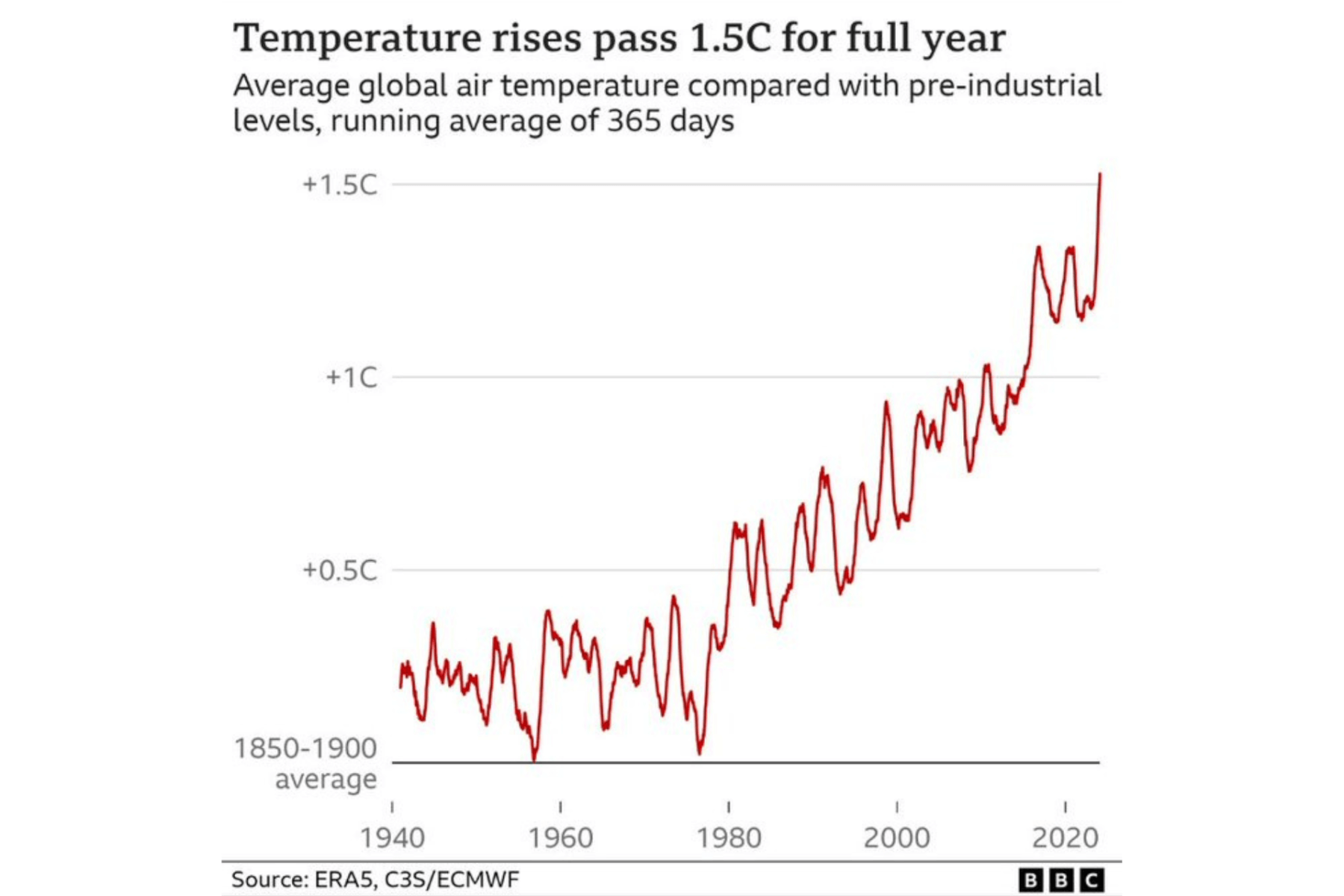
From February 2023 to January 2024, the average global temperature reached 1.52C above pre-industrial levels. Courtesy of BBC News
2023 was the first time on record that the average global temperature for the year rose past the 1.5 degrees Celsius above pre-industrial temperature target. Similarly, NOAA reported 2024 to be the hottest year on record. (The NOAA is under virulent attack from the current administration, facing budget cuts and a scrubbing of its data and analysis.) The planet’s 10 warmest years since 1850 — before the Industrial Revolution — have all been within the past 10 years.
Despite the Paris Agreement, the international community has not met its goals and the world is not cooling down. We are burning up. The breach of 1.5 degrees is a grave sign. Professor Sir Bob Watson, a former chair of the UN’s climate body, told BBC Radio 4’s Today, “Look what’s happened this year with only 1.5 C [rise in temps] — we’ve seen floods, we’ve seen droughts, we’ve seen heatwaves and wildfires all over the world.”
***
It does not always feel like we are burning. The climate crisis has many faces.
On the day I’m writing this, it is cool, cloudy and wet. I wonder about the rain and the concentration of hazardous chemicals in each droplet. I think about all the places where it has not rained in a long time, and all the places where it has not stopped. For the first time in a while, I pray. I beg that the land will be hospitable long enough for me and my cohorts to make a positive impact on it. I pray for my family in central Texas and plead that we can weather the new normal of abnormal weather.
Not too long ago, my parents made a snowman in their driveway. This was a weather anomaly for our area. Too bad misinformation, and now measles, still spread in the cold. I want to call my mom and cry and tell her how scared I am, but she would say I’m overreacting.
She does not believe in “man-made” climate change. She would tell me that the oil and gas companies give jobs to good, hard-working people and that it would be a shame to take that away. It would be, of course. According to the Department of Energy, 12.3 million people are employed by the fossil fuel industry in America (including 3.15 million in Texas) and it provides 80 percent of the nation’s energy. The cost is great, too, especially when measured in drought and flood and habitat depletion.
I try to explain to my mom that shifting to green energy creates new employment opportunities at a lower environmental cost. For instance, the Green New Deal (GND) could “generate more than 18.3 additional million jobs throughout the economy,” as estimated by Dr. Roger Bezdek, an internationally recognized energy analyst and economist. Currently a senior fellow at the Heartland Institute, Bezdek has three decades of experience in energy, the environment, and related fields. His extensive research found that the jobs created by the GND would not only be numerous, but highly-paid and sought after.
How many times did I need to walk to school to offset one week of flights on the Kardashian’s private jet, or one teenager’s Shein haul? Can I wear out enough sneakers to prevent small island states from disappearing with the tide?
Better preparation and response to climate disasters would also benefit the individual Americans for whom my mother is concerned, as extreme weather events bring a heavy economic toll (along with loss of life) with them. A UCLA report estimated the property damage from California’s Altadena Eaton Fire and Palisades fires earlier this year to be between $95 and $164 billion, with losses to GDP around $4.6 billion. Thirty people with families and friends perished in those fires. In North Carolina, the cost of damage from Hurricane Helene in September 2024 was about $59.6 billion, according to an updated North Carolina state budget report. The storm caused more than 100 deaths in the state.
My mother means well, but her sympathies are misplaced. She hangs up the phone after voicing her concerns for the future of the fossil fuel industry and then looks into our backyard, where the heat is already tough to bear in mid-May. In another month, the time she cherishes tending to her garden or sitting by the pool will be marred by inhumane temperatures.
***
After graduation, I returned to my parents’ home just outside of Austin, fresh out of college and into the furnace. Austin residents experienced 80 days with temperatures of 100 degrees or higher in 2023. It was the hottest summer on record, according to the city’s Office of Resilience. Heat-induced hospital visits were 184 percent higher than the average over the previous six years. That summer, at least 10 Austin residents died from the heat. This is common now throughout the Southwest, where every summer brings new heat and heat-related mortality records.
Last summer in Austin, temperatures hit triple digits in June and remained that way into September. The sun had defeated me by 10 A.M. each day. By noon, sweat soaked through my shirt. The nights were not much cooler than the days, and there was little solace in sleep. It’s hard to rest without the comfort of my covers.
In July, I woke up to find a dead doe in my parents’ yard. She had rammed herself into our fence over and over during the hot night. I only caught a glimpse of a disfigured corpse before my parents took her to the woods nearby. I imagine she felt trapped by the heat, maybe trying to escape one reality in hopes of finding a cooler one. I am not sure. I do know she died slowly and painfully and alone.
My mother cried for hours that day. As a child, her compassion annoyed me. She shows empathy for every living thing, from a financially struggling family at our church to a spider in our kitchen. At a time when my own emotions were shallow, the depth of hers was a nuisance. Now, this is a source of confusion. Her kind heart directly conflicts with her views. Can my mother not see how we wrote this doe’s death sentence?
We are ramming ourselves into extinction.
***
Where do I fit into all of this? How many times did I need to walk to school to offset one week of flights on the Kardashian’s private jet, or one teenager’s Shein haul? Can I wear out enough sneakers to prevent small island states from disappearing with the tide?
I went to California to get an education with hopes of making the world a better place. My involvement with the paper and Model U.N. allowed me to communicate with my peers about pressing issues — including the climate crisis — and to learn from professors and experts on campus. I want everyone to become politically active and environmentally aware, and I know my efforts had some impact. But not enough. The Shein hauls continue unabated. Instagram and TikTok influencers continue to encourage grotesque consumption and the pursuit of unsustainable lifestyles. The temperatures continue to rise.
The consequences of our overconsumption saturate every crevice of the planet. Our species has invaded every ecosystem, and the damage is grave. Not only have our poor decisions infected our water, air and cities, but they also plague the species with whom we share the Earth.
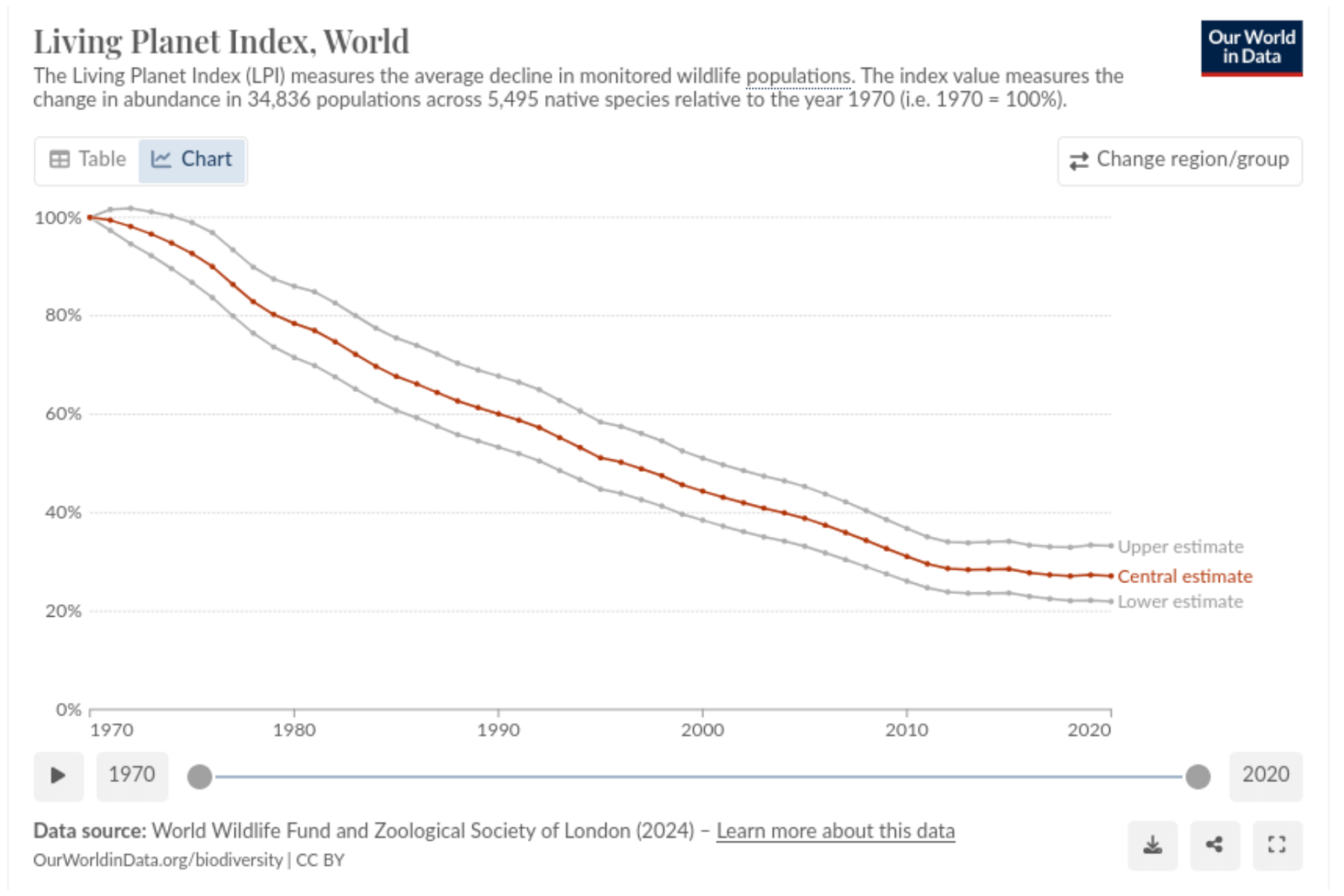
In 2020, Our World In Data reported wildlife population had fallen to 27.1 percent of 1970 levels across tens of thousands of species. As this figure is an average estimate, the decline in biodiversity is presumably steeper for some species, while other species have not experienced as drastic of a decline.
Yet, we regard our cities, sprawling infrastructure, global trade of cheap consumer goods and industrial agriculture so highly that we continue to destroy the natural world. According to the World Wildlife Fund, 16 million acres of forest were lost globally in 2023, which is equivalent in size to West Virginia. The Amazon rainforest — the Earth’s most biodiverse ecosystem, the so-called lungs of the Earth — lost 17 percent of its area over the last 50 years. With each forest we fell, and with each species that fades into oblivion, the hole we dig grows deeper.
***
I am not innocent. I have been known to take two showers in a day, and occasionally buy water in plastic bottles. I don’t know how much rainforest was sacrificed for my petroleum-based sneakers. I never know if I am recycling properly. But my culpability is not complacency and it does not invalidate the terror pressing on my chest, invading my dreams.
We can adapt, and we can mitigate the destruction. We can salvage something, but we can’t go back. So, I am scared, and I am angry. And I struggle against the nihilism of hopelessness. I want to use my education to build a life with purpose. I want a future. I want my children to breathe clean air and exist at the same time as polar bears.
I didn’t want to look up at the night sky and notice that the stars are getting fewer and farther between. I didn’t want to live above 1.5°C.
Help us sustain independent journalism...
Our team is working hard every day to bring you compelling, carefully-crafted pieces that shed light on the pressing issues of our time. We rely on caring supporters like you to help us sustain our mission. Your support ensures that we can continue to provide deeply-reported, independent, ad-free journalism without fear, favor or pandering. Support us today and make a lasting investment in the future.
RELATED STORIES

Award Winning



Today’s environmental and social justice challenges are unprecedented, and require an unprecedented collective effort.


Stay updated on our latest features, events and more. Subscribe to our Note From the Nest newsletter!
